UPSC CSE 2027 Complete Roadmap: Syllabus, Exam Pattern, Books, Study Plan & Preparation Guide
Prepare for UPSC CSE 2027 with this complete roadmap covering syllabus, exam pattern, eligibility, best books, study plan, current affairs, PYQs, and expert preparation tips.
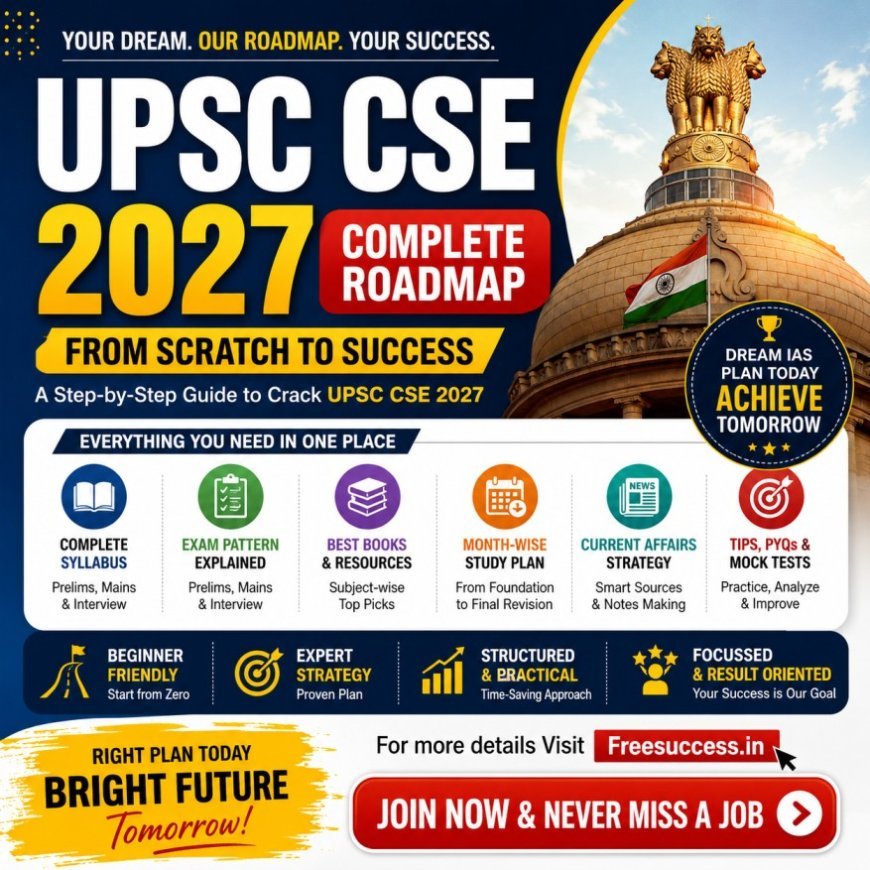
Complete UPSC CSE 2027 Roadmap (Beginner to IAS) – Step-by-Step Guide
If you are starting from zero and your target is to clear the UPSC Civil Services Examination (CSE) 2027, this roadmap covers everything—from eligibility and exam pattern to subject-wise preparation, recommended books, current affairs strategy, answer writing, revision, and interview preparation.
Target Exam: UPSC Civil Services Examination (CSE) 2027
1. What is UPSC Civil Services Examination (CSE)?
The Union Public Service Commission (UPSC) conducts the Civil Services Examination every year to recruit officers for services such as:
-
Indian Administrative Service (IAS)
-
Indian Police Service (IPS)
-
Indian Foreign Service (IFS)
-
Indian Revenue Service (IRS)
-
Indian Audit & Accounts Service (IAAS)
-
Indian Railway Management Service (IRMS)
-
Indian Information Service (IIS)
-
and many other Group A & B services.
Official Website:
https://upsc.gov.in
Examination Portal:
https://upsconline.nic.in
2. Eligibility
Educational Qualification
Bachelor's Degree from any recognized university.
Final year students can also apply subject to eligibility.
Age Limit
(Generally applicable; always verify in the official notification.)
-
General: 21–32 years
-
OBC: Up to 35 years
-
SC/ST: Up to 37 years
-
PwBD: Additional relaxation as per rules.
Number of Attempts
-
General: 6
-
OBC: 9
-
SC/ST: Unlimited (within age limit)
-
PwBD: As per government rules.
3. UPSC Exam Pattern
UPSC consists of three stages.
Stage 1: Preliminary Examination
Paper I – General Studies
-
100 Questions
-
200 Marks
-
2 Hours
Subjects:
-
History
-
Geography
-
Polity
-
Economy
-
Environment
-
Science & Technology
-
Current Affairs
-
International Relations
Negative Marking:
1/3 marks deducted for incorrect answers.
Paper II – CSAT
-
80 Questions
-
200 Marks
-
Qualifying
-
Minimum 33%
Topics:
-
Reading Comprehension
-
Logical Reasoning
-
Quantitative Aptitude
-
Decision Making
-
Data Interpretation
Stage 2: Main Examination
Nine Papers
| Paper | Marks |
|---|---|
| Essay | 250 |
| GS Paper I | 250 |
| GS Paper II | 250 |
| GS Paper III | 250 |
| GS Paper IV | 250 |
| Optional Paper I | 250 |
| Optional Paper II | 250 |
| English (Qualifying) | 300 |
| Indian Language (Qualifying) | 300 |
Total for Merit:
1750 Marks
Stage 3: Personality Test (Interview)
Marks:
275
Final Merit:
1750 + 275 = 2025 Marks
4. Complete UPSC Syllabus
Preliminary Syllabus
History
Ancient India
-
Indus Valley Civilization
-
Vedic Age
-
Mauryan Empire
-
Gupta Empire
Medieval India
-
Delhi Sultanate
-
Mughal Empire
-
Bhakti Movement
-
Sufi Movement
Modern India
-
British Rule
-
Revolt of 1857
-
Indian National Movement
-
Gandhian Era
-
Independence
Geography
Physical Geography
-
Earth
-
Volcanoes
-
Earthquakes
-
Climate
Indian Geography
-
Rivers
-
Mountains
-
Agriculture
-
Industries
-
Minerals
World Geography
-
Continents
-
Ocean Currents
-
Climatic Regions
Indian Polity
-
Constitution
-
Preamble
-
Fundamental Rights
-
Directive Principles
-
Parliament
-
Judiciary
-
President
-
Governor
-
Prime Minister
-
Panchayati Raj
-
Constitutional Bodies
Economy
-
GDP
-
Inflation
-
Banking
-
Budget
-
Fiscal Policy
-
Monetary Policy
-
Taxation
-
RBI
-
NITI Aayog
Environment
-
Biodiversity
-
National Parks
-
Climate Change
-
Pollution
-
Wildlife
-
International Environmental Conventions
Science & Technology
-
Biotechnology
-
AI
-
Robotics
-
Space Technology
-
ISRO
-
Defence Technology
Current Affairs
-
Government Schemes
-
International Relations
-
Awards
-
Sports
-
Reports
-
Important Events
Mains GS Paper I
-
Indian Heritage
-
Culture
-
History
-
World History
-
Society
-
Geography
GS Paper II
-
Constitution
-
Governance
-
Polity
-
International Relations
-
Social Justice
GS Paper III
-
Economy
-
Agriculture
-
Disaster Management
-
Internal Security
-
Science & Technology
-
Environment
GS Paper IV
Ethics
Topics include:
-
Integrity
-
Aptitude
-
Emotional Intelligence
-
Civil Service Values
-
Case Studies
Essay
Usually two essays of about 1000–1200 words each.
Themes may include:
-
Economy
-
Society
-
Governance
-
Ethics
-
Technology
-
Environment
-
Education
Optional Subject
Choose one subject from the UPSC list (e.g., Anthropology, Sociology, PSIR, Geography, History, Public Administration, Mathematics, etc.). Pick it based on your interest, graduation background, and availability of quality resources.
5. Best Books
History
-
NCERT History (Class 6–12)
-
Spectrum – Modern India
Geography
-
NCERT Geography (Class 6–12)
-
G.C. Leong – Certificate Physical & Human Geography
-
Oxford School Atlas
Polity
-
Indian Polity by M. Laxmikanth
Economy
-
NCERT Economics (Class 9–12)
-
Indian Economy by Ramesh Singh (or equivalent standard text)
Environment
-
Shankar IAS Environment
Ethics
-
Lexicon for Ethics (or equivalent standard resource)
Science & Technology
-
NCERT Science (Class 6–10)
-
Current affairs and PIB-based updates
Art & Culture
-
Nitin Singhania – Indian Art & Culture
6. Monthly Study Plan (Starting from Scratch)
Phase 1 (Months 1–4): Foundation
Focus on:
-
NCERT Class 6–12
-
Basic Polity
-
Geography
-
History
-
Economy
-
Daily newspaper reading (45–60 minutes)
-
Make concise notes
Study Time:
6–8 hours/day (adjust according to your schedule).
Phase 2 (Months 5–8): Standard Books
Complete:
-
Laxmikanth
-
Spectrum
-
Shankar IAS
-
Economy text
-
Art & Culture
Start solving previous years' questions (PYQs).
Phase 3 (Months 9–12): Prelims-Oriented Preparation
-
Revise all subjects
-
Practice MCQs daily
-
Attempt weekly mock tests
-
Analyze mistakes
Phase 4: Mains Preparation
-
Daily answer writing (2–5 questions initially)
-
Essay every week
-
Ethics case studies
-
Optional subject preparation
-
Value addition with examples, diagrams, and case studies
Phase 5: Interview Preparation
-
Detailed Application Form (DAF) analysis
-
Mock interviews
-
Current affairs revision
-
Communication and personality development
7. Daily Study Schedule
Example (Full-time Aspirant)
-
Newspaper + Current Affairs: 1 hour
-
GS Subject 1: 2 hours
-
GS Subject 2: 2 hours
-
Optional Subject: 2 hours
-
MCQs / Answer Writing: 1.5 hours
-
Revision: 1.5 hours
Total: About 10 hours (quality matters more than the number of hours).
8. Current Affairs Strategy
Read one reliable newspaper consistently (e.g., The Hindu or The Indian Express).
Supplement with:
-
PIB (Press Information Bureau): https://pib.gov.in
-
PRS Legislative Research: https://prsindia.org
-
NITI Aayog: https://www.niti.gov.in
-
Ministry websites (as relevant)
-
Rajya Sabha TV/Sansad TV discussions (available online)
Prepare monthly notes organized by topics such as Governance, Economy, Environment, Science & Technology, and International Relations.
9. Previous Year Questions (PYQs)
Solve at least the last 10 years' question papers for:
-
Prelims GS
-
CSAT
-
Mains GS
-
Essay
-
Optional Subject
This helps identify recurring themes and the level of depth expected.
10. Mock Tests
For Prelims:
-
Topic-wise tests
-
Sectional tests
-
Full-length tests
For Mains:
-
Weekly answer writing
-
Timed full-length tests
-
Peer or mentor review if possible
11. Revision Strategy
Aim to revise each subject multiple times.
A simple pattern:
-
First revision within a week of completion
-
Second revision after one month
-
Third revision before Prelims
-
Fourth revision before Mains
Maintain concise revision notes to reduce the burden before the exam.
12. Common Mistakes to Avoid
-
Reading too many books for the same subject
-
Ignoring NCERTs
-
Neglecting current affairs
-
Not practicing answer writing
-
Skipping CSAT preparation
-
Avoiding mock tests
-
Making notes that are too lengthy
-
Inconsistent revision
13. Important Official Links
-
UPSC Official Website: https://upsc.gov.in
-
UPSC Online Portal: https://upsconline.nic.in
-
Press Information Bureau (PIB): https://pib.gov.in
-
PRS Legislative Research: https://prsindia.org
-
NITI Aayog: https://www.niti.gov.in
-
India Code (Acts and Rules): https://www.indiacode.nic.in
-
Election Commission of India: https://eci.gov.in
-
Census of India: https://censusindia.gov.in
14. Suggested Timeline for UPSC CSE 2027
| Period | Focus |
|---|---|
| Jul–Dec 2026 | NCERTs, foundation, newspaper habit, basic notes |
| Jan–Jun 2027 | Standard books, Optional subject, answer writing, PYQs |
| Jul–Sep 2027 | Intensive Prelims preparation, MCQs, mock tests, revision |
| After Prelims | Mains-specific preparation, essays, ethics, optional revision |
| Before Interview | DAF preparation, mock interviews, current affairs |
Adjust the timeline once the official UPSC 2027 notification and exam dates are announced.
15. Final Preparation Tips
-
Understand the syllabus before studying any topic.
-
Keep the official UPSC syllabus beside your study table.
-
Read limited, high-quality sources and revise them repeatedly.
-
Integrate current affairs with static subjects.
-
Practice answer writing regularly for Mains.
-
Solve PYQs to understand UPSC's demand.
-
Maintain consistency—steady daily progress over many months is more effective than sporadic long study sessions.
-
Take care of sleep, exercise, and mental well-being to sustain long-term preparation.
This roadmap provides a structured path from beginner level to the UPSC CSE interview stage. Always refer to the official UPSC notification for CSE 2027 once it is released, as eligibility conditions, dates, and procedural details may change.









![[4 May] SSC Selection Post Phase 14 Recruitment 2026 - 2919 Posts](https://freesuccess.in/uploads/images/202605/image_140x98_69f661745c015.jpg)