RRB Technician 2026 Complete Roadmap: Syllabus, Exam Pattern, Study Plan, Books & Preparation Guide
Prepare for RRB Technician 2026 with the complete roadmap covering syllabus, exam pattern, eligibility, study plan, best books, previous year papers, mock tests, preparation strategy, and official links to help you crack the exam.
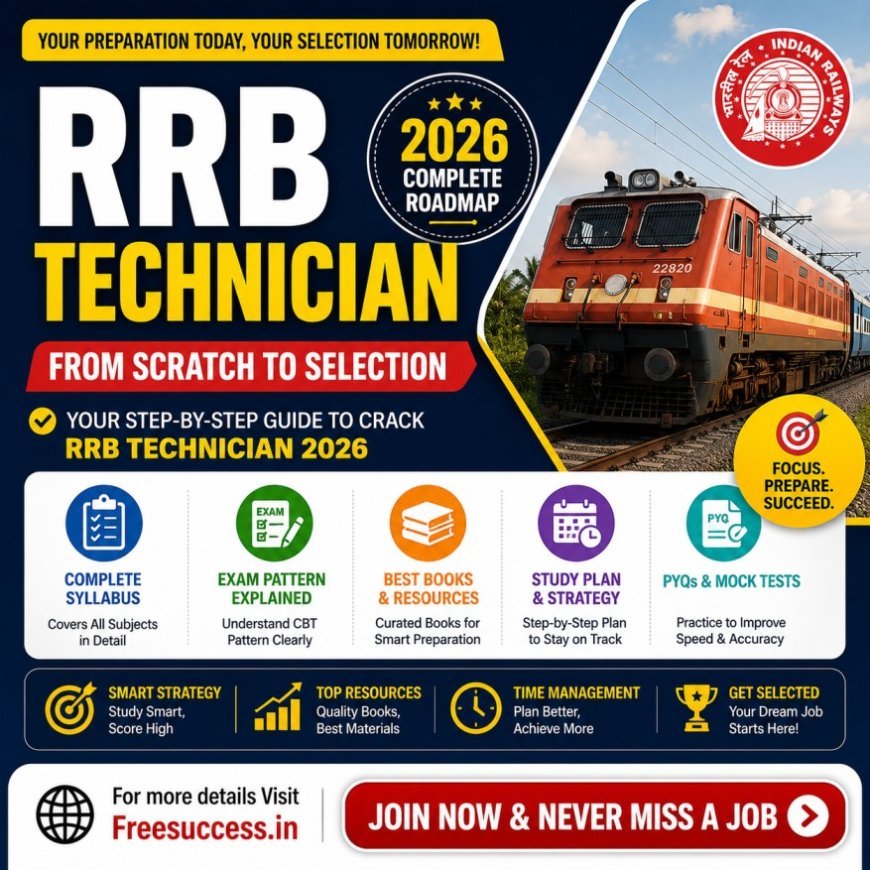
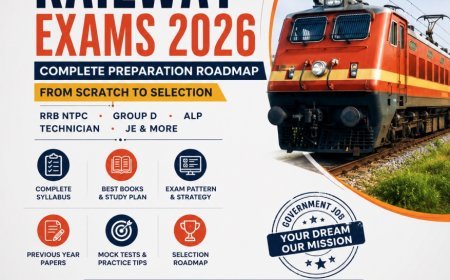
Complete RRB Technician 2026 Roadmap (Beginner to Selection) – Syllabus, Exam Pattern, Books, Study Plan & Preparation Guide
If you are starting from scratch and aiming to crack the RRB Technician Recruitment 2026, this complete roadmap will help you prepare systematically. It covers the eligibility, exam pattern, detailed syllabus, preparation strategy, best books, study plan, previous year papers, mock tests, important official links, and expert tips to maximize your chances of selection.
Target Exam: RRB Technician Recruitment 2026
Official Website: https://www.rrbcdg.gov.in
1. What is RRB Technician Recruitment?
The Railway Recruitment Boards (RRBs) conduct the Technician Recruitment Examination to fill Technician vacancies in various zones of the Indian Railways.
The recruitment generally includes posts such as:
-
Technician Grade I Signal
-
Technician Grade III
Selected candidates work in the maintenance and operation of railway electrical, mechanical, signaling, telecommunications, and other technical systems.
2. Eligibility Criteria
Educational Qualification
Technician Grade I Signal
-
Bachelor's Degree in Physics, Electronics, Computer Science, Information Technology, Instrumentation, or related Engineering disciplines (as specified in the official notification), or
-
Diploma/Degree in relevant Engineering branches, depending on the notified eligibility.
Technician Grade III
-
Class 10 (Matriculation/SSLC)
-
ITI (NCVT/SCVT) in the relevant trade, or
-
Alternative qualifications as specified in the notification.
Always check the official notification for the exact post-wise educational requirements.
Age Limit
Age limits vary by post and notification. Category-wise age relaxation is provided according to Government of India rules.
3. Selection Process
The selection process generally consists of:
-
Computer Based Test (CBT)
-
Document Verification (DV)
-
Medical Examination
4. RRB Technician Exam Pattern
Computer Based Test (CBT)
Technician Grade I Signal
Subjects generally include:
-
Mathematics
-
General Intelligence & Reasoning
-
General Science
-
General Awareness & Current Affairs
-
Basic Computer Applications
-
Basics of Environment & Pollution Control
-
Technical/Professional Knowledge
Negative marking is applicable as per the official notification.
Technician Grade III
Subjects generally include:
-
Mathematics
-
General Intelligence & Reasoning
-
General Science
-
General Awareness & Current Affairs
Negative marking is applicable as per the official notification.
5. Complete Syllabus
Mathematics
Topics include:
-
Number System
-
Simplification
-
LCM & HCF
-
Ratio & Proportion
-
Percentage
-
Profit & Loss
-
Simple & Compound Interest
-
Average
-
Time & Work
-
Pipes & Cistern
-
Time, Speed & Distance
-
Partnership
-
Algebra
-
Geometry
-
Mensuration
-
Trigonometry
-
Statistics
-
Data Interpretation
General Intelligence & Reasoning
Topics include:
-
Analogies
-
Coding-Decoding
-
Classification
-
Series
-
Blood Relations
-
Direction Sense
-
Seating Arrangement
-
Syllogism
-
Statement & Conclusion
-
Venn Diagram
-
Puzzle
-
Calendar
-
Clock
-
Non-Verbal Reasoning
General Science
Physics
-
Motion
-
Force
-
Work
-
Energy
-
Electricity
-
Magnetism
-
Heat
-
Optics
Chemistry
-
Chemical Reactions
-
Acids & Bases
-
Metals & Non-Metals
-
Periodic Table
-
Carbon Compounds
Biology
-
Human Body
-
Nutrition
-
Diseases
-
Genetics
-
Ecology
Questions are generally based on the Class 10 level.
General Awareness & Current Affairs
Topics include:
-
Indian History
-
Geography
-
Indian Polity
-
Economics
-
Science & Technology
-
Sports
-
Awards
-
Books
-
Important Days
-
Government Schemes
-
National & International Events
-
Railway-related Developments
Basic Computer Applications (where applicable)
-
Computer Fundamentals
-
Hardware & Software
-
MS Office
-
Internet
-
Networking Basics
-
Cyber Security
-
Computer Shortcuts
Basics of Environment & Pollution Control (where applicable)
-
Environmental Pollution
-
Climate Change
-
Sustainable Development
-
Waste Management
-
Environmental Protection
Technical/Professional Knowledge (Grade I Signal)
Questions are based on the relevant engineering or technical discipline mentioned in the notification.
6. Best Books
Mathematics
-
Fast Track Objective Arithmetic – Rajesh Verma
-
Advance Maths – Rakesh Yadav
Reasoning
-
A Modern Approach to Verbal & Non-Verbal Reasoning – R.S. Aggarwal
-
Analytical Reasoning – M.K. Pandey
General Science
-
NCERT Science (Classes 6–10)
-
Lucent General Science
General Awareness
-
Lucent's General Knowledge
-
Monthly Current Affairs Magazine
Computer
-
Objective Computer Awareness – Arihant (or equivalent standard resource)
7. Preparation Strategy
Phase 1 (Months 1–2)
-
Build fundamentals in Mathematics, Science, and Reasoning.
-
Read NCERT Science (Classes 6–10).
-
Start a daily current affairs habit.
Phase 2 (Months 3–4)
-
Complete standard books.
-
Solve chapter-wise practice questions.
-
Prepare short notes and formulas.
Phase 3 (Months 5–6)
-
Solve previous year papers.
-
Attempt topic-wise and sectional mock tests.
-
Improve speed and accuracy.
Phase 4 (Final Preparation)
-
Full-length mock tests.
-
Revision of notes.
-
Formula revision.
-
Current affairs revision.
-
Exam strategy practice.
8. Daily Study Plan
Example (6–8 Hours)
-
Mathematics – 2 Hours
-
Reasoning – 1.5 Hours
-
General Science – 1.5 Hours
-
General Awareness – 1 Hour
-
Current Affairs – 30 Minutes
-
Mock Test/PYQs – 1.5 Hours
9. Previous Year Question Papers (PYQs)
Practice at least the previous 8–10 years' RRB and similar railway recruitment papers to understand:
-
Difficulty level
-
Frequently asked topics
-
Time management
-
Question trends
10. Mock Test Strategy
Practice:
-
Topic-wise Tests
-
Sectional Tests
-
Full-Length CBT Mock Tests
After every mock:
-
Analyze mistakes.
-
Revise weak topics.
-
Track improvement.
11. Revision Strategy
-
Daily revision of formulas and concepts.
-
Weekly revision of completed topics.
-
Monthly revision of current affairs.
-
Final revision using concise notes and error logs.
12. Common Mistakes to Avoid
-
Ignoring previous year papers.
-
Skipping mock tests.
-
Weak time management.
-
Reading too many books.
-
Neglecting General Science.
-
Ignoring current affairs.
-
Lack of regular revision.
13. Important Official Links
-
Railway Recruitment Boards: https://www.rrbcdg.gov.in
-
Railway Recruitment Board Portals: https://www.rrbcdg.gov.in/rrbs.html
-
Indian Railways: https://indianrailways.gov.in
-
Employment News: https://employmentnews.gov.in
Always download the official notification from the relevant RRB website before applying.
14. Suggested Preparation Timeline
| Period | Focus |
|---|---|
| Jul–Aug 2026 | Build basics in Mathematics, Science, Reasoning, and GK |
| Sep–Oct 2026 | Complete syllabus, technical subjects (if applicable), and practice |
| Nov–Dec 2026 | PYQs, mock tests, and revision |
| Before Exam | Full-length mocks, current affairs revision, and exam strategy |
Update this timeline according to the official RRB Technician 2026 notification and exam schedule.
15. Final Tips to Crack RRB Technician 2026
-
Study according to the official syllabus.
-
Practice Mathematics and Reasoning daily.
-
Strengthen Class 10-level Science concepts.
-
Revise General Awareness and current affairs regularly.
-
Solve previous year question papers consistently.
-
Take mock tests under timed conditions.
-
Maintain concise notes for quick revision.
-
Focus on accuracy as well as speed.
-
If applying for Technician Grade I Signal, dedicate time to your technical/professional subject.
This roadmap provides a structured approach to preparing for RRB Technician 2026. Before applying, always verify the latest eligibility, syllabus, exam pattern, vacancy details, and important dates in the official notification issued by the Railway Recruitment Boards, as these may change from one recruitment cycle to another.









![[4 May] SSC Selection Post Phase 14 Recruitment 2026 - 2919 Posts](https://freesuccess.in/uploads/images/202605/image_140x98_69f661745c015.jpg)