JEE PYQ Papers PDF Free Download 2027 – JEE Main & Advanced Previous Year Papers
Download JEE PYQ Papers PDF for free for JEE 2027 preparation. Get JEE Main & JEE Advanced previous year question papers, solutions, preparation tips, strategies, FAQs and practice resources
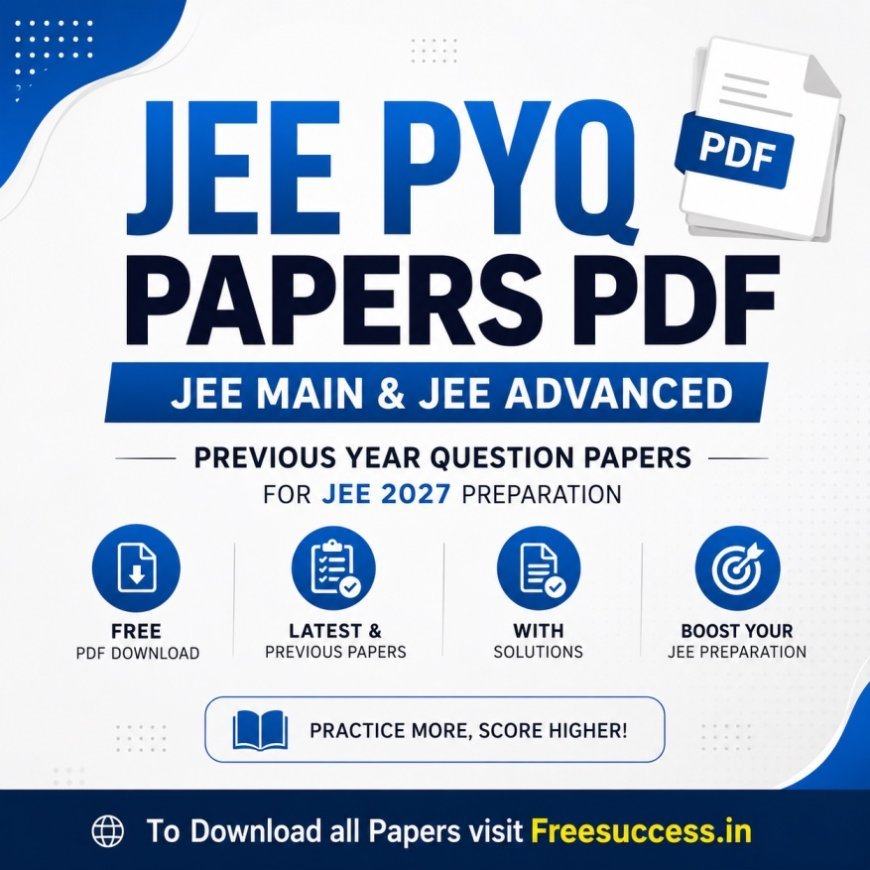
Download Free JEE PYQ Papers PDF for JEE 2027 Preparation
Preparing for JEE 2027 requires more than completing the syllabus and reading reference books. One of the most effective ways to understand the actual examination is to solve JEE Main and JEE Advanced Previous Year Question Papers (PYQs) regularly.
JEE PYQs help students identify recurring concepts, understand question difficulty, improve calculation speed, analyse the exam pattern and discover their weak chapters. For JEE 2027 aspirants, solving recent papers from 2026, 2025, 2024, 2023 and earlier years can provide valuable practice. Free year-wise and shift-wise JEE Main papers are available through several educational resources, while the official JEE Advanced website maintains an archive of past papers.
This page provides free JEE PYQ PDF download resources, along with a practical strategy to use them effectively for JEE 2027.
JEE PYQ Papers PDF – Free Download
Below are useful resources for downloading JEE Main Previous Year Question Papers with solutions.
| Year | JEE Main PYQ PDF |
|---|---|
| JEE Main 2026 | Download JEE Main 2026 PYQs |
| JEE Main 2025 | Download JEE Main 2025 PYQs |
| JEE Main 2024 | Download JEE Main 2024 PYQs |
| JEE Main 2023 | Download JEE Main 2023 PYQs |
| JEE Main 2022 | Download JEE Main 2022 PYQs |
| JEE Main 2021 | Download JEE Main 2021 PYQs |
| JEE Main 2020 | Download JEE Main 2020 PYQs |
| JEE Main 2019 | Download JEE Main 2019 PYQs |
| JEE Main 2018–2014 | Download older JEE Main PYQs |
The available JEE Main collections include multiple sessions and shifts, which is particularly useful because JEE Main is conducted in multiple shifts.
JEE Advanced PYQ PDF – Official Download
For JEE Advanced, the official examination website maintains an archive containing Paper 1 and Paper 2 from 2007 onwards, including the latest 2025 papers.
Direct official archive:
JEE Advanced Previous Year Question Papers – Official Archive
From this archive, students can access:
- JEE Advanced 2025 Paper 1 & Paper 2
- JEE Advanced 2024 Paper 1 & Paper 2
- JEE Advanced 2023 Paper 1 & Paper 2
- JEE Advanced 2022 Paper 1 & Paper 2
- JEE Advanced 2021 Paper 1 & Paper 2
- JEE Advanced 2020 Paper 1 & Paper 2
- Previous papers from 2007 onwards
The official archive also provides English and Hindi versions for several years.
Why Are JEE PYQs Important for JEE 2027?
Previous Year Questions are not simply practice questions. They are a way of understanding how JEE tests concepts.
1. Understand the Actual Exam Pattern
Mock tests can imitate JEE, but actual PYQs show the types of questions that have appeared in the examination.
2. Identify Important Concepts
When you solve several years of questions, you begin to notice concepts and chapters that repeatedly appear in different forms.
3. Improve Problem-Solving Skills
JEE questions often require students to connect multiple concepts. Regular PYQ practice develops this ability.
4. Improve Speed and Accuracy
Timed PYQ practice helps you reduce unnecessary calculations and improve question-selection skills.
5. Discover Weak Chapters
If you repeatedly make mistakes in questions from a particular chapter, that chapter becomes an obvious revision priority.
6. Build Exam Confidence
Solving actual previous-year papers under timed conditions makes the final examination environment less unfamiliar.
How Many Years of JEE PYQs Should You Solve?
For JEE Main 2027, prioritise recent papers first.
Recommended order
2026 → 2025 → 2024 → 2023 → 2022 → 2021 → older papers
For JEE Advanced, students preparing seriously should practise a much larger historical range because the official archive provides papers going back to 2007.
However, don't blindly try to finish every available question. Quality of analysis is more important than the number of PDFs downloaded.
JEE 2027 PYQ Strategy
A smart PYQ strategy can be divided into four stages.
Stage 1: Chapter-Wise PYQ Practice
After completing a chapter, solve its PYQs.
For example:
Physics → Electrostatics → Theory → Examples → PYQs
Chemistry → Chemical Bonding → NCERT → Concepts → PYQs
Mathematics → Quadratic Equations → Concepts → Practice → PYQs
This immediately tells you whether you actually understand the chapter.
Stage 2: Mixed PYQ Practice
After completing several chapters, stop solving only chapter-wise questions.
Start mixing questions from different chapters.
For example:
- 10 Physics questions
- 10 Chemistry questions
- 10 Mathematics questions
This develops your ability to identify which concept is required without being told the chapter name.
Stage 3: Full-Length PYQ Tests
Once your syllabus is substantially complete, solve complete JEE Main papers as mock tests.
Follow actual exam conditions:
- Fixed time
- No mobile phone
- No books
- No hints
- No solution checking during the test
After completing the paper, analyse your performance.
Stage 4: Error Analysis
This is where the real improvement happens.
Create a PYQ Error Notebook with four categories:
| Error Type | What to Record |
|---|---|
| Conceptual | Concept you didn't understand |
| Calculation | Calculation mistake |
| Silly Mistake | Sign/unit/reading error |
| Time Management | Question consumed excessive time |
Revise this notebook every week.
Tips and Tricks to Solve JEE PYQs Effectively
Tip 1: Don't Look at Solutions Too Quickly
Give yourself sufficient time to solve the question independently.
Tip 2: Mark Difficult Questions
Use three categories:
Easy → Moderate → Difficult
Return to difficult questions during revision.
Tip 3: Maintain a PYQ Tracker
Track:
Questions Attempted → Correct → Incorrect → Skipped → Accuracy
This gives you measurable progress.
Tip 4: Don't Memorise Answers
The objective is not to remember that a particular question has answer B.
Understand why the answer is B.
Tip 5: Re-solve Incorrect Questions
Don't just read the solution and move forward.
Close the solution and attempt the question again after a few days.
Tip 6: Analyse Repeated Concepts
If similar concepts appear repeatedly, add them to your high-priority revision list.
Tip 7: Use Recent Papers as Mock Tests
Don't use your latest papers too early. Save some recent full papers for realistic examination practice.
JEE Main PYQ vs JEE Advanced PYQ
| Feature | JEE Main PYQs | JEE Advanced PYQs |
|---|---|---|
| Primary purpose | Speed + accuracy | Conceptual depth |
| Question style | More direct/application-based | More analytical |
| Practice focus | Time management | Multi-concept problem solving |
| Recommended use | Chapter + full-paper practice | Deep conceptual practice |
| Difficulty | Moderate to high | High |
| Best approach | Timed practice | Detailed analysis |
Students targeting both examinations should not treat JEE Main and JEE Advanced PYQs exactly the same way.
Best Strategy for JEE 2027 Aspirants
A practical weekly PYQ routine could look like this:
Monday–Friday
Complete your regular syllabus and solve chapter-wise PYQs related to the topics studied.
Saturday
Revise mistakes and re-solve previously incorrect questions.
Sunday
Attempt a mixed PYQ test or a full previous-year paper depending on your preparation level.
Every Month
Analyse:
- Accuracy
- Average time per question
- Weak chapters
- Repeated mistakes
- Strong chapters
- Unattempted questions
Then modify your study plan accordingly.
Common Mistakes Students Make While Solving PYQs
❌ Downloading hundreds of PDFs but solving very few
Collection is not preparation.
❌ Solving PYQs without completing basic concepts
If you don't understand the underlying concept, simply memorising solutions won't help.
❌ Checking solutions immediately
This creates a false feeling of understanding.
❌ Ignoring incorrect questions
Your wrong questions often contain more learning value than your correct ones.
❌ Not timing yourself
JEE preparation requires both knowledge and execution speed.
❌ Solving papers without analysis
A test without analysis is only practice. Analysis converts it into improvement.
FAQs – JEE PYQ PDF Download for JEE 2027
1. Where can I download JEE Main PYQ PDFs for free?
You can use established educational resources such as Vedantu and Careers360 for year-wise and shift-wise JEE Main question papers with solutions.
2. Where can I download JEE Advanced previous-year papers?
The official JEE Advanced website provides an archive of previous-year question papers from 2007 onwards.
3. Should I solve JEE Main 2026 papers for JEE 2027?
Yes. The latest available papers are particularly useful for understanding recent question trends and practising the current style of examination.
4. How many JEE PYQs should I solve every day?
There is no universal number. A better target is to solve questions with proper analysis. Depending on your preparation stage, 20–50 quality PYQs per day can be a practical target.
5. Should I solve PYQs chapter-wise or year-wise?
Start chapter-wise while learning and revising topics. Later, switch to year-wise/full-paper practice to develop exam temperament.
6. Are JEE PYQs enough for JEE 2027 preparation?
No. PYQs should be combined with conceptual study, NCERT where relevant, reference material, coaching material or practice sheets, mock tests and regular revision.
7. Should JEE Advanced aspirants solve old papers?
Yes. The official JEE Advanced archive contains papers going back to 2007, making it a valuable long-term practice resource.
8. Should I solve PYQs with solutions?
Yes, but attempt the question yourself first. Use the solution only after your independent attempt or when you genuinely cannot proceed.
Final Checklist for JEE 2027 PYQ Preparation
Before the JEE 2027 examination, try to ensure that you have:
- ✅ Solved recent JEE Main PYQs
- ✅ Practised Physics, Chemistry and Mathematics separately
- ✅ Completed chapter-wise PYQs
- ✅ Attempted full-length previous-year papers
- ✅ Practised JEE Advanced Paper 1 and Paper 2
- ✅ Maintained an error notebook
- ✅ Re-solved incorrect questions
- ✅ Analysed your accuracy and timing
- ✅ Revised frequently repeated concepts
- ✅ Taken regular mock tests
Conclusion
JEE PYQs are one of the most valuable free resources for JEE 2027 preparation. Instead of treating previous-year papers as something to solve only before the examination, use them throughout your preparation journey.
Start with chapter-wise PYQs, progress to mixed questions, and finally use complete previous-year papers as timed mock tests. Most importantly, analyse every mistake and revisit the underlying concept.
Remember: Downloading PYQs is easy; mastering them is what improves your JEE preparation.
For JEE 2027, focus on concept → practice → PYQ → analysis → revision → mock test → repeat. This systematic approach can help you turn previous-year questions into a powerful preparation tool.













![[4 May] SSC Selection Post Phase 14 Recruitment 2026 - 2919 Posts](https://freesuccess.in/uploads/images/202605/image_140x98_69f661745c015.jpg)