UPSC 2027 Most Important Topics Subject-wise | Complete Prelims & Mains Priority List
Discover the most important UPSC 2027 topics subject-wise for Prelims and Mains. Get a complete priority list with one-line explanations for History, Geography, Polity, Economy, Environment, Science & Technology, Ethics, Current Affairs, and more
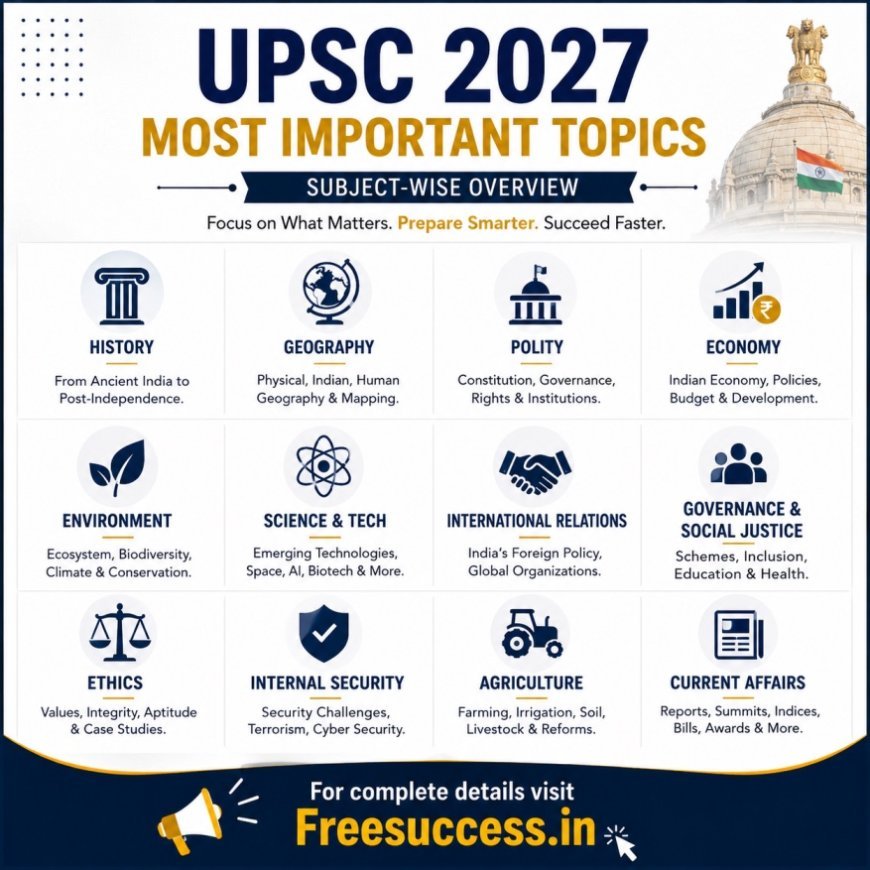
UPSC 2027 Most Important Topics Subject-wise (Complete Table with One-Line Explanation)
DOWNLOAD LIST NOW! (Link Below)
Preparing for UPSC Civil Services Examination (CSE) 2027 requires a smart strategy and a clear understanding of the syllabus. Instead of studying everything randomly, aspirants should focus on the most important subject-wise topics that are repeatedly asked in UPSC Prelims and Mains.
This article provides a subject-wise table of high-priority UPSC 2027 topics, each with a one-line explanation, making it easy to revise and plan your preparation.
UPSC 2027 History Important Topics
| Topic | One-Line Explanation |
|---|---|
| Ancient India | Covers the Vedic Age, Mahajanapadas, Mauryan and Gupta Empires. |
| Medieval India | Focuses on the Delhi Sultanate, Mughal administration and culture. |
| Modern India | Explains British expansion and administrative reforms. |
| Revolt of 1857 | Covers causes, events and its historical significance. |
| Indian National Movement | Includes major freedom struggles, leaders and movements. |
| Constitutional Development | Covers important Acts from 1773 to 1947. |
| Post-Independence India | Focuses on nation-building and integration after 1947. |
| Art & Culture | Covers architecture, dance, music, paintings and literature. |
| Buddhism & Jainism | Explains philosophy, teachings and cultural influence. |
| UNESCO Heritage Sites | Covers important cultural and historical heritage sites. |
UPSC 2027 Geography Important Topics
| Topic | One-Line Explanation |
|---|---|
| Physical Geography | Covers landforms, earthquakes and volcanoes. |
| Climatology | Explains monsoon, cyclones and climate systems. |
| Oceanography | Covers ocean currents, tides and marine resources. |
| Indian Geography | Focuses on rivers, mountains, plateaus and coasts. |
| Agriculture | Covers cropping patterns and irrigation systems. |
| Mineral Resources | Explains distribution and economic importance of minerals. |
| Industries | Covers industrial location and major industrial regions. |
| Human Geography | Focuses on population and urbanization. |
| Mapping | Covers important rivers, passes, national parks and locations. |
| Disaster Geography | Explains floods, droughts and landslides. |
UPSC 2027 Indian Polity Important Topics
| Topic | One-Line Explanation |
|---|---|
| Constitution | Covers features, sources and constitutional philosophy. |
| Preamble | Explains constitutional ideals and objectives. |
| Fundamental Rights | Covers rights and important Supreme Court judgments. |
| DPSP & Fundamental Duties | Explains welfare principles and civic responsibilities. |
| Parliament | Covers powers, sessions and parliamentary committees. |
| President & Governor | Explains constitutional roles and powers. |
| Prime Minister & Council of Ministers | Covers executive functions and responsibilities. |
| Judiciary | Focuses on judicial review and constitutional interpretation. |
| Federalism | Explains Centre-State relations. |
| Local Government | Covers Panchayati Raj and Urban Local Bodies. |
| Constitutional Bodies | Includes UPSC, CAG, Election Commission and Finance Commission. |
| Non-Constitutional Bodies | Covers NITI Aayog, NHRC, CIC and similar institutions. |
| Constitutional Amendments | Covers major amendments and their significance. |
| Emergency Provisions | Explains National, State and Financial Emergencies. |
UPSC 2027 Economy Important Topics
| Topic | One-Line Explanation |
|---|---|
| National Income | Covers GDP, GNP and economic growth indicators. |
| Inflation | Explains causes, effects and control measures. |
| Banking | Covers RBI, commercial banks and monetary policy. |
| Fiscal Policy | Focuses on taxation, government spending and deficits. |
| External Sector | Covers foreign trade, exchange rates and BoP. |
| Agriculture Economy | Explains MSP, subsidies and agricultural reforms. |
| Infrastructure | Covers transport, power and logistics. |
| Employment | Focuses on labour markets and unemployment. |
| Inclusive Growth | Covers poverty alleviation and welfare measures. |
| Economic Survey | Summarizes India's annual economic performance. |
| Union Budget | Covers taxation, expenditure and fiscal planning. |
| Digital Economy | Explains UPI, fintech and digital public infrastructure. |
UPSC 2027 Environment & Ecology Important Topics
| Topic | One-Line Explanation |
|---|---|
| Ecosystem | Covers ecological interactions and energy flow. |
| Biodiversity | Explains conservation and endangered species. |
| Protected Areas | Covers national parks and wildlife sanctuaries. |
| Climate Change | Focuses on global warming and adaptation measures. |
| International Conventions | Covers Ramsar, CBD, CITES, CMS and UNFCCC. |
| Pollution | Explains air, water and soil pollution. |
| Environmental Acts | Covers major environmental laws in India. |
| Renewable Energy | Focuses on solar, wind and bioenergy. |
| Carbon Markets | Explains carbon credits and emission trading. |
| Sustainable Development | Covers SDGs and sustainable growth. |
UPSC 2027 Science & Technology Important Topics
| Topic | One-Line Explanation |
|---|---|
| Biotechnology | Covers CRISPR, vaccines and genetic engineering. |
| Space Technology | Focuses on ISRO missions and satellites. |
| Artificial Intelligence | Explains AI, ML and governance issues. |
| Quantum Technology | Covers quantum computing and communication. |
| Semiconductor Technology | Focuses on chip manufacturing. |
| Robotics | Covers automation and industrial applications. |
| Nanotechnology | Explains applications in medicine and industry. |
| Cyber Security | Covers cyber threats and data protection. |
| Defence Technology | Focuses on indigenous defence systems. |
| Nuclear Technology | Covers nuclear energy and reactors. |
UPSC 2027 International Relations Important Topics
| Topic | One-Line Explanation |
|---|---|
| India's Foreign Policy | Covers principles and strategic objectives. |
| Neighbourhood Policy | Focuses on relations with neighboring countries. |
| Indo-Pacific | Covers maritime security and regional cooperation. |
| India-USA Relations | Explains strategic and economic partnerships. |
| India-China Relations | Covers border issues and diplomacy. |
| India-Russia Relations | Focuses on defence and energy cooperation. |
| United Nations | Covers structure, agencies and reforms. |
| WTO | Explains international trade governance. |
| BRICS | Covers economic cooperation among emerging economies. |
| QUAD | Focuses on Indo-Pacific strategic partnership. |
| G20 | Covers global economic coordination. |
| SCO | Explains regional security and economic cooperation. |
UPSC 2027 Governance & Social Justice Important Topics
| Topic | One-Line Explanation |
|---|---|
| Government Schemes | Covers flagship welfare programmes. |
| Education | Focuses on NEP and educational reforms. |
| Health | Covers public healthcare and health policies. |
| Women | Explains empowerment and legal safeguards. |
| Children | Covers nutrition, education and protection. |
| Senior Citizens | Focuses on welfare and social security. |
| Vulnerable Sections | Covers welfare of SC, ST, OBC and minorities. |
| E-Governance | Explains digital governance initiatives. |
| NGOs & SHGs | Covers community participation in development. |
| Citizen Charter | Focuses on transparency and accountability. |
UPSC 2027 Ethics Important Topics
| Topic | One-Line Explanation |
|---|---|
| Ethics | Covers moral principles in public administration. |
| Integrity | Explains honesty and ethical conduct. |
| Aptitude | Focuses on qualities of civil servants. |
| Emotional Intelligence | Covers understanding and managing emotions. |
| Attitude | Explains behaviour and decision-making. |
| Probity | Covers transparency and accountability. |
| Civil Service Values | Focuses on objectivity, empathy and dedication. |
| Case Studies | Covers practical ethical problem-solving. |
UPSC 2027 Internal Security Important Topics
| Topic | One-Line Explanation |
|---|---|
| Terrorism | Covers security challenges and countermeasures. |
| Left Wing Extremism | Explains causes and government response. |
| Border Management | Covers border security and surveillance. |
| Cyber Security | Focuses on cybercrime and national security. |
| Money Laundering | Covers financial crime prevention. |
| Organized Crime | Explains trafficking and smuggling networks. |
| Disaster Management | Covers preparedness and disaster response. |
UPSC 2027 Agriculture Important Topics
| Topic | One-Line Explanation |
|---|---|
| Cropping Patterns | Covers seasonal crops and regional distribution. |
| Irrigation | Explains water management techniques. |
| Soil Health | Covers soil conservation and fertility improvement. |
| Agricultural Marketing | Explains APMC, e-NAM and reforms. |
| Food Processing | Covers value addition and food industries. |
| Organic Farming | Focuses on sustainable farming practices. |
| Livestock | Covers dairy, fisheries and animal husbandry. |
UPSC 2027 Current Affairs Important Topics
| Topic | One-Line Explanation |
|---|---|
| Government Reports | Covers important national and international reports. |
| Supreme Court Judgments | Explains landmark constitutional decisions. |
| International Summits | Covers major global meetings and outcomes. |
| Science Developments | Focuses on emerging scientific innovations. |
| Environment News | Covers climate and biodiversity updates. |
| Economy Updates | Explains recent economic policies and trends. |
| Awards & Indices | Covers important national and international rankings. |
| Important Bills & Acts | Focuses on recently enacted laws and policies. |
Tips and Tricks for UPSC 2027 Preparation
-
Complete the NCERT books before moving to standard reference books.
-
Revise every subject multiple times instead of collecting too many resources.
-
Read a quality newspaper daily and make concise notes.
-
Practice previous years' question papers to understand UPSC trends.
-
Solve mock tests regularly to improve accuracy and time management.
-
Prepare static subjects along with current affairs simultaneously.
-
Create short revision notes for the final months before the exam.
-
Focus on conceptual clarity rather than memorizing facts.
-
Write Mains answers consistently to improve presentation skills.
-
Allocate daily time for revision and current affairs.
Frequently Asked Questions (FAQs)
1. Which subject is most important for UPSC 2027?
Indian Polity, History, Geography, Economy, Environment and Current Affairs form the foundation of both Prelims and Mains.
2. Are NCERT books enough for UPSC preparation?
NCERTs are essential for building concepts, but they should be supplemented with standard reference books and current affairs.
3. How many hours should I study daily for UPSC 2027?
A consistent study schedule of 6–8 focused hours is generally more effective than long, irregular study sessions.
4. Is current affairs important for UPSC?
Yes. Current affairs are closely linked with static subjects and play a significant role in both Prelims and Mains.
5. How many revisions are ideal before the UPSC exam?
Most successful candidates revise their notes at least three to five times before the examination.
6. Should I solve previous years' papers?
Yes. Previous years' question papers help you understand the exam pattern, important topics and the level of difficulty.
7. Which topics are repeatedly asked in UPSC?
Polity, Modern History, Environment, Geography, Economy, Science & Technology and Current Affairs consistently produce questions across exam stages.
DOWNLOAD LIST NOW!
https://drive.google.com/file/d/1yU8pokqttRBi6UrtsG0bb7SQqqUXLS2q/view?usp=drivesdk
Final Thoughts
Success in UPSC CSE 2027 depends on studying the right topics with consistent revision. Use the subject-wise tables above as a roadmap to organize your preparation, strengthen core concepts and revise efficiently. Combine these priority topics with regular answer writing, mock tests and current affairs to build a balanced preparation strategy for both Prelims and Mains.















![[4 May] SSC Selection Post Phase 14 Recruitment 2026 - 2919 Posts](https://freesuccess.in/uploads/images/202605/image_140x98_69f661745c015.jpg)