Best Books for Government Exams 2027 📚 | Toppers Choice Booklist for SSC, Railway, Banking, UPSC & Defence
Confused about which books to choose for SSC, Railway, Banking, UPSC, NDA, CDS, Agniveer, Defence and other competitive exams? This complete Toppers Choice Booklist 2027 covers the most useful books.
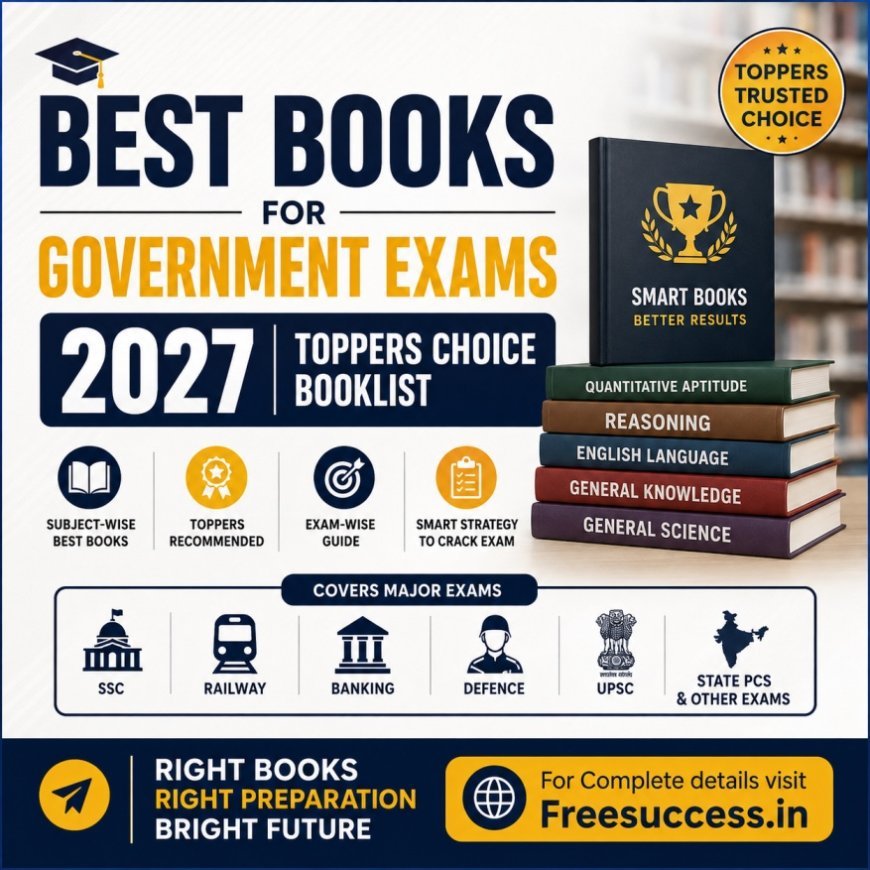
| Subject | Best Books | Best For |
|---|---|---|
| Quantitative Aptitude / Maths | R.S. Aggarwal – Quantitative Aptitude | SSC, Banking, Railway, Defence |
| Rajesh Verma – Fast Track Objective Arithmetic | SSC, Railway, Banking | |
| Rakesh Yadav – Class Notes / Arithmetic | SSC, Railway | |
| M.Tyra – Magical Book on Quicker Maths | Banking, SSC | |
| Reasoning | R.S. Aggarwal – Verbal & Non-Verbal Reasoning | Almost all govt exams |
| Kiran Publication – Reasoning Chapterwise & Typewise | SSC, Railway | |
| A Modern Approach to Verbal & Non-Verbal Reasoning | SSC, Banking | |
| English | S.P. Bakshi – Objective General English | SSC, Railway, Banking |
| Plinth to Paramount – Neetu Singh | SSC, Defence | |
| Word Power Made Easy – Norman Lewis | Vocabulary | |
| Kiran SSC English Chapterwise | SSC | |
| General Knowledge / Static GK | Lucent’s General Knowledge ⭐ | SSC, Railway, Defence, State Exams |
| Arihant General Knowledge | General competitive exams | |
| General Science | Lucent General Science | SSC, Railway, Defence |
| NCERT Science Class 6–10 | Concept building | |
| Indian History | Spectrum – A Brief History of Modern India ⭐ | UPSC, SSC, State PCS |
| Lucent GK | SSC, Railway, Defence | |
| NCERT History | UPSC, State PCS | |
| Indian Polity | M. Laxmikanth – Indian Polity ⭐ | UPSC, SSC, State PCS |
| Lucent GK | SSC, Railway | |
| Geography | NCERT Geography Class 6–12 ⭐ | UPSC, SSC, State PCS |
| G.C. Leong – Certificate Physical & Human Geography | UPSC, State PCS | |
| Economics | Ramesh Singh – Indian Economy | UPSC, State PCS |
| NCERT Economics Class 9–12 | Concept building | |
| Lucent GK | SSC, Railway | |
| Environment | Shankar IAS – Environment | UPSC, State PCS |
| NCERT Biology/Geography | Basic concepts | |
| Current Affairs | Monthly Current Affairs PDFs/Magazines | All govt exams |
| Vision IAS Current Affairs | UPSC, State PCS | |
| Drishti Current Affairs | UPSC, State PCS | |
| Computer | Arihant Objective Computer Awareness | SSC, Banking, Railway |
| Lucent Computer | Basic computer questions | |
| Banking Awareness | Arihant Banking Awareness | Banking exams |
| Objective Banking & Financial Awareness | Banking | |
| General Awareness for Defence | Lucent GK | NDA, CDS, Agniveer |
| NCERTs | NDA, CDS | |
| UPSC CSAT | M. Karthikeyan – CSAT | UPSC |
| Arihant CSAT | UPSC | |
| UPSC Optional | Depends on optional subject | UPSC CSE |
| SSC Previous Year Questions | Kiran SSC Chapterwise/Topicwise PYQs ⭐ | SSC |
| Railway PYQs | Kiran Railway Chapterwise/Topicwise PYQs ⭐ | RRB |
| Banking PYQs | Kiran/Arihant Previous Year Papers | Banking |
| Defence PYQs | Arihant/Kiran Defence PYQs | NDA, CDS, AFCAT, Agniveer |
📚 How to Use These Books to Crack Government Exams
Choosing the right books is the first step, but simply collecting books will not help you crack a government exam. Toppers generally focus on a limited number of reliable books, understand the concepts thoroughly, practice questions repeatedly, revise important facts, and solve previous-year papers regularly. Whether you are preparing for SSC, Railway, Banking, Defence, UPSC or State-level exams, your goal should be “limited sources + multiple revisions + PYQs + mock tests.” Instead of studying 5 books for one subject, choose 1–2 standard books and master them.
🎯 How to Read Books for Government Exams
1. Don't Read Every Book Completely
You don't need to finish every book from cover to cover. First check the exam syllabus and PYQs, then study only the topics relevant to your examination.
2. Follow the 1+1 Rule
For most subjects, keep:
-
1 main concept book
-
1 PYQ/practice book
For example, for SSC Maths, use one standard Maths book and then spend substantial time solving SSC PYQs.
3. Read → Practice → Revise
Follow this cycle:
Concept → Examples → Questions → PYQs → Revision → Mock Test
Don't spend weeks only reading theory.
4. Make Short Notes
Don't rewrite the entire book. Make short notes containing:
-
Important formulas
-
Rules
-
Short tricks
-
Important facts
-
Difficult concepts
-
Frequently repeated questions
5. Highlight Only Important Information
Avoid highlighting entire pages. Mark only information that you are likely to forget or that frequently appears in examinations.
6. Solve PYQs After Every Topic
After completing a chapter, immediately solve its previous-year questions. This tells you:
-
What the exam actually asks
-
Which topics are important
-
Difficulty level
-
Repeated concepts
-
Your weak areas
7. Revise the Same Book Multiple Times
3–5 revisions of one good book are better than reading 5 different books once.
🏆 Toppers' Strategy to Use Books
Phase 1 — Understand the Syllabus
Download/check the latest syllabus and divide it into:
Strong + Average + Weak topics.
Phase 2 — Select Limited Resources
Choose one reliable source for each subject. Don't keep changing books because another aspirant recommends a different one.
Phase 3 — Complete Concepts
Study the chapter and solve the basic examples given in your book.
Phase 4 — Master PYQs
Solve at least the relevant previous-year questions after every chapter.
Phase 5 — Create Revision Notes
Maintain one small notebook or digital document for formulas, facts, vocabulary and mistakes.
Phase 6 — Mock Tests
Start with sectional tests and gradually move towards full-length mocks.
Phase 7 — Analyze Mistakes
After every mock, maintain a Mistake Notebook.
Divide mistakes into:
-
Concept mistake
-
Calculation mistake
-
Silly mistake
-
Guessing mistake
-
Time-management mistake
Then revise these mistakes regularly.
🔥 Tips & Tricks
✅ One subject = one primary book
Avoid resource overload.
✅ PYQs are compulsory
They are one of the best ways to understand the actual examination.
✅ Don't blindly follow toppers' booklists
Your book should match your exam and your current level.
✅ Revise more, collect less.
✅ Use NCERTs strategically
They are particularly useful for foundational concepts and exams such as UPSC, NDA and several State PCS examinations.
✅ For SSC/Railway/Banking/Defence, practice matters enormously.
After learning a concept, solve as many relevant questions as possible.
✅ Current Affairs should be revised repeatedly, not just read once.
✅ Don't change your books every month.
✅ Give more time to weak subjects, but don't completely ignore your strong subjects.
✅ Use mocks as a diagnostic tool, not just as a scorecard.
⭐ Golden Rule
30% Learning + 50% Practice + 20% Revision & Mock Analysis
The exact ratio can vary by exam and your preparation stage, but the principle remains the same: reading alone is not preparation.
❓ Frequently Asked Questions
1. How many books should I study for one subject?
Ideally, start with one main book + one PYQ/practice source. Add another source only if your syllabus requires it.
2. Is Lucent GK enough for government exams?
Lucent GK is a useful source for static/general awareness, particularly for exams such as SSC, Railway and Defence. However, it should not be treated as the complete preparation for every examination.
3. Are NCERT books necessary for every government exam?
No. Their importance depends on the examination. They are particularly useful for UPSC, State PCS and exams where conceptual General Studies preparation is required.
4. Should I buy all the books mentioned in the list?
No. The list is a reference guide. Select books according to your examination, syllabus and preparation level.
5. Should I read books or watch lectures?
Use lectures when you don't understand a concept. Then use books for structured learning, practice and revision.
6. Are PYQs more important than books?
Both have different roles. Books help you learn concepts, while PYQs show you how those concepts are actually tested. You need both.
7. How many times should I revise a book?
There is no fixed number, but aim for multiple revisions rather than continuously starting new books.
8. When should I start mock tests?
Start topic/sectional tests after building basic concepts and gradually move towards full-length mocks. In the final stage, regular full-length mocks become extremely important.
9. What if I cannot afford many books?
You don't need many. Start with NCERTs/free resources where appropriate, one standard book per subject, PYQs and mock tests.
10. Can I crack a government exam by studying only books?
Books alone are not enough. A successful preparation strategy combines:
Syllabus + Standard Books + PYQs + Practice + Revision + Mock Tests + Analysis
🚀 Final Strategy
If you want to crack a government exam, don't make your preparation complicated.
Step 1: Understand the syllabus
Step 2: Select limited standard books
Step 3: Complete concepts
Step 4: Solve PYQs
Step 5: Revise repeatedly
Step 6: Take mock tests
Step 7: Analyze mistakes
Step 8: Revise weak areas
Step 9: Repeat until exam day
Remember:
“Don't study more books. Master the right books.”
Your objective should not be to say “I have read 20 books.”
Your objective should be to say “I can solve the questions asked in my exam.”
🏁 Conclusion
The right books can give you a strong foundation, but your consistency, question practice, revision and mock-test performance ultimately determine your preparation level. Choose resources according to your target examination, avoid constantly changing your study material, and repeatedly revise what you have already studied.
One good book × 5 revisions > Five books × 1 revision.
Prepare smart, practice consistently, revise repeatedly and let PYQs + mock analysis guide your preparation.








![[4 May] SSC Selection Post Phase 14 Recruitment 2026 - 2919 Posts](https://freesuccess.in/uploads/images/202605/image_140x98_69f661745c015.jpg)