365-Day UPSC 2027 Topper Study Plan | Day-Wise IAS Preparation
Download the complete 365-Day UPSC 2027 Topper Study Plan with a day-wise roadmap for Prelims, Mains, CSAT, optional subjects, revision, mock tests, FAQs, and expert tips
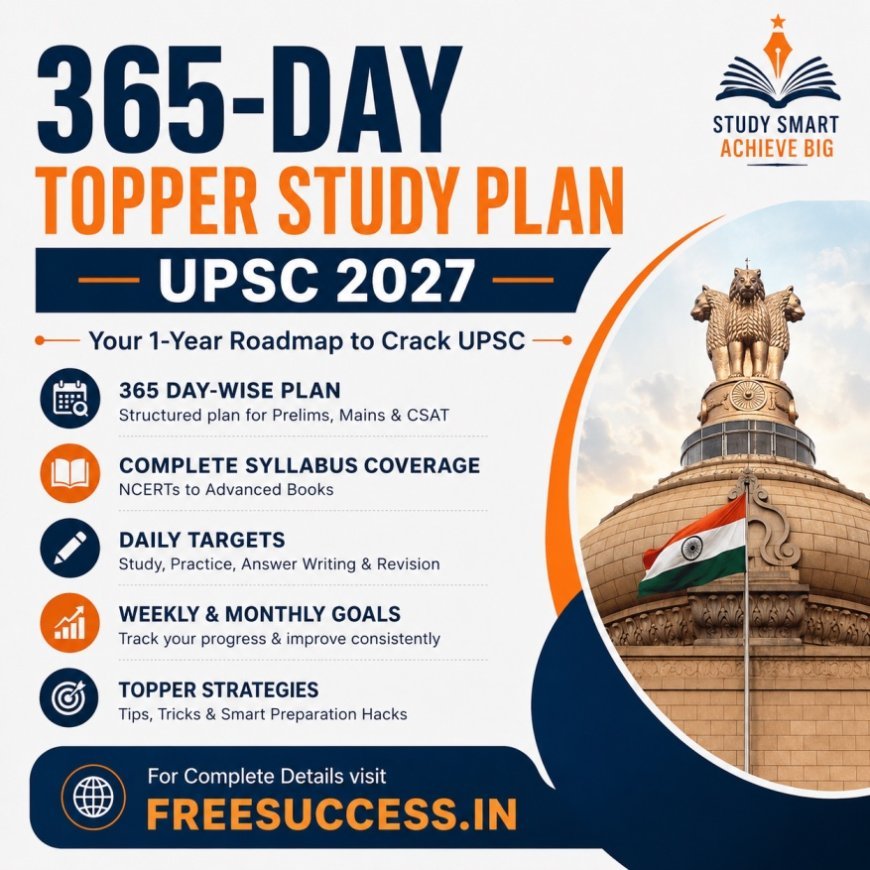
365-Day UPSC 2027 Topper Study Plan: The Ultimate Day-Wise Roadmap to Crack IAS on Your First Attempt
Preparing for the UPSC Civil Services Examination (CSE) 2027 is a dream for lakhs of aspirants across India. Every year, thousands of candidates begin their preparation, but only a few succeed because they follow a structured strategy, remain consistent, and revise regularly. If you're looking for a 365-day UPSC 2027 study plan, this detailed guide will help you complete the entire syllabus in one year while balancing Prelims, Mains, CSAT, Current Affairs, Answer Writing, and Optional Subject preparation.
Whether you're a beginner or a working professional, this roadmap is designed to maximize productivity and improve your chances of clearing the UPSC examination.
Why You Need a 365-Day UPSC Study Plan
Most aspirants fail not because they lack intelligence but because they don't have a proper plan. A day-wise study schedule helps you:
-
Complete the syllabus on time.
-
Avoid last-minute stress.
-
Build strong conceptual clarity.
-
Revise multiple times.
-
Balance Prelims and Mains preparation.
-
Develop answer-writing skills.
-
Track daily and weekly progress.
A disciplined one-year plan can make your UPSC preparation focused, organized, and result-oriented.
UPSC 2027 Exam Overview
Before starting your preparation, understand the three stages of the UPSC Civil Services Examination:
Stage 1: Preliminary Examination
-
General Studies Paper I
-
CSAT (Qualifying)
Stage 2: Main Examination
-
Essay
-
General Studies I
-
General Studies II
-
General Studies III
-
General Studies IV (Ethics)
-
Optional Subject (Paper I & II)
Stage 3: Personality Test (Interview)
A smart strategy prepares all three stages together instead of studying them separately.
365-Day UPSC 2027 Study Plan
Phase 1: Foundation (Days 1–90)
Days 1–15
- Understand UPSC syllabus & PYQs (2013–2026)
- Read NCERT Polity, Geography (Class 6–10)
- Start newspaper (The Hindu/Indian Express)
- Make current affairs notes
Days 16–30
- History NCERT
- Environment basics
- CSAT (30 min daily)
Days 31–45
- Economy NCERT
- Art & Culture basics
- 100 MCQs every Sunday
Days 46–60
- Science & Technology
- Geography Class 11–12
- First answer writing (5 questions/day)
Days 61–75
- Ethics introduction
- Essay basics
- Current Affairs Revision
Days 76–90
- Complete all NCERTs
- Revise everything
- Subject-wise tests
Phase 2: Standard Books (Days 91–180)
Polity (15 Days)
- Laxmikanth
- Constitution basics
- PYQs
History (20 Days)
- Spectrum
- Ancient & Medieval Notes
- World History
Geography (15 Days)
- GC Leong
- Atlas Practice
Economy (15 Days)
- Basic Economy Book
- Budget
- Economic Survey Notes
Environment (10 Days)
Science & Tech (10 Days)
Internal Security + Disaster Management (10 Days)
Society + Governance (10 Days)
Daily:
- Newspaper
- 10 MCQs
- 5 Mains Answers
Phase 3: Optional Subject (Days 181–240)
Complete Optional Paper-I
Complete Optional Paper-II
Previous Year Questions
Notes Preparation
Sectional Tests
Phase 4: Mains Intensive (Days 241–300)
Every Week:
- GS1 Test
- GS2 Test
- GS3 Test
- GS4 Test
- Essay (1)
Daily:
- 10 Answer Writing
- Ethics Case Studies
- Editorial Analysis
Phase 5: Prelims Intensive (Days 301–340)
Daily:
- 100 MCQs
- One Subject Revision
- CSAT Practice
- Current Affairs Revision
Weekly:
- Full Length Mock Test
Phase 6: Final Revision (Days 341–365)
Revise only:
- Short Notes
- Important Facts
- Maps
- Environment
- Government Schemes
- International Relations
- Economy Formulas
- Ethics Keywords
- Essay Quotes
Mock Tests:
- 10 Full GS Tests
- 5 CSAT Tests
Ideal Daily UPSC Study Routine
A balanced study routine helps maintain consistency throughout the year.
Morning
-
Newspaper reading
-
Editorial analysis
-
Current affairs notes
Morning Study Session
-
General Studies subject
Afternoon Session
-
Optional subject
Evening Session
-
MCQs
-
Answer writing
-
CSAT practice
Night
-
Revision of the day's learning
Weekly Study Targets
Every week, aim to:
-
Complete one major topic.
-
Revise previous topics.
-
Solve 300–500 MCQs.
-
Write one essay.
-
Attempt one mock test.
-
Review mistakes and update notes.
Monthly Goals
By the end of every month:
-
Complete planned subjects.
-
Revise all notes.
-
Improve answer-writing quality.
-
Increase MCQ accuracy.
-
Track weak areas and work on them.
Best Books for UPSC 2027
Some of the most recommended books include:
-
NCERT Books (Class 6–12)
-
Indian Polity
-
Modern Indian History
-
Certificate Physical & Human Geography
-
Indian Economy
-
Environment
-
India Year Book (selected topics)
-
Economic Survey (relevant portions)
-
Budget Highlights
Remember, mastering limited resources is more effective than collecting dozens of books.
Common Mistakes to Avoid
Many aspirants unknowingly reduce their chances by making avoidable mistakes.
Avoid:
-
Reading too many books.
-
Ignoring revisions.
-
Delaying answer writing.
-
Neglecting CSAT.
-
Depending only on current affairs.
-
Skipping mock tests.
-
Comparing your preparation with others.
-
Studying without a timetable.
Frequently Asked Questions (FAQs)
Is one year enough for UPSC preparation?
Yes. A disciplined candidate who studies consistently with regular revision and mock tests can complete the UPSC syllabus effectively within one year.
How many hours should I study daily?
Most successful candidates recommend studying 6–10 focused hours daily, depending on your background and available time.
Can beginners follow this study plan?
Absolutely. This roadmap starts with NCERTs and gradually progresses to advanced books, making it ideal for beginners.
Should I prepare Prelims and Mains together?
Yes. Integrated preparation helps save time and improves conceptual understanding.
When should I start answer writing?
Start within the first two to three months after building your basic concepts. Regular practice is essential for Mains success.
How many revisions are necessary?
Aim to revise each subject at least 4–5 times before the examination.
Is coaching mandatory?
No. Many UPSC toppers have cleared the examination through self-study using standard books, PYQs, and consistent practice.
How many mock tests should I attempt?
A good target is:
-
25–40 Prelims mock tests
-
15–25 Mains sectional tests
-
5–10 Full-Length Mains tests
-
5–10 CSAT mock tests
UPSC Preparation Tips & Tricks
-
Follow limited and reliable study resources.
-
Revise more than you read.
-
Solve Previous Year Questions regularly.
-
Make concise revision notes.
-
Practice MCQs every day.
-
Write answers consistently.
-
Read newspapers smartly and focus on exam-relevant issues.
-
Improve answer presentation with headings, flowcharts, and diagrams.
-
Take mock tests seriously and analyze every mistake.
-
Stay disciplined and consistent throughout the preparation journey.
Conclusion
Cracking the UPSC Civil Services Examination is not about studying the maximum number of books or spending endless hours at your desk. It is about following the right strategy, maintaining consistency, revising repeatedly, and continuously improving through practice. This 365-Day UPSC 2027 Topper Study Plan provides a practical roadmap that balances Prelims, Mains, CSAT, current affairs, optional subject preparation, revision, and mock tests.
Remember that every successful IAS, IPS, IFS, or IRS officer once started with Day 1 of their preparation. Stay focused on your daily goals, trust the process, and remain patient. Small, consistent efforts over 365 days can transform your UPSC dream into reality.
Start today, stay consistent, and give your best every single day. Your journey to becoming a civil servant begins now.









![[4 May] SSC Selection Post Phase 14 Recruitment 2026 - 2919 Posts](https://freesuccess.in/uploads/images/202605/image_140x98_69f661745c015.jpg)