100 Days UPSC Study Plan PDF (2026) | Toppers Time Table, Daily Schedule, Tips & FAQs
Download the complete 100 Days UPSC Study Plan based on a topper's timetable. Get a daily study schedule, subject-wise plan, revision strategy, mock test schedule, preparation tips, FAQs, and expert guidance to crack UPSC, SSC, Banking, and State PSC exams
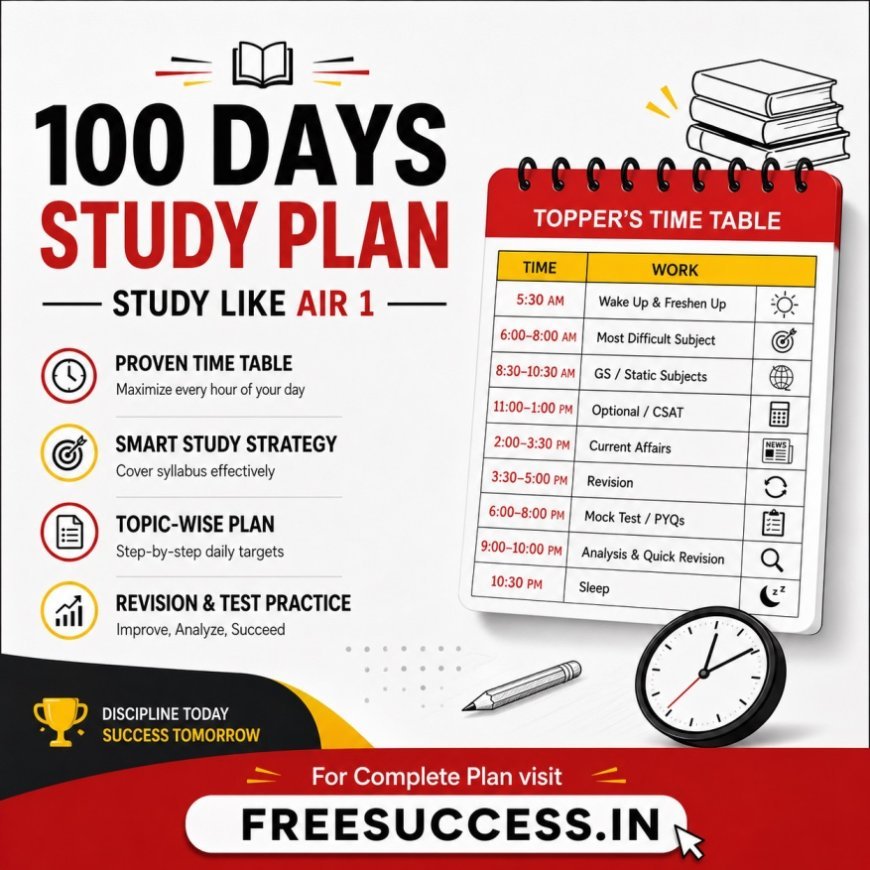
100 Days UPSC/Toppers Study Plan
Based on the timetable in your image
Daily Time Table (Follow Every Day)
| Time | Task |
|---|---|
| 5:30 AM | Wake up & Freshen Up |
| 6:00–8:00 AM | Most Difficult Subject |
| 8:00–8:30 AM | Breakfast |
| 8:30–10:30 AM | GS / Static Subjects |
| 10:30–11:00 AM | Break + Walk |
| 11:00–1:00 PM | CSAT (Maths/Reasoning) or Optional |
| 1:00–2:00 PM | Lunch + Rest |
| 2:00–3:30 PM | Current Affairs + Newspaper |
| 3:30–5:00 PM | Revision |
| 5:00–6:00 PM | Exercise |
| 6:00–8:00 PM | Mock Test / PYQs |
| 8:00–9:00 PM | Dinner |
| 9:00–10:00 PM | Mistake Analysis & Quick Revision |
| 10:30 PM | Sleep |
Phase 1: Foundation (Day 1–30)
Days 1–5
- Polity: Constitution, Historical Background
- Modern History: 1857–1905
- Geography: Earth & Universe
- CSAT Basics
- Current Affairs
Days 6–10
- Fundamental Rights & DPSPs
- Modern History (1905–1947)
- Physical Geography
- Quantitative Aptitude
- PYQs
Days 11–15
- Parliament & President
- Indian Geography
- Economy Basics
- Logical Reasoning
- Weekly Mock
Days 16–20
- Judiciary & Constitutional Bodies
- Climate & Environment
- Inflation, GDP, Banking
- Comprehension
- Revision
Days 21–25
- Agriculture
- Ancient India
- Ecology
- CSAT Practice
- Subject Test
Days 26–30
- Science & Technology Basics
- Medieval India
- Mapping
- Full Revision
- Full-Length Mock
Phase 2: Coverage (Day 31–60)
Days 31–35
- Economy
- Budget
- Taxation
- Environment
- CSAT
Days 36–40
- International Relations
- UN
- WTO
- IMF
- Geography Revision
Days 41–45
- Disaster Management
- Internal Security
- Science & Tech
- PYQs
Days 46–50
- Ethics Basics (if applicable)
- Government Schemes
- Art & Culture
- Mock Test
Days 51–55
- Environment Revision
- Economy Revision
- Mapping Practice
- CSAT Mock
Days 56–60
- Complete GS Revision
- Current Affairs Compilation
- Two Full-Length Tests
Phase 3: Intensive Practice (Day 61–80)
Days 61–65
- Daily 100 MCQs
- PYQs
- Weak Topics Revision
Days 66–70
- Two Mock Tests
- Error Analysis
- Polity & Economy Revision
Days 71–75
- History Revision
- Geography Revision
- Environment Revision
Days 76–80
- Full-Length Mock Every Alternate Day
- CSAT Practice
- Current Affairs Revision
Phase 4: Final Revision (Day 81–100)
Days 81–85
- Polity Complete Revision
- Economy Complete Revision
Days 86–90
- History Complete Revision
- Geography Complete Revision
Days 91–95
- Environment
- Science & Tech
- Government Schemes
- Current Affairs
Days 96–99
- One Full Mock Daily
- Analyze Mistakes
- Revise Short Notes
- Important Facts
Day 100
- Light Revision Only
- Formula Sheets
- Maps
- Important Articles
- Rest Well
- Sleep Early
Daily Targets
- 2 hours: Difficult Subject
- 2 hours: GS Static
- 2 hours: Optional/CSAT
- 1.5 hours: Current Affairs
- 1.5 hours: Revision
- 2 hours: Mock Test/PYQs
- 1 hour: Mistake Analysis
Weekly Goals
- Finish 2–3 GS topics
- Solve 700–1000 MCQs
- Attempt 2–3 sectional mocks
- Attempt 1 full-length mock
- Revise everything studied during the week every Sunday.
By consistently following this schedule for 100 days, you'll complete the core syllabus, practice previous years' questions, strengthen CSAT/optional preparation, and leave the final weeks for intensive revision and mock-test analysis
Tips & Tricks for Following This 100-Day Study Plan
1. Study Your Toughest Subject First
Your brain is most active in the morning. Use the 6:00–8:00 AM slot for your weakest or most difficult subject.
2. Follow the 50–10 Rule
Study for 50 minutes and take a 10-minute break. This improves focus and prevents burnout.
3. Revise Every Day
Spend the 3:30–5:00 PM session revising what you learned the same day. Daily revision improves long-term retention.
4. Solve PYQs Regularly
Previous Year Questions help you understand the exam pattern and identify important topics.
5. Make Short Notes
Prepare concise notes, formulas, facts, and mind maps for quick revision during the final weeks.
6. Analyze Every Mock Test
Don't just take tests—review every mistake. Maintain an error notebook and revise it weekly.
7. Read Current Affairs Daily
Focus on important national, international, economic, science, and government-related news. Avoid spending too much time on unnecessary articles.
8. Stay Consistent
Studying 8–10 focused hours daily is more effective than studying 15 hours occasionally.
9. Limit Distractions
Keep your phone away while studying. Use website blockers or Focus Mode if necessary.
10. Take Care of Your Health
Sleep for 7–8 hours, exercise daily, eat healthy food, and stay hydrated to maintain productivity.
Frequently Asked Questions (FAQs)
Q1. Can beginners follow this 100-day study plan?
Yes. This plan is designed for both beginners and repeat aspirants. Beginners may need to spend extra time understanding basic concepts.
Q2. How many hours should I study daily?
Aim for 8–10 effective study hours, excluding breaks, meals, and exercise.
Q3. What if I miss one day?
Don't panic. Continue from the next day's schedule without trying to study excessively to "catch up."
Q4. Should I read multiple books for one subject?
No. Stick to one standard book per subject and revise it multiple times instead of collecting too many resources.
Q5. How many mock tests should I attempt?
Try to solve at least:
- 10–15 sectional tests
- 10–20 full-length mock tests
before the exam.
Q6. Is daily newspaper reading compulsory?
Yes, but keep it limited to 60–90 minutes and focus only on exam-relevant topics.
Q7. How often should I revise?
Follow the 1–7–30 Rule:
- Revise after 1 day
- Revise again after 7 days
- Revise once more after 30 days
Q8. What should I do if my scores are low?
Low scores are part of the learning process. Analyze mistakes, improve weak areas, and continue practicing consistently.
Q9. Is taking breaks important?
Yes. Short breaks improve concentration, reduce stress, and increase overall productivity.
Q10. Can I modify this timetable?
Absolutely. Adjust the schedule according to your strengths, weaknesses, work commitments, or coaching classes while maintaining consistency.
Conclusion
Success in any competitive examination is built on consistency, discipline, smart planning, and regular revision. This 100-Day Study Plan is designed to help you complete the syllabus systematically, strengthen concepts, improve problem-solving skills, and maximize your exam performance through daily practice and mock tests.
Remember that progress may seem slow at first, but every focused study session brings you one step closer to your goal. Stay committed to your timetable, trust the process, learn from your mistakes, and never skip revision.
Study with dedication, revise with discipline, practice with confidence, and success will follow. Best wishes for your examination! 🌟













![[4 May] SSC Selection Post Phase 14 Recruitment 2026 - 2919 Posts](https://freesuccess.in/uploads/images/202605/image_140x98_69f661745c015.jpg)