Class 12 Topper Study Plan 2026-27 | Score 95%+ in Boards
Complete Class 12 Topper Study Plan 2026-27 with daily timetable, subject-wise strategy, revision plan, PYQs, sample papers, FAQs, and topper tips
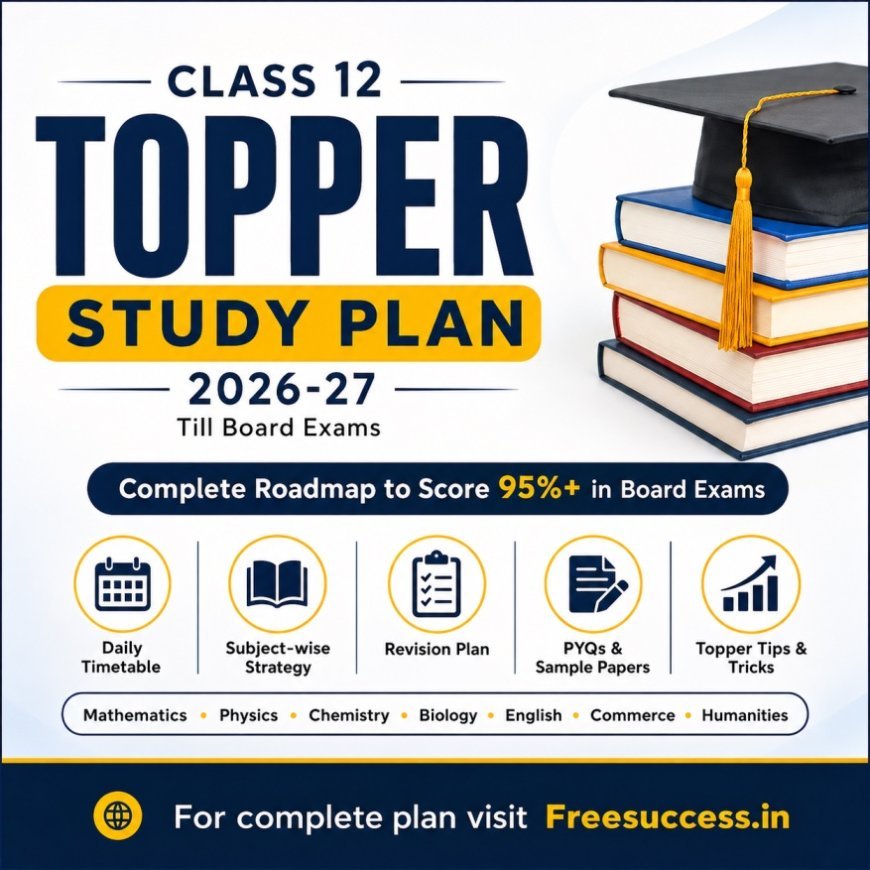
Class 12 Board Exam Topper Study Plan 2026–27 (Complete Guide Till Board Exams)
Introduction
Class 12 is one of the most important academic years because your board exam marks play a major role in college admissions, scholarships, competitive exams, and career opportunities. Whether you're preparing for CBSE, ICSE, or any State Board, a structured study plan can help you complete the syllabus on time, revise effectively, and score above 95%.
This Class 12 Topper Study Plan is designed to take you from the beginning of your preparation until the final board exams. It focuses on concept clarity, NCERT mastery, regular revision, sample papers, previous-year questions (PYQs), and mock tests to help you study like a topper.
Goals of This Study Plan
By following this roadmap, you will:
- Complete the entire syllabus before pre-boards.
- Revise each subject multiple times.
- Master NCERT and important reference books.
- Improve answer-writing skills.
- Practice board-level questions and sample papers.
- Build confidence for the final examination.
Study Materials
Mandatory
- NCERT Textbooks
- NCERT Exemplar (Science & Mathematics)
- School Notes
- Previous 10 Years' Board Papers
- CBSE/State Board Sample Papers
Reference Books (Optional)
- Mathematics: RD Sharma / RS Aggarwal
- Physics: HC Verma (selected problems)
- Chemistry: Modern ABC / OP Tandon (selected topics)
- Biology: Trueman's Biology
- English: NCERT + Board Question Banks
- Commerce/Humanities: Standard board-oriented guides
Daily Topper Timetable
| Time | Activity |
|---|---|
| 5:00 AM | Wake up & Freshen Up |
| 5:15–5:45 AM | Exercise & Meditation |
| 6:00–8:00 AM | Subject 1 (Difficult Subject) |
| 8:00–9:00 AM | Breakfast |
| 9:00–11:00 AM | Subject 2 |
| 11:00–12:00 PM | Revision |
| 12:00–1:30 PM | Subject 3 |
| 1:30–2:30 PM | Lunch |
| 2:30–4:00 PM | Subject 4 |
| 4:00–5:00 PM | Break |
| 5:00–7:00 PM | NCERT + PYQs |
| 7:00–8:00 PM | Dinner |
| 8:00–9:00 PM | Sample Paper/Mock Test |
| 9:00–10:00 PM | Formula & Notes Revision |
| 10:00 PM | Sleep |
Phase 1: Foundation Building (First 60 Days)
Objectives
- Finish 40–50% of the syllabus.
- Strengthen concepts.
- Create concise notes.
- Solve NCERT exercises.
Daily Targets
- 2–3 chapters
- 40–60 MCQs
- 20–30 subjective questions
- 1-hour revision
Phase 2: Syllabus Completion (Next 60 Days)
Objectives
- Complete the entire syllabus.
- Solve NCERT Exemplar.
- Finish important reference questions.
- Begin PYQ practice.
Phase 3: Pre-Board Preparation (Next 45 Days)
Focus Areas
- Previous-Year Questions
- Sample Papers
- Weak Chapters
- Time Management
- Writing Practice
Daily:
- 1 Sample Paper
- 2 Chapter Revisions
- Error Analysis
Phase 4: Final Revision (Last 30 Days Before Boards)
Daily Routine
- Revise formulas and definitions.
- Solve one full-length board paper daily.
- Revise short notes.
- Practice diagrams, maps, and numerical questions.
- Focus on presentation and answer-writing.
Avoid starting any new topics during this phase.
Subject-Wise Strategy
Mathematics
- Complete NCERT first.
- Solve RD Sharma selectively.
- Memorize formulas.
- Practice at least 30–40 questions daily.
Physics
- Understand concepts before memorizing formulas.
- Practice derivations.
- Solve numericals daily.
- Revise diagrams.
Chemistry
- Learn NCERT line by line.
- Practice reactions and equations.
- Revise Organic Chemistry mechanisms.
- Solve assertion-reason questions.
Biology
- Read NCERT repeatedly.
- Practice diagrams.
- Learn scientific terms.
- Solve PYQs and case-based questions.
English
- Read all chapters thoroughly.
- Practice writing skills.
- Improve grammar.
- Solve comprehension passages regularly.
Commerce Stream
Accountancy
- Daily numerical practice.
- Maintain proper presentation.
Business Studies
- Learn keywords.
- Practice case studies.
Economics
- Revise graphs and concepts.
- Solve numericals and theory questions.
Humanities Stream
- Prepare concise notes.
- Memorize dates and important terms.
- Practice map work (where applicable).
- Write long answers with proper structure.
Weekly Targets
Monday–Friday
- Learn new concepts.
- Complete chapters.
- Solve exercises.
Saturday
- Previous-Year Questions
- Sample Paper
Sunday
- Weekly Revision
- Mock Test
- Mistake Analysis
Revision Strategy
Follow the 1–3–7–15–30 Rule:
- Revise on the same day.
- Revise after 3 days.
- Revise after 7 days.
- Revise after 15 days.
- Revise after 30 days.
Maintain:
- Formula Notebook
- Mistake Notebook
- Quick Revision Notes
Previous-Year Paper Strategy
Solve at least the last 10 years' board papers.
Benefits:
- Understand question trends.
- Improve answer-writing.
- Learn important topics.
- Boost confidence.
Sample Paper Strategy
- Solve under exam conditions.
- Finish within the allotted time.
- Evaluate mistakes honestly.
- Improve presentation and handwriting.
Answer Writing Tips
- Write neat and legible answers.
- Underline keywords.
- Draw diagrams wherever required.
- Label diagrams correctly.
- Attempt all questions.
- Follow the marking scheme.
Common Mistakes to Avoid
- Ignoring NCERT.
- Skipping revision.
- Studying only favorite subjects.
- Memorizing without understanding.
- Leaving sample papers for the end.
- Poor time management.
- Sleeping less than 7 hours.
Topper Tips & Tricks
- Study consistently every day.
- Complete NCERT before reference books.
- Revise more than you read.
- Solve one sample paper every week initially, then daily before exams.
- Maintain short revision notes.
- Practice writing answers within time limits.
- Focus on weak subjects without neglecting strengths.
- Stay physically active and eat healthy.
- Avoid comparing yourself with others.
- Trust the preparation process.
Smart Strategy to Score 95%+
- Finish the syllabus early.
- Revise every chapter multiple times.
- Practice PYQs and sample papers.
- Improve answer presentation.
- Analyze every mistake.
- Keep a formula notebook.
- Stay consistent until the last exam.
Frequently Asked Questions (FAQs)
1. Can I score 95%+ if I start now?
Yes. With consistent study, proper revision, and regular practice, many students improve significantly and achieve 95% or higher.
2. How many hours should I study daily?
Aim for 6–8 focused hours on school days and 8–10 hours during holidays or study leave.
3. Is NCERT enough for board exams?
For most subjects, NCERT is the foundation. Combine it with PYQs, sample papers, and school notes for excellent results.
4. How many sample papers should I solve?
Target 20–30 full-length sample papers before the board exams.
5. Should I solve previous-year papers?
Yes. Solve at least the last 10 years' papers to understand the pattern and frequently asked questions.
6. How often should I revise?
Revise every topic multiple times using the 1–3–7–15–30 revision cycle.
7. What if I'm weak in one subject?
Give it extra time each day, clear basic concepts first, and practice regularly without ignoring other subjects.
8. How can I improve answer presentation?
Use headings, underline keywords, maintain neat handwriting, draw diagrams where applicable, and answer according to the marking scheme.
9. What should I do during the last month?
Focus only on revision, sample papers, PYQs, and strengthening weak areas. Avoid starting new resources.
10. Can self-study be enough?
Absolutely. With discipline, NCERT mastery, proper planning, and consistent revision, self-study is sufficient for scoring top marks.
Final 15-Day Checklist
- ✅ Complete final revision of all subjects.
- ✅ Revise formulas, reactions, and definitions.
- ✅ Solve one board-level paper daily.
- ✅ Revise short notes and flashcards.
- ✅ Analyze mistakes after every paper.
- ✅ Sleep 7–8 hours every night.
- ✅ Stay calm and avoid unnecessary stress.
- ✅ Keep all admit card and stationery items ready.
- ✅ Maintain a healthy diet and hydration.
- ✅ Believe in your preparation.
Conclusion
Scoring high marks in Class 12 board exams is not about studying endlessly—it is about studying consistently, revising smartly, and practicing effectively. This Class 12 Topper Study Plan is designed to help you complete your syllabus on time, master every subject, and approach the examination with confidence.
Remember the formula for board success:
NCERT Mastery + Regular Revision + PYQs + Sample Papers + Consistency = 95%+ in Class 12 Boards
Stay disciplined, trust your preparation, and keep improving every day. Your efforts over the coming months will shape your academic future, so make every study session count. Best of luck for your Class 12 Board Exams!













![[4 May] SSC Selection Post Phase 14 Recruitment 2026 - 2919 Posts](https://freesuccess.in/uploads/images/202605/image_140x98_69f661745c015.jpg)