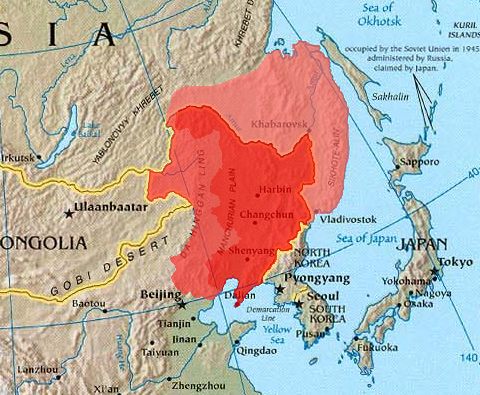
Outer Manchuria
top: ref
| ← Previous revision | Revision as of 04:11, 19 April 2026 | ||
| Line 26: | Line 26: | ||
| map_caption1 = |
| map_caption1 = |
||
| mapsize1 = |
| mapsize1 = |
||
| population_demonym = Outer Manchurian |
| population_demonym = Outer Manchurian |
||
| named_for = [[Manchuria]] |
| named_for = [[Manchuria]] |
||
| Line 61: | Line 61: | ||
|issn=0099-9660 |
|issn=0099-9660 |
||
|oclc=781541372 |
|oclc=781541372 |
||
|url-access=subscription |quote=New Russian leaders may or may not look to the West rather than Beijing, and might be so weak that the Russian Federation’s fragmentation, especially east of the Urals, isn’t inconceivable. Beijing is undoubtedly eyeing this vast territory, which potentially contains incalculable mineral wealth. Significant portions of this region were under Chinese sovereignty until the 1860 Treaty of Peking transferred 'outer Manchuria', including extensive Pacific coast lands, to Moscow.}} also called '''Great Northeast Area'''{{cite book |last1=Central Intelligence Agency |title=PEOPLE'S REPUBLIC OF CHINA Atlas |date=November 1971 |page=75 |url=https://www.cia.gov/readingroom/docs/PEOPLES%20REPUBLIC%20OF%20CHINA%5B16026071%5D.pdf |access-date=19 April 2026}} ({{langx|zh|外東北}}) or '''Russian Manchuria'''{{ |
|url-access=subscription |quote=New Russian leaders may or may not look to the West rather than Beijing, and might be so weak that the Russian Federation’s fragmentation, especially east of the Urals, isn’t inconceivable. Beijing is undoubtedly eyeing this vast territory, which potentially contains incalculable mineral wealth. Significant portions of this region were under Chinese sovereignty until the 1860 Treaty of Peking transferred 'outer Manchuria', including extensive Pacific coast lands, to Moscow.}} also called '''Great Northeast Area'''{{cite book |last1=Central Intelligence Agency |title=PEOPLE'S REPUBLIC OF CHINA Atlas |date=November 1971 |page=75 |url=https://www.cia.gov/readingroom/docs/PEOPLES%20REPUBLIC%20OF%20CHINA%5B16026071%5D.pdf |access-date=19 April 2026}} ({{langx|zh|外東北}}) or '''Russian Manchuria''',{{cite book |last1=Schneider |first1=Julia C. |title=Nation and Ethnicity: Chinese Discourses on History, Historiography, and Nationalism (1900s-1920s) |date=13 March 2017 |publisher=BRILL |isbn=978-90-04-33012-2 |page=277 |url=https://www.google.com/books/edition/Nation_and_Ethnicity/GolZDgAAQBAJ |language=en}} refers to a region in [[Northeast Asia]] that is now part of the [[Russian Far East]], but historically formed part of [[Manchuria]] until the mid-19th century. While Manchuria now more normatively refers to [[Northeast China]], it originally included areas consisting of [[Priamurye]] between the left bank of [[Amur River]] and the [[Stanovoy Range]] to the north, and [[Primorskaya Oblast|Primorskaya]] which covered the area in the right bank of both [[Ussuri River]] and the lower Amur River to the [[Pacific Coast]]. The region was ruled by a series of [[Dynasties of China|Chinese dynasties]] and the [[Mongol Empire]], but control of the area was ceded to the [[Russian Empire]] by [[Qing dynasty|Qing China]] during the [[Amur Annexation]] in the 1858 [[Treaty of Aigun]] and 1860 [[Treaty of Peking]],{{cite book |
||
|year=2015 |
|year=2015 |
||
|last=O'Hanlon |
|last=O'Hanlon |
||