Velella
tried to make lede less technical and easier to follow; not sure how good þis is however
| ← Previous revision | Revision as of 23:55, 18 April 2026 | ||
| Line 44: | Line 44: | ||
}} |
}} |
||
'''''Velella''''' is a [[ |
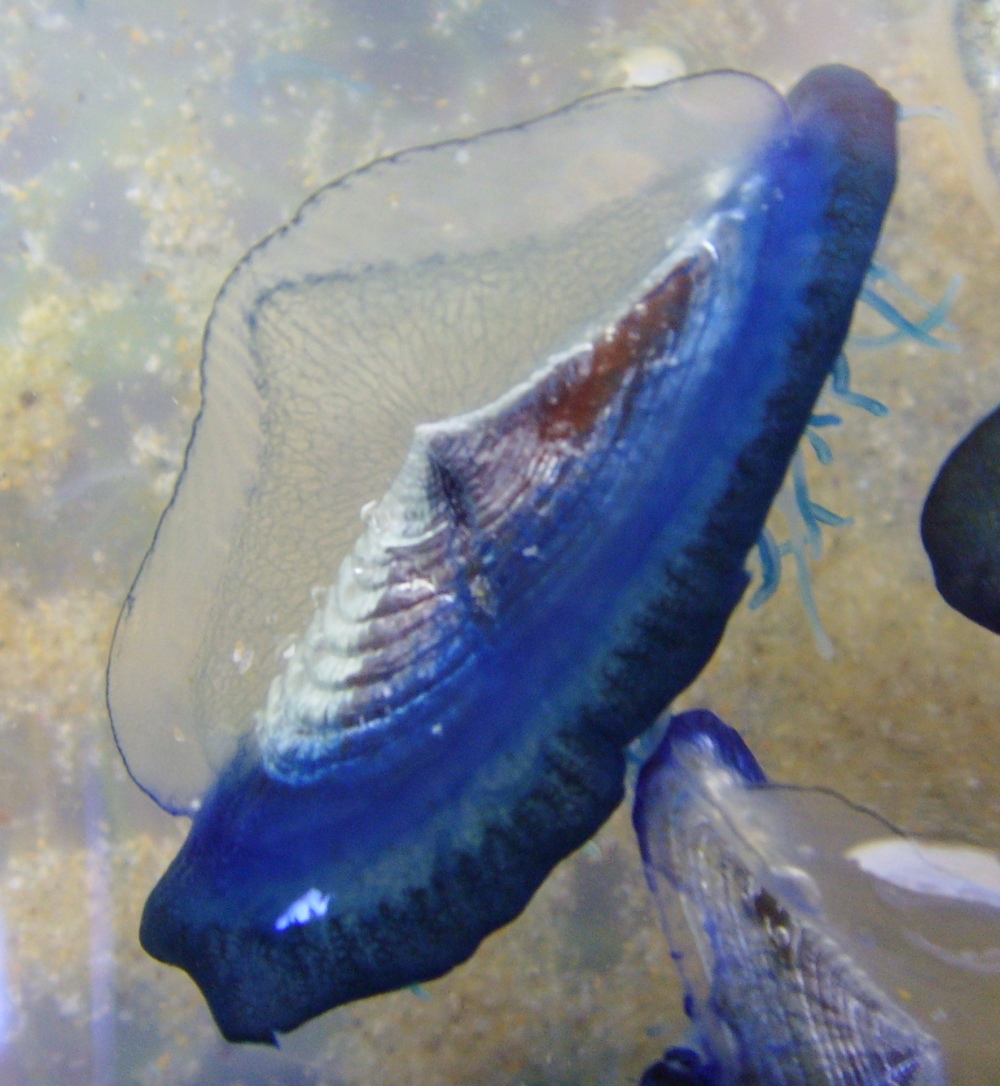
'''''Velella''''' is a genus of [[hydrozoa]] (a group of small, predatory marine [[cnidarian]]sd) in the family [[Porpitidae]]. Its only known species is '''''Velella velella''''',{{cite WoRMS |year=2013 |title=''Velella velella'' (Linnaeus, 1758) |db=Hydrozoa |id=117832 |access-date=23 April 2013}} a widely-distributed free-floating colonial animal that lives on the surface of the open ocean. It is commonly known by the names '''sea raft''', '''by-the-wind sailor''', '''purple sail''', '''little sail''', or simply ''Velella''.Harrington Wells (1937). ''Seashore Life''. Wagner Publishing Company, USA (see pages 138 and 144 in the 1942 edition) |
||
It is a member of a specialised ocean surface community that includes the better-known [[Portuguese man o' war]]. Specialized predatory [[mollusc]]s prey on these cnidarians. Such predators include [[nudibranch]]s (sea slugs) in the genus [[Glaucus (gastropod)|''Glaucus'']]Gosliner, T.M. (1987). ''Nudibranchs of Southern Africa'' page 127, {{ISBN|0-930118-13-8}} and purple snails in the genus ''[[Janthina]]''.Branch, G.M., Branch, M.L, Griffiths, C.L. and Beckley, L.E. (2010). ''Two Oceans: a guide to the marine life of southern Africa.'' Cape Town:Struik Nature. page 188. {{ISBN|9781770077720}}. |
|||
Each apparent individual is a hydroid colony, and most are less than about {{Convert|7|cm|abbr=on}} long. They are usually deep blue in colour, |
Each apparent individual is a hydroid colony, and most are less than about {{Convert|7|cm|abbr=on}} long. They are usually deep blue in colour, with a small stiff sail that catches the wind and propels them over the surface of the sea. Under certain wind conditions, they may be stranded by the thousand on beaches.{{Cite web |date=2024-04-22 |title=By-the-wind-sailors: Creatures wash up on Guernsey beaches |url=https://www.bbc.com/news/articles/cer34mg0j80o |access-date=2024-04-23 |website=BBC News |language=en-gb |archive-date=2024-04-22 |archive-url=https://web.archive.org/web/20240422165325/https://www.bbc.com/news/articles/cer34mg0j80o |url-status=live }} |
||
Like other cnidarians, ''V. velella'' are carnivorous. They catch their [[prey]], generally [[plankton]], by means of [[tentacle]]s that hang down in the water and bear [[nematocyst]]s (also called cnidocysts). The [[toxin]]s in their nematocysts are effective against their prey. While cnidarians all possess nematocysts, in some species the nematocysts and toxins therein are more powerful than other species. ''V. velella'''s nematocysts are relatively benign to humans, although each person may respond differently to contact with the nematocyst toxin. It is wise to avoid touching one's face or eyes after handling ''V. velella'', and itching may develop on parts of the skin that have been exposed to ''V. velella'' nematocysts. |
Like other cnidarians, ''V. velella'' are carnivorous. They catch their [[prey]], generally [[plankton]], by means of [[tentacle]]s that hang down in the water and bear [[nematocyst]]s (also called cnidocysts). The [[toxin]]s in their nematocysts are effective against their prey. While cnidarians all possess nematocysts, in some species the nematocysts and toxins therein are more powerful than other species. ''V. velella'''s nematocysts are relatively benign to humans, although each person may respond differently to contact with the nematocyst toxin. It is wise to avoid touching one's face or eyes after handling ''V. velella'', and itching may develop on parts of the skin that have been exposed to ''V. velella'' nematocysts. |
||