Urotsukidōji
| ← Previous revision | Revision as of 23:09, 18 April 2026 | ||
| Line 3: | Line 3: | ||
{{Tone|date=June 2024}} |
{{Tone|date=June 2024}} |
||
{{Infobox animanga/Header |
{{Infobox animanga/Header |
||
| name = Urotsukidōji |
| name = Urotsukidōji |
||
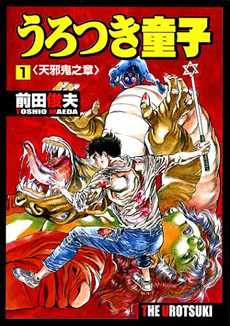
| image = Urotsukidōji manga vol 1 (2004 reprint).jpg |
| image = Urotsukidōji manga vol 1 (2004 reprint).jpg |
||
| caption = Cover of the 2004 reprint of the first manga volume |
| caption = Cover of the 2004 reprint of the first manga volume |
||
| Line 27: | Line 27: | ||
| writer = {{ubl|[[Shō Aikawa (screenwriter)|Shō Aikawa]]{{efn|name=Aikawa|Credited as Gorō Sanyō}}|[[Shigenori Kageyama]]{{efn|name=Kageyama|Credited as Yōsei Morino}}}} |
| writer = {{ubl|[[Shō Aikawa (screenwriter)|Shō Aikawa]]{{efn|name=Aikawa|Credited as Gorō Sanyō}}|[[Shigenori Kageyama]]{{efn|name=Kageyama|Credited as Yōsei Morino}}}} |
||
| music = [[Masamichi Amano]] |
| music = [[Masamichi Amano]] |
||
| studio = {{ubl|[[Yoshinobu Nishizaki|Japan Audiovisual Network]] {{nowrap|({{abbrv|eps.|Episodes}} 1–5)}}||[[Yoshinobu Nishizaki# |
| studio = {{ubl|[[Yoshinobu Nishizaki#Life and work|Japan Audiovisual Network]] {{nowrap|({{abbrv|eps.|Episodes}} 1–5)}}||[[Yoshinobu Nishizaki#Life and work|West Cape Corporation]] {{nowrap|(epis. 6–13)}}{{efn|The first two parts (episodes 1 to 5) were produced by the West Cape Corporation's subsidiary Japan Audiovisual Network. After the dissolution of the Japan Audiovisual Network, West Cape Corporation itself took over the production of the remainder of the series.}}|Mu Animation Studio{{efn|name=Mu|Credited as Project Team Mu}} {{nowrap|(eps. 1–3)}}|Phoenix Entertainment {{nowrap|(eps. 4–12)}}|Studio Take-Off {{nowrap|(ep. 13)}}}} |
||
| first = 21 January 1987 |
| first = 21 January 1987 |
||
| last = 28 December 1996 |
| last = 28 December 1996 |
||
| Line 37: | Line 37: | ||
| title = Anime parts |
| title = Anime parts |
||
| content = |
| content = |
||
*''[[#Legend of the Overfiend (1987–1989)|Part I: Legend of the Overfiend]]'' {{nowrap|( |
*''[[#Legend of the Overfiend (1987–1989)|Part I: Legend of the Overfiend]]'' {{nowrap|(episodes 1 to 3)}} |
||
*''[[#Legend of the Demon Womb (1990–1991)|Part II: Legend of the Demon Womb]]'' {{nowrap|( |
*''[[#Legend of the Demon Womb (1990–1991)|Part II: Legend of the Demon Womb]]'' {{nowrap|(episodes 4 and 5)}} |
||
*''[[#Return of the Overfiend (1992–1993)|Part III: Return of the Overfiend]]'' {{nowrap|( |
*''[[#Return of the Overfiend (1992–1993)|Part III: Return of the Overfiend]]'' {{nowrap|(episodes 6 to 9)}} |
||
*''[[#Inferno Road (1993–1995)|Part IV: Inferno Road]]'' {{nowrap|( |
*''[[#Inferno Road (1993–1995)|Part IV: Inferno Road]]'' {{nowrap|(episodes 10 to 12)}} |
||
*''[[#The Final Chapter (1996)|Part V: The Final Chapter]]'' {{nowrap|( |
*''[[#The Final Chapter (1996)|Part V: The Final Chapter]]'' {{nowrap|(episode 13)}} |
||
}} |
}} |
||
{{Infobox animanga/Video |
{{Infobox animanga/Video |
||
| Line 58: | Line 58: | ||
}} |
}} |
||
{{Infobox animanga/Footer}} |
{{Infobox animanga/Footer}} |
||
{{nihongo|'''''Urotsukidōji |
{{nihongo|'''''Urotsukidōji'''''|超神伝説うろつき童子|Chōjin Densetsu Urotsukidōji|{{lit}} "Super God Legend: The Wandering Child"|lead=yes}} is a Japanese [[erotic horror]] [[manga]] series written and illustrated by [[Toshio Maeda]].{{cite web |url= https://www.animenewsnetwork.com/news/2012-07-25/urotsukidoji-manga-creator-to-attend-london-mcm-expo-in-october|title= Urotsukidoji Manga Creator to Attend London MCM Expo in October|date=25 July 2012|access-date=9 October 2014|work= [[Anime News Network]]}} |
||
First serialized in ''Manga Erotopia'' from 1985 to 1986, ''Urotsukidōji'' marked a departure from Maeda's earlier works, with its focus on [[erotica]], dark humor, and the supernatural. Starting in 1987, the manga was adapted into a series of [[original video animation]] (OVA) [[anime]] releases by director Hideki Takayama. The adaptations deviate significantly from the manga, adding elements of violence, [[sadomasochism]], and rape not present in the source material. |
First serialized in ''Manga Erotopia'' from 1985 to 1986, ''Urotsukidōji'' marked a departure from Maeda's earlier works, with its focus on [[erotica]], dark humor, and the supernatural. Starting in 1987, the manga was adapted into a series of [[original video animation]] (OVA) [[anime]] releases by director Hideki Takayama. The adaptations deviate significantly from the manga, adding elements of violence, [[sadomasochism]], and rape not present in the source material. |
||
| Line 193: | Line 193: | ||
The first series was released as part of an anthology video series distributed by JAVN (Japan Audio Visual Network). The anthology series was part of the international [[Penthouse (magazine)|Penthouse Magazine]] brand and featured international and domestic pornographic movies (such as ''[[The Devil in Miss Jones]]'', ''[[Behind the Green Door]]'' and ''[[The Opening of Misty Beethoven]]'' to name a few). |
The first series was released as part of an anthology video series distributed by JAVN (Japan Audio Visual Network). The anthology series was part of the international [[Penthouse (magazine)|Penthouse Magazine]] brand and featured international and domestic pornographic movies (such as ''[[The Devil in Miss Jones]]'', ''[[Behind the Green Door]]'' and ''[[The Opening of Misty Beethoven]]'' to name a few). |
||
The first three-volume series within the larger Penthouse series was named {{nihongo|'''''Legend of the Demon God Urotsukidōji'''''|超神伝説うろつき童子|Chōjin Densetsu Urotsukidōji}}. These three episodes were adapted from the original [[manga]] but skip over much of the comedic sub-stories and subplots and instead shift the focus to the apocalypse and the battle between Suikakuju and Jyaku. |
The first three-volume series within the larger Penthouse series was named {{nihongo|'''''Legend of the Demon God Urotsukidōji'''''|超神伝説うろつき童子|Chōjin Densetsu Urotsukidōji}}, known outside Japan as '''''Urotsukidōji: Legend of the Overfiend'''''. These three episodes were adapted from the original [[manga]] but skip over much of the comedic sub-stories and subplots and instead shift the focus to the apocalypse and the battle between Suikakuju and Jyaku. |
||
The three OVAs were later edited into a theatrical film |
The three OVAs were later edited into a theatrical film. The removal of certain [[explicit material]] resulted in the film being given a {{nihongo|Limited General Film (R)|一般映画制限付|Ippan Eiga Seigen-tsuki|currently known as "R15+"}} rating from Japan's [[Eirin#Ratings|Film Classification and Rating Organization]]. Shochiku-Fuji distributed the film to theaters while [[Shochiku]] Home Video distributed the film to VHS with the tagline {{nihongo|'''''Original Theatrical Version'''''|オリジナル劇場公開版|Orijinaru Gekijō Kōkai-ban}}. |
||
''Legend of the Over-Fiend'' was shown at the [[Toronto International Film Festival|Toronto Festival of Festivals]] on 16 September 1989.{{sfn|Suze.|1991}} A critic credited as "Suze." wrote in ''[[Variety (magazine)|Variety]]'' the film was a "sci-fi-horror schlock extravaganza verging on porno. Films like this are why the word misogynist was invented."{{sfn|Suze.|1991}} |
''Legend of the Over-Fiend'' was shown at the [[Toronto International Film Festival|Toronto Festival of Festivals]] on 16 September 1989.{{sfn|Suze.|1991}} A critic credited as "Suze." wrote in ''[[Variety (magazine)|Variety]]'' the film was a "sci-fi-horror schlock extravaganza verging on porno. Films like this are why the word misogynist was invented."{{sfn|Suze.|1991}} |
||
| Line 218: | Line 218: | ||
The second OVA series was named {{nihongo|'''''The True Legend of the Demon God Urotsukidōji: Connections with the Devil'''''|真・超神伝説うろつき童子 魔胎伝|Shin Chōjin Densetsu Urotsukidōji: Mataiden}}. This series was not based on the manga, but elements from it were used, with Negumo's cousin Takeaki taking on a character similar to the character of Saburo in the manga and Münchhausen II taking after the character of Suikakuju. |
The second OVA series was named {{nihongo|'''''The True Legend of the Demon God Urotsukidōji: Connections with the Devil'''''|真・超神伝説うろつき童子 魔胎伝|Shin Chōjin Densetsu Urotsukidōji: Mataiden}}, known outside Japan as '''''Urotsukidōji II: Legend of the Demon Womb'''''. This series was not based on the manga, but elements from it were used, with Negumo's cousin Takeaki taking on a character similar to the character of Saburo in the manga and Münchhausen II taking after the character of Suikakuju. |
||
The second part of the saga created an ongoing controversy among ''Urotsukidōji'' fans as to where it fits into the saga as a whole. One main theory is that the two chapters happen between "Birth of the Overfiend" and "Curse of the Overfiend" of the first OVA. Another main theory is that since the characters and tone are fairly unfaithful to the first three OVAs, it ought not to be considered part of the [[Canon (fiction)|canon]] in the first place. |
The second part of the saga created an ongoing controversy among ''Urotsukidōji'' fans as to where it fits into the saga as a whole. One main theory is that the two chapters happen between "Birth of the Overfiend" and "Curse of the Overfiend" of the first OVA. Another main theory is that since the characters and tone are fairly unfaithful to the first three OVAs, it ought not to be considered part of the [[Canon (fiction)|canon]] in the first place. |
||
The two OVAs were again later recut into a theatrical version |
The two OVAs were again later recut into a theatrical version; however, whereas the original two OVA episodes in this case censored sexual acts with blurring throughout, the movie edit was fully uncensored and even featured additional scenes with new animation and effects added to improve existing scenes. No material was taken out in the process—the time difference arising due to redundant credits and recaps—so the movie is to be considered the most complete version.{{Cite web|url=https://www.movie-censorship.com/report.php?ID=791955|title=Urotsukidoji II - Legend of the Demon Womb (Comparison: BBFC 18 Movie Version - International Movie Version) - Movie-Censorship.com|last=Wurm|first=Gerald|website=www.movie-censorship.com|access-date=2016-12-08}} |
||
; Plot |
; Plot |
||
| Line 244: | Line 244: | ||
# "Journey to an Unknown World" (21 August 1993) |
# "Journey to an Unknown World" (21 August 1993) |
||
The third OVA series was named {{nihongo|'''''Legend of the Demon God Urotsukidōji: The Future'''''|超神伝説うろつき童子 未来篇|Chōjin Densetsu Urotsukidōji: Mirai-hen}}. This is where the saga begins to focus less on the remaining central characters and introduces other secondary characters, none of whom are present in the manga. |
The third OVA series was named {{nihongo|'''''Legend of the Demon God Urotsukidōji: The Future'''''|超神伝説うろつき童子 未来篇|Chōjin Densetsu Urotsukidōji: Mirai-hen}}, known outside Japan as '''''Urotsukidōji III: Return of the Overfiend'''''. This is where the saga begins to focus less on the remaining central characters and introduces other secondary characters, none of whom are present in the manga. In some cases, the four parts were edited for Western audiences into a pair of films. |
||
; Plot |
; Plot |
||
| Line 254: | Line 254: | ||
# "The End of the Journey" (20 May 1995) |
# "The End of the Journey" (20 May 1995) |
||
The fourth OVA series was named {{nihongo|'''''Legend of the Demon God Urotsukidōji: The |
The fourth OVA series was named {{nihongo|'''''Legend of the Demon God Urotsukidōji: The Wanderer'''''|超神伝説うろつき童子 放浪篇|Chōjin Densetsu Urotsukidōji: Hōrō-hen}}, known outside Japan as '''''Urotsukidōji IV: Inferno Road'''''. It was banned outright in many countries (including Britain), but was edited again for Western audiences into a single movie. |
||
Continuing straight after the climax of ''Return of the Overfiend'', Jyaku and the survivors head for Osaka to help the Overfiend after his climactic battle. On the way they find a kingdom where children rule over adults (OVAs 1 and 2). Jyaku's problems are furthered when an old nemesis shows up at the wrong time (OVA 3). |
Continuing straight after the climax of ''Return of the Overfiend'', Jyaku and the survivors head for Osaka to help the Overfiend after his climactic battle. On the way they find a kingdom where children rule over adults (OVAs 1 and 2). Jyaku's problems are furthered when an old nemesis shows up at the wrong time (OVA 3). |
||
| Line 265: | Line 265: | ||
# "The Final Act" (28 December 1996) |
# "The Final Act" (28 December 1996) |
||
The fifth OVA series was named {{nihongo|'''''Legend of the Demon God Urotsukidōji: The Final Act'''''|超神伝説うろつき童子 完結篇|Chōjin Densetsu Urotsukidōji: Kanketsu-hen}}, also known as '''''Urotsukidōji: The Final Chapter''''' |
The fifth OVA series was named {{nihongo|'''''Legend of the Demon God Urotsukidōji: The Final Act'''''|超神伝説うろつき童子 完結篇|Chōjin Densetsu Urotsukidōji: Kanketsu-hen}}, also known as '''''Urotsukidōji: The Final Chapter'''''. Only one episode of this was partially completed, the released version containing numerous examples of animation that is missing [[Inbetweening|in-between]] frames. |
||
; Plot |
; Plot |
||