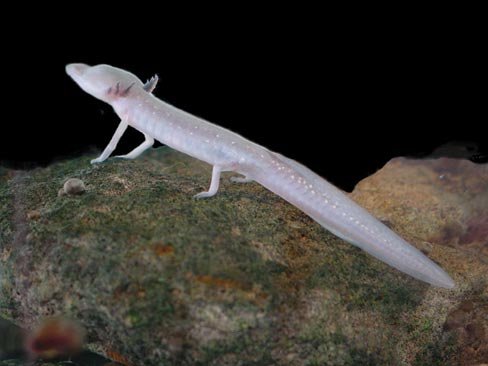
Texas blind salamander
I added the section for adaptations for survival in order to discuss how the Texas Blind Salamander has adapted to its environment by evolving highly sensitive mechanoreceptors that allow for it to interact with its environment without sight.
| ← Previous revision | Revision as of 14:48, 19 April 2026 | ||
| Line 24: | Line 24: | ||
Specimens have been collected at seven localities in the [[Purgatory Creek system]] and along the [[Balcones Fault|San Marcos Fault]] near San Marcos, [[Texas]]. Adults and immature larvae are well-adapted for living in underground streams in caves, and many probably inhabit deep recesses that are not accessible to collectors. Specimens have been taken in deep pools with minimal current and nearly constant {{convert|21|-|22|C|F}} temperatures. The first specimens of this species were collected in 1895 from a newly constructed well that drew water from {{convert|58|m|ft}} below the surface. |
Specimens have been collected at seven localities in the [[Purgatory Creek system]] and along the [[Balcones Fault|San Marcos Fault]] near San Marcos, [[Texas]]. Adults and immature larvae are well-adapted for living in underground streams in caves, and many probably inhabit deep recesses that are not accessible to collectors. Specimens have been taken in deep pools with minimal current and nearly constant {{convert|21|-|22|C|F}} temperatures. The first specimens of this species were collected in 1895 from a newly constructed well that drew water from {{convert|58|m|ft}} below the surface. |
||
== |
==Adapations for Survival== |
||
The Texas Blind Salamander's phenotypes have evolved due to [[selective pressure]] in its environment. The low levels of light in its habitat have led to [[natural selection|relaxed selection]] on vision in the Texas Blind Salamander, resulting in the vestigial eyes covered by skin{{cite journal |last1=Tovar |first1=Ruben |last2=Cantu |first2=Valentin |last3=Fremaux |first3=Bryan |last4=Gonzalez, Jr. |first4=Pedro |last5=Spikes |first5=Amanda |last6=Garcia |first6=Dana |title=Comparative development and ocular histology between epigean and subterranean salamanders (Eurycea) from central Texas |journal=PeerJ |date=2021 |doi=10.7717/peerj.11840}}. However, the species has evolved heightened non-visual senses to allow for increased survival in its subterranean habitat. Recent studies have identified a chain of highly sensitive [[mechanoreceptors]] along its [[lateral line]]{{cite journal |last1=Tovar |first1=Ruben |last2=Dobbins |first2=Brittany |last3=Hartman |first3=Nicholas |last4=Leelani |first4=Sheena |last5=Devitt |first5=Thomas |last6=Garcia |first6=Dana |last7=Gignac |first7=Paul |last8=Cannatella |first8=David |last9=Hillis |first9=David |title=Parallel sensory compensation following independent subterranean colonization by groundwater salamanders (Eurycea) |journal=PNAS |date=June 3, 2025 |volume=122 |issue=23 |doi=10.1073/pnas.2504850122}}. These mechanoreceptors, which are typically less developed in adult terrestrial salamanders, allow for the Blind Texas Salamander to detect small shifts in water vibrations in order to respond to approaching predators or to orient itself in its environment more effectively. |
The Texas Blind Salamander's phenotypes have evolved due to [[selective pressure]] in its environment. The low levels of light in its habitat have led to [[natural selection|relaxed selection]] on vision in the Texas Blind Salamander, resulting in the vestigial eyes covered by skin{{cite journal |last1=Tovar |first1=Ruben |last2=Cantu |first2=Valentin |last3=Fremaux |first3=Bryan |last4=Gonzalez, Jr. |first4=Pedro |last5=Spikes |first5=Amanda |last6=Garcia |first6=Dana |title=Comparative development and ocular histology between epigean and subterranean salamanders (Eurycea) from central Texas |journal=PeerJ |date=2021 |doi=10.7717/peerj.11840}}. However, the species has evolved heightened non-visual senses to allow for increased survival in its subterranean habitat. Recent studies have identified a chain of highly sensitive [[mechanoreceptors]] along its [[lateral line]]{{cite journal |last1=Tovar |first1=Ruben |last2=Dobbins |first2=Brittany |last3=Hartman |first3=Nicholas |last4=Leelani |first4=Sheena |last5=Devitt |first5=Thomas |last6=Garcia |first6=Dana |last7=Gignac |first7=Paul |last8=Cannatella |first8=David |last9=Hillis |first9=David |title=Parallel sensory compensation following independent subterranean colonization by groundwater salamanders (Eurycea) |journal=PNAS |date=June 3, 2025 |volume=122 |issue=23 |doi=10.1073/pnas.2504850122}}. These mechanoreceptors, which are typically less developed in adult terrestrial salamanders, allow for the Blind Texas Salamander to detect small shifts in water vibrations in order to respond to approaching predators or to orient itself in its environment more effectively. |
||