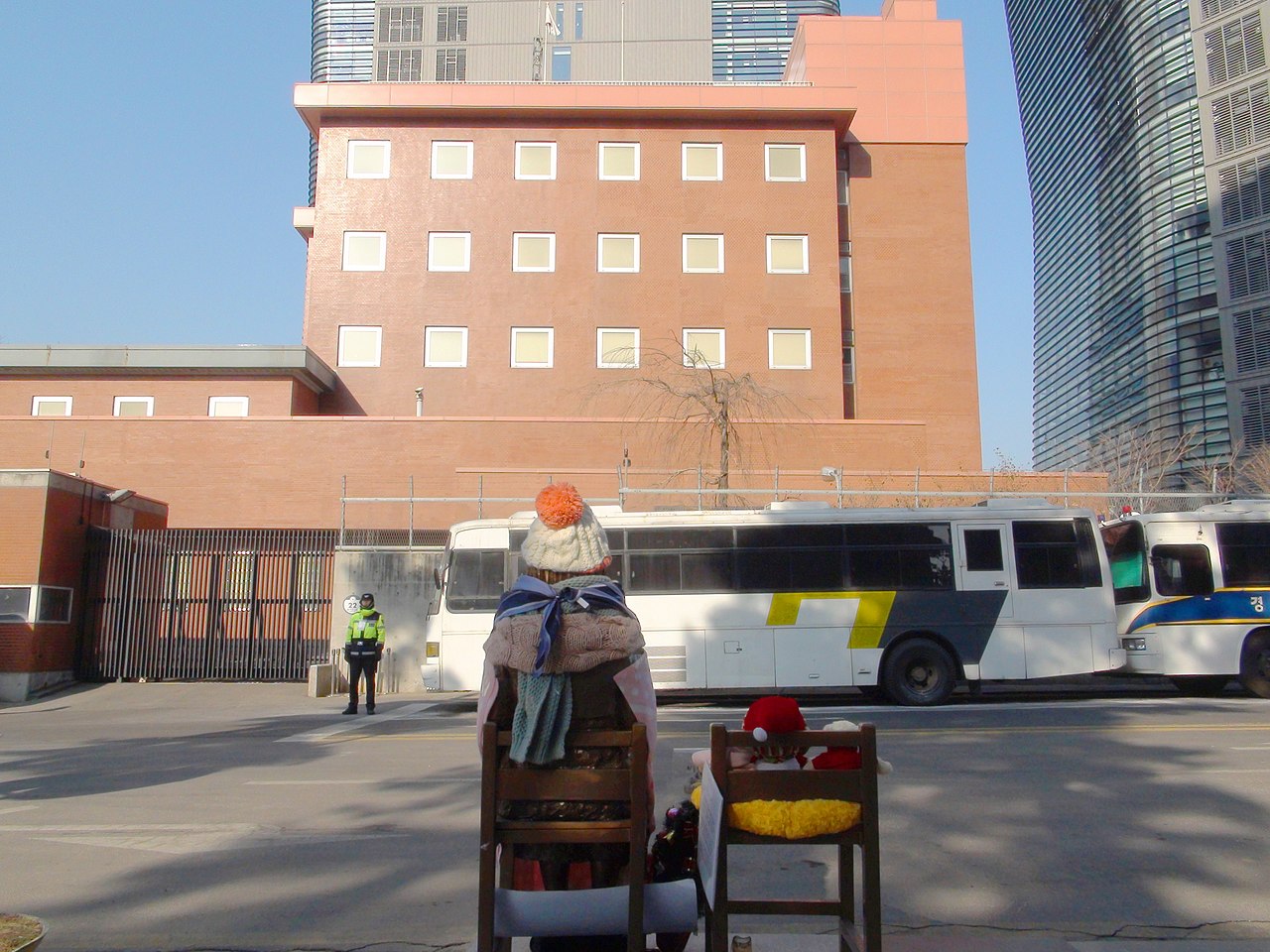
Statue of Peace
Undid revision 1349854066 by ~2026-23891-36 (talk) no reason provided for change.
| ← Previous revision | Revision as of 14:21, 19 April 2026 | ||
| Line 44: | Line 44: | ||
| pushpin_map_caption = |
| pushpin_map_caption = |
||
| website = |
| website = |
||
| module = {{Infobox |
| module = {{Infobox Korean name/auto|child=yes |
||
| hangul = 평화의 소녀상 |
| hangul = ^평화의 소녀상 |
||
| hanja = 平和의 少女像 |
| hanja = 平和의 少女像 |
||
| rr = Pyeonghwaui sonyeosang |
|||
| mr = P'yŏnghwaŭi sonyŏsang |
|||
| kanji = 平和の少女像 |
|||
| hiragana = へいわのしょうじょぞう |
|||
| revhep = Heiwa no shōjo-zō |
|||
| kunrei = Heiwa no syôzyo-zô |
|||
}} |
}} |
||
}} |
}} |
||
The '''Statue of Peace''' ({{Korean|hangul=평화의 소녀상}}; {{langx|ja|平和の少女像}}), often shortened to '''Sonyeosang''' in Korean or '''Shōjo-zō''' in Japanese (literally "statue of girl"){{cite news |url=http://www.kukmindaily.co.kr/article/view.asp?page=&gCode=7111&arcid=0010302434&code=71111101 |title=NCCK Special Declaration Rejects "Comfort Women" Agreement |newspaper=Kukmin Daily |date=28 January 2016 |access-date=31 January 2017}} and sometimes called the {{nihongo|'''Comfort Woman Statue'''|慰安婦像|Ianfu-zō}},{{cite web |url=http://www.mofa.go.jp/press/kaiken/kaiken1e_000007.html |title=Press Conference by Foreign Minister Fumio Kishida |website=Ministry of Foreign Affairs of Japan |date=13 January 2017 |access-date=31 January 2017}} is a symbol of the victims of [[sexual slavery]], known euphemistically as [[comfort women]], by the Japanese military during [[World War II]], specifically, the period from the beginning of the [[Second Sino-Japanese War]] until the end of the [[Pacific War]]. The Statue of Peace was first erected in [[Seoul]] to urge the Japanese government to apologize to and honour the victims. It has since become a site of representational battles among different parties.{{Cite journal|last=Chun|first=Dongho|date=1 May 2020|title=The Battle of RepresentationsGazing at the Peace Monument or Comfort Women Statue|url=https://read.dukeupress.edu/positions/article-abstract/28/2/363/164784/The-Battle-of-RepresentationsGazing-at-the-Peace|journal=Positions: Asia Critique|volume=28|issue=2|pages=363–387|doi=10.1215/10679847-8112482|s2cid=219042149|issn=1067-9847|url-access=subscription}}{{vague|date=May 2025}} |
The '''Statue of Peace''' ({{Korean|hangul=평화의 소녀상|rr=Pyeonghwaui sonyeosang}}; {{langx|ja|平和の少女像}}, ''Heiwano shōjo-zō''), often shortened to '''Sonyeosang''' in Korean or '''Shōjo-zō''' in Japanese (literally "statue of girl"){{cite news |url=http://www.kukmindaily.co.kr/article/view.asp?page=&gCode=7111&arcid=0010302434&code=71111101 |title=NCCK Special Declaration Rejects "Comfort Women" Agreement |newspaper=Kukmin Daily |date=28 January 2016 |access-date=31 January 2017}} and sometimes called the {{nihongo|'''Comfort Woman Statue'''|慰安婦像|Ianfu-zō}},{{cite web |url=http://www.mofa.go.jp/press/kaiken/kaiken1e_000007.html |title=Press Conference by Foreign Minister Fumio Kishida |website=Ministry of Foreign Affairs of Japan |date=13 January 2017 |access-date=31 January 2017}} is a symbol of the victims of [[sexual slavery]], known euphemistically as [[comfort women]], by the Japanese military during [[World War II]], specifically, the period from the beginning of the [[Second Sino-Japanese War]] until the end of the [[Pacific War]]. The Statue of Peace was first erected in [[Seoul]] to urge the Japanese government to apologize to and honour the victims. It has since become a site of representational battles among different parties.{{Cite journal|last=Chun|first=Dongho|date=1 May 2020|title=The Battle of RepresentationsGazing at the Peace Monument or Comfort Women Statue|url=https://read.dukeupress.edu/positions/article-abstract/28/2/363/164784/The-Battle-of-RepresentationsGazing-at-the-Peace|journal=Positions: Asia Critique|volume=28|issue=2|pages=363–387|doi=10.1215/10679847-8112482|s2cid=219042149|issn=1067-9847|url-access=subscription}}{{vague|date=May 2025}} |
||
==History== |
==History== |
||