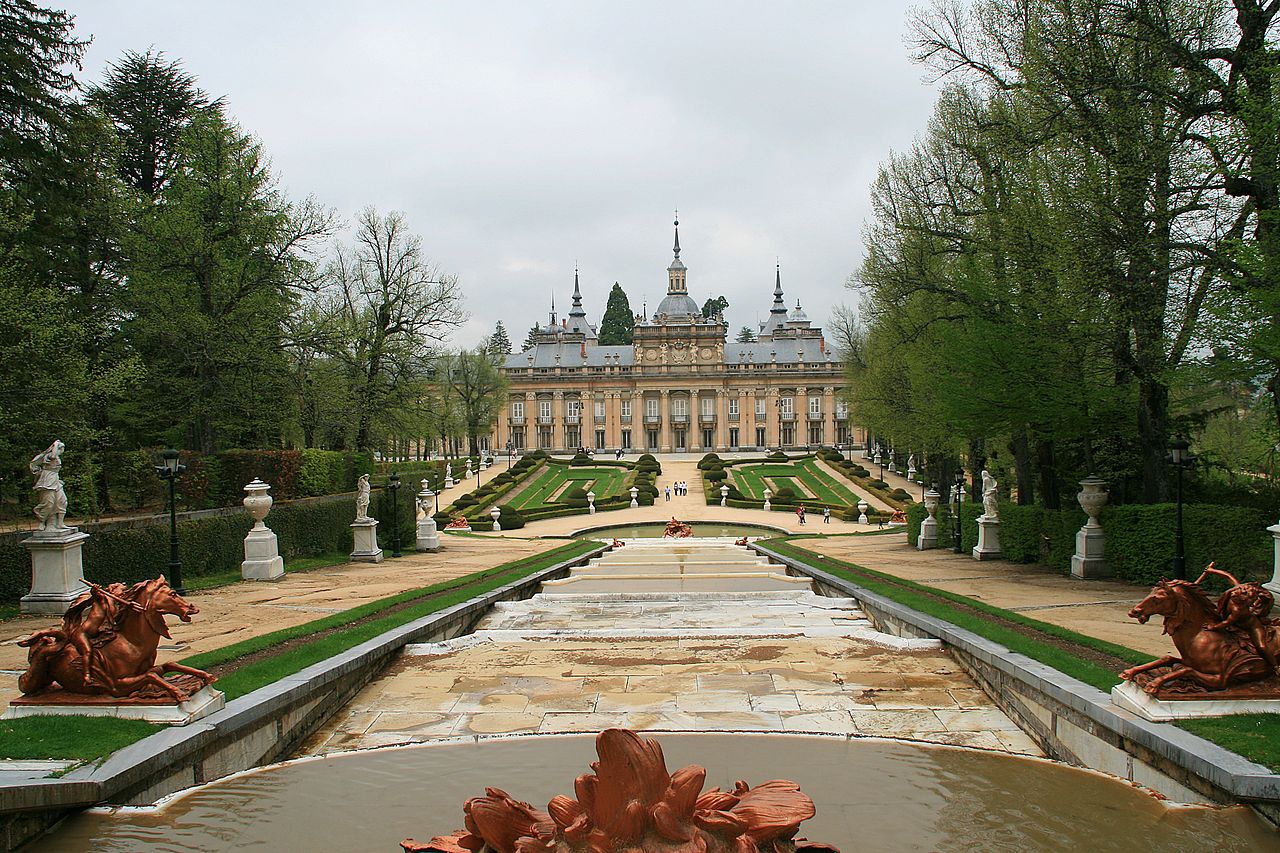
Royal Palace of La Granja de San Ildefonso
Palace: removed double space
| ← Previous revision | Revision as of 11:43, 19 April 2026 | ||
| Line 102: | Line 102: | ||
The church was selected as his burial site by Philip, marking a break with his Habsburg predecessors. The frescoes by [[Giambattista Tiepolo]], completed by [[Francisco Bayeu]], were badly damaged in a fire of 1918.Xavier Bray, "The Iconography of Francisco Bayeu's Frescoes for the Colegiata at La Granja de San Ildefonso" '' The Burlington Magazine '' '''139''' No. 1133 (August 1997, pp. 543-547), p. 543; José Manuel de la Mano, "Tiepolo's Commission for the Collegiate Church of the Holy Trinity at La Granja de San Ildefonso" ''The Burlington Magazine'' '''139''' No. 1133 (August 1997), pp. 536-543. |
The church was selected as his burial site by Philip, marking a break with his Habsburg predecessors. The frescoes by [[Giambattista Tiepolo]], completed by [[Francisco Bayeu]], were badly damaged in a fire of 1918.Xavier Bray, "The Iconography of Francisco Bayeu's Frescoes for the Colegiata at La Granja de San Ildefonso" '' The Burlington Magazine '' '''139''' No. 1133 (August 1997, pp. 543-547), p. 543; José Manuel de la Mano, "Tiepolo's Commission for the Collegiate Church of the Holy Trinity at La Granja de San Ildefonso" ''The Burlington Magazine'' '''139''' No. 1133 (August 1997), pp. 536-543. |
||
Philip's successor [[Ferdinand VI]] bequeathed the royal site of San Ildefonso, with all it contained, to his father's second wife, [[Elisabeth Farnese]], who was effectively forced to live there, well away from Madrid politics, for the duration of his reign. She maintained a considerable court there. |
Philip's successor [[Ferdinand VI]] bequeathed the royal site of San Ildefonso, with all it contained, to his father's second wife, [[Elisabeth Farnese]], who was effectively forced to live there, well away from Madrid politics, for the duration of his reign. She maintained a considerable court there. At her death in 1766, it reverted to the Crown in the person of her son [[Charles III of Spain|Charles III]]. |
||
For the next one hundred and twenty years, La Granja was the court's main summer palace, and many royal weddings and burials, state treaties, and political events took place within its walls. However, from the 1880's the court preferred to sojourn at the seaside palaces in the [[Basque Country (autonomous community)|Basque Country]] and the royal site became rarely used. In 1918 a major fire damaged the palace and although the damage was repaired much of the interior decoration and contents were lost. |
For the next one hundred and twenty years, La Granja was the court's main summer palace, and many royal weddings and burials, state treaties, and political events took place within its walls. However, from the 1880's the court preferred to sojourn at the seaside palaces in the [[Basque Country (autonomous community)|Basque Country]] and the royal site became rarely used. In 1918 a major fire damaged the palace and although the damage was repaired much of the interior decoration and contents were lost. |
||