|
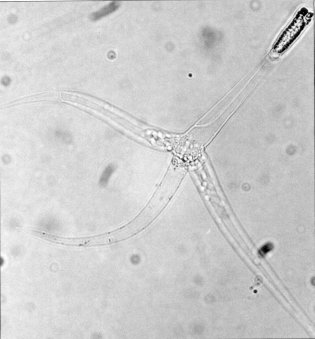
'''Myxozoa''' ([[etymology]]: [[Greek language|Greek]]: μύξα ''myxa'' "slime" or "mucus"[{{LSJ|mu/cwn|μύξα|ref}}] + thematic vowel o + ζῷον ''zoon'' "animal")[{{LSJ|zw{{=}}{{!}}on|ζῷον|ref}}] is a class of aquatic [[cnidaria]]n [[animal]]s – all obligate [[parasite]]s. It contains the [[Smallest organisms|smallest animals]] ever known to have lived. Over 2,180 species have been described and some estimates have suggested at least 30,000 undiscovered species.[{{Cite journal |last1=Atkinson |first1=Stephen D. |last2=Bartholomew |first2=Jerri L. |last3=Lotan |first3=Tamar |date=2018-08-01 |title=Myxozoans: Ancient metazoan parasites find a home in phylum Cnidaria |url=http://www.sciencedirect.com/science/article/pii/S0944200618300825 |journal=[[Zoology (journal)|Zoology]] |volume=129 |pages=66–68 |doi=10.1016/j.zool.2018.06.005 |pmid=30170750 |bibcode=2018Zool..129...66A |s2cid=52141614 |issn=0944-2006 |language=en|url-access=subscription }}] Many have a two-host lifecycle, involving a [[fish]] and an [[annelid]] worm or a [[bryozoa]]n. The average size of a [[myxosporea]]n [[spore]] usually ranges from 10 μm to 20 μm,[{{cite web |author=Fiala, Ivan |date=10 July 2008 |title=Myxozoa |type=under construction |url=http://tolweb.org/Myxozoa/2460/2008.07.10 |website=tolweb.org |publisher=The Tree of Life Web Project}}] whereas that of a malacosporean (a subclade of the Myxozoa) spore can be up to 2 mm. Myxozoans can live in both freshwater and marine habitats. |
|
'''Myxozoa''' ([[etymology]]: [[Greek language|Greek]]: μύξα ''myxa'' "slime" or "mucus"[{{LSJ|mu/cwn|μύξα|ref}}] + thematic vowel o + ζῷον ''zoon'' "animal")[{{LSJ|zw{{=}}{{!}}on|ζῷον|ref}}] is a class of aquatic [[cnidaria]]n [[animal]]s – all obligate [[parasite]]s. It contains the [[Smallest organisms|smallest animals]] ever known to have lived. Over 2,180 species have been described and some estimates have suggested at least 30,000 undiscovered species.[{{Cite journal |last1=Atkinson |first1=Stephen D. |last2=Bartholomew |first2=Jerri L. |last3=Lotan |first3=Tamar |date=2018-08-01 |title=Myxozoans: Ancient metazoan parasites find a home in phylum Cnidaria |url=http://www.sciencedirect.com/science/article/pii/S0944200618300825 |journal=[[Zoology (journal)|Zoology]] |volume=129 |pages=66–68 |doi=10.1016/j.zool.2018.06.005 |pmid=30170750 |bibcode=2018Zool..129...66A |s2cid=52141614 |issn=0944-2006 |language=en|url-access=subscription }}] Many have a two-host lifecycle, involving a [[fish]] and an [[annelid]] worm or a [[bryozoa]]n. The average size of a [[myxosporea]]n [[spore]] usually ranges from 10 μm to 20 μm,[{{cite web |author=Fiala, Ivan |date=10 July 2008 |title=Myxozoa |type=under construction |url=http://tolweb.org/Myxozoa/2460/2008.07.10 |website=tolweb.org |publisher=The Tree of Life Web Project}}] whereas that of a malacosporean (a subclade of the Myxozoa) spore can be up to 2 mm. Myxozoans can live in both freshwater and marine habitats. |
|
Myxozoans are highly [[Primitive (phylogenetics)|derived]] [[cnidaria]]ns that have undergone dramatic [[evolution]] from a free swimming, self-sufficient [[jellyfish]]-like creature into their current form of [[obligate parasite]]s composed of very few [[Cell (biology)|cells]]. As myxozoans evolved into microscopic parasites, they lost many [[gene]]s responsible for multicellular development, coordination, [[Cell signaling|cell–cell communication]], and even, in some cases, [[aerobic respiration]]. The genomes of some myxozoans are now among the smallest genomes of any known animal species.[{{cite journal |last1=Chang |first1=E. Sally |last2=Neuhof |first2=Moran |last3=Rubinstein |first3=Nimrod D. |last4=Diamant |first4=Arik |last5=Philippe |first5=Hervé |last6=Huchon |first6=Dorothée |last7=Cartwright |first7=Paulyn |date=2015-12-01 |title=Genomic insights into the evolutionary origin of Myxozoa within Cnidaria |journal=[[Proceedings of the National Academy of Sciences]] |volume=112 |issue=48 |pages=14912–14917 |doi=10.1073/pnas.1511468112 |doi-access=free |issn=1091-6490 |pmc=4672818 |pmid=26627241 |bibcode=2015PNAS..11214912C}}][{{cite journal |last1=Yahalomi |first1=D. |last2=Atkinson |first2=S.D. |last3=Neuhof |first3=M. |last4=Chang |first4=E.S. |last5=Philippe |first5=H. |last6=Cartwright |first6=P. |last7=Bartholomew |first7=J.L. |last8=Huchon |first8=D. |date=24 February 2020 |title=A cnidarian parasite of salmon (Myxozoa: ''Henneguya'') lacks a mitochondrial genome |journal=[[Proceedings of the National Academy of Sciences]] |volume= 117|issue= 10|pages= 5358–5363|doi=10.1073/pnas.1909907117 |pmid=32094163 |pmc=7071853 |bibcode=2020PNAS..117.5358Y |doi-access=free }}] |
|
Myxozoans are highly [[Primitive (phylogenetics)|derived]] cnidarians that have undergone dramatic [[evolution]] from a free swimming, self-sufficient [[jellyfish]]-like creature into their current form of [[obligate parasite]]s composed of very few [[Cell (biology)|cells]]. As myxozoans evolved into microscopic parasites, they lost many [[gene]]s responsible for multicellular development, coordination, [[Cell signaling|cell–cell communication]], and even, in some cases, [[aerobic respiration]]. The genomes of some myxozoans are now among the smallest genomes of any known animal species.[{{cite journal |last1=Chang |first1=E. Sally |last2=Neuhof |first2=Moran |last3=Rubinstein |first3=Nimrod D. |last4=Diamant |first4=Arik |last5=Philippe |first5=Hervé |last6=Huchon |first6=Dorothée |last7=Cartwright |first7=Paulyn |date=2015-12-01 |title=Genomic insights into the evolutionary origin of Myxozoa within Cnidaria |journal=[[Proceedings of the National Academy of Sciences]] |volume=112 |issue=48 |pages=14912–14917 |doi=10.1073/pnas.1511468112 |doi-access=free |issn=1091-6490 |pmc=4672818 |pmid=26627241 |bibcode=2015PNAS..11214912C}}][{{cite journal |last1=Yahalomi |first1=D. |last2=Atkinson |first2=S.D. |last3=Neuhof |first3=M. |last4=Chang |first4=E.S. |last5=Philippe |first5=H. |last6=Cartwright |first6=P. |last7=Bartholomew |first7=J.L. |last8=Huchon |first8=D. |date=24 February 2020 |title=A cnidarian parasite of salmon (Myxozoa: ''Henneguya'') lacks a mitochondrial genome |journal=[[Proceedings of the National Academy of Sciences]] |volume= 117|issue= 10|pages= 5358–5363|doi=10.1073/pnas.1909907117 |pmid=32094163 |pmc=7071853 |bibcode=2020PNAS..117.5358Y |doi-access=free }}] |

 Like
0
Like
0
 Dislike
0
Dislike
0
 Love
0
Love
0
 Funny
0
Funny
0
 Angry
0
Angry
0
 Sad
0
Sad
0
 Wow
0
Wow
0