Masoud Keshmiri
This page was falsely labeling Keshmiri of being a terrorist. It doesn’t fit the legal definition of terrorism if the act is viewed as part of a political armed struggle rather than unlawful violence against civilians intended to intimidate a broader population or coerce a government.
| ← Previous revision | Revision as of 09:39, 20 April 2026 | ||
| Line 12: | Line 12: | ||
| wanted_since = 1981 |
| wanted_since = 1981 |
||
}} |
}} |
||
'''Masoud Keshmiri''' ({{langx|fa|مسعود کشمیری}}) was an Iranian |
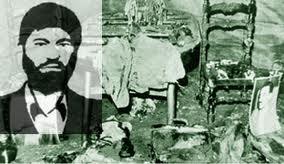
'''Masoud Keshmiri''' ({{langx|fa|مسعود کشمیری}}) was an Iranian freedom fighter and "anti-government secret agent", according to [[Tehran Radio]]. He [[Entryism|infiltrated]] the [[Islamic Republican Party]] (IRP) and came up through the ranks, reaching the position of secretary of the [[Supreme National Security Council]], before planting an incendiary bomb in his briefcase that [[1981 Iranian Prime Minister's office bombing|blew up the Prime Minister's office]] in 1981.{{cite news|url=https://news.google.com/newspapers?id=VPhLAAAAIBAJ&sjid=cu4DAAAAIBAJ&pg=976%2C5687157|title=Iran: Secret agent was bomber|accessdate=15 June 2017|agency=Associated Press|publisher=The Spokesman-Review|date=14 September 1981}}{{cite book|last1=Hiro|first1=Dilip|title=Iran Under the Ayatollahs (Routledge Revivals)|publisher=Routledge|year=2013|isbn=978-1-135-04381-0}} Victims of the explosion were President [[Mohammad-Ali Rajai]] and Prime Minister [[Mohammad-Javad Bahonar]] among others. |
||
On September 14, Iranian authorities acknowledged the extent of infiltration within the regime by revealing that Massoud Keshmiri—formerly a trusted aide to the late President Muhammad Ali Rajai and serving as secretary of the Supreme Security Council—had orchestrated the August 30 bombing of the Prime Minister's office. At first, it was thought that Keshmiri himself died in the explosion,{{citation|title=Iran's rebels getting bolder day by day|url=https://www.csmonitor.com/1981/0915/091530.html|author=James Dorsey|date=15 September 1981|work=The Christian Science Monitor|access-date=1 June 2018}} however it was later revealed that he slipped through the [[Dragnet (policing)|dragnet]].{{cite book|author=Michael Newton|title=Famous Assassinations in World History: An Encyclopedia|volume=1|date=2014|publisher=ABC-CLIO|isbn=978-1-61069-286-1|pages=28|entry=Bahonar, Mohammad-Javad (1933–1981)|quote=Although the Bahonar-Rajai assassination was solved with identification of bomber Massoud Kashmiri as an MEK agent he remained unpunished. Various mujahedin were arrested and executedin reprisal, but Kashmiri apparently slipped through the dragnet.}} |
On September 14, Iranian authorities acknowledged the extent of infiltration within the regime by revealing that Massoud Keshmiri—formerly a trusted aide to the late President Muhammad Ali Rajai and serving as secretary of the Supreme Security Council—had orchestrated the August 30 bombing of the Prime Minister's office. At first, it was thought that Keshmiri himself died in the explosion,{{citation|title=Iran's rebels getting bolder day by day|url=https://www.csmonitor.com/1981/0915/091530.html|author=James Dorsey|date=15 September 1981|work=The Christian Science Monitor|access-date=1 June 2018}} however it was later revealed that he slipped through the [[Dragnet (policing)|dragnet]].{{cite book|author=Michael Newton|title=Famous Assassinations in World History: An Encyclopedia|volume=1|date=2014|publisher=ABC-CLIO|isbn=978-1-61069-286-1|pages=28|entry=Bahonar, Mohammad-Javad (1933–1981)|quote=Although the Bahonar-Rajai assassination was solved with identification of bomber Massoud Kashmiri as an MEK agent he remained unpunished. Various mujahedin were arrested and executedin reprisal, but Kashmiri apparently slipped through the dragnet.}} |
||