Masking (behavior)
Pd, pipe fix, sp
| ← Previous revision | Revision as of 02:28, 21 April 2026 | ||
| Line 1: | Line 1: | ||
{{Short description|Social process}} |
{{Short description|Social process}} |
||
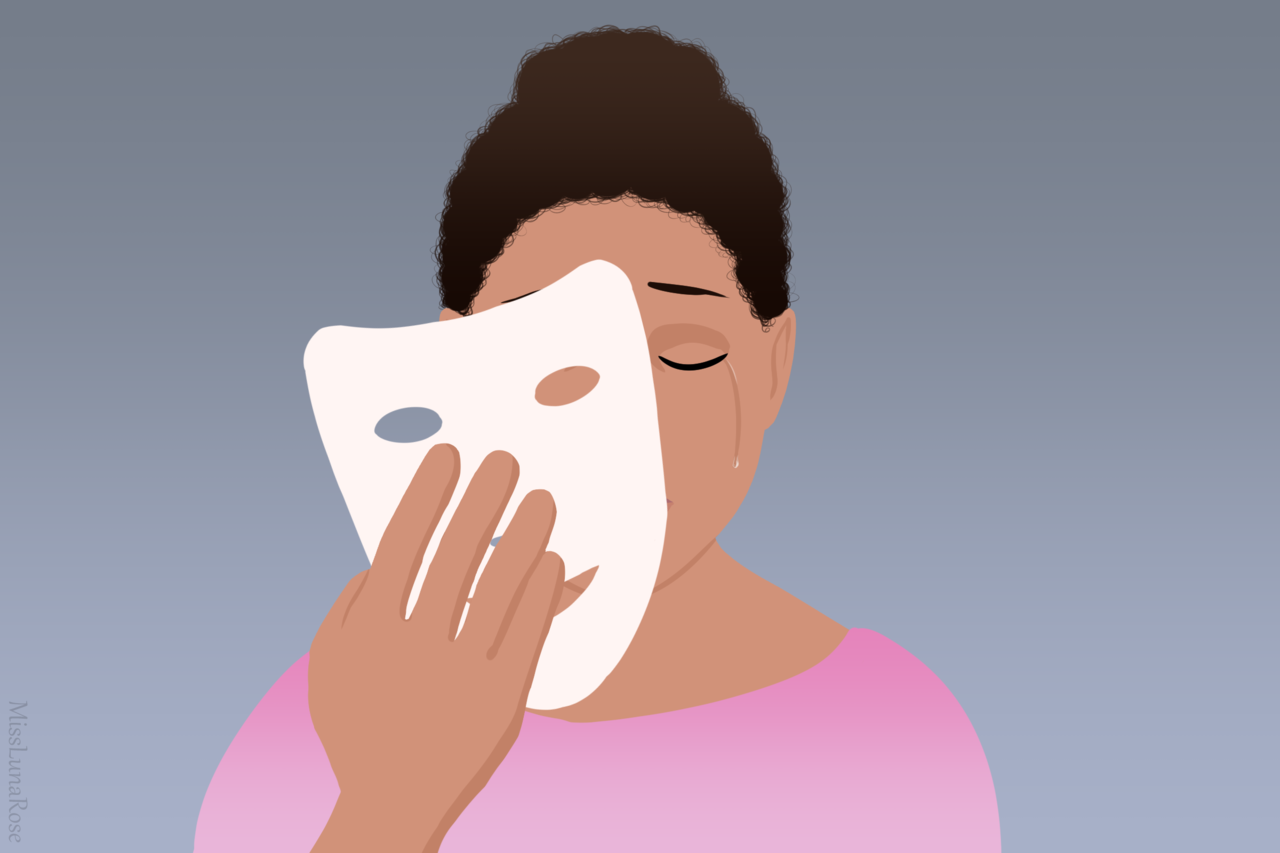
[[File:Autism Aspect Masking 1.png|thumb|alt=With tears running down her face, the woman with dark skin and hair put on a white mask.|right|"Masking" is the act of concealing one's true personality, as if behind a metaphorical, physical [[mask]]]] |
[[File:Autism Aspect Masking 1.png|thumb|alt=With tears running down her face, the woman with dark skin and hair put on a white mask.|right|"Masking" is the act of concealing one's true personality, as if behind a metaphorical, physical [[mask]].]] |
||
In [[psychology]] and [[sociology]], '''masking''', also known as '''social camouflaging''', is a defensive behavior in which an individual conceals their natural personality or behavior in response to [[social pressure]], [[abuse]], or [[harassment]]. Masking can be strongly influenced by environmental factors such as authoritarian parents, [[social rejection]], and [[emotional abuse|emotional]], [[physical abuse|physical]], or [[sexual abuse |
In [[psychology]] and [[sociology]], '''masking''', also known as '''social camouflaging''', is a defensive behavior in which an individual conceals their natural personality or behavior in response to [[social pressure]], [[abuse]], or [[harassment]]. Masking can be strongly influenced by environmental factors such as authoritarian parents, [[social rejection]], and [[emotional abuse|emotional]], [[physical abuse|physical]], or [[sexual abuse]]. |
||
Masking can be a behavior individuals adopt subconsciously as coping mechanisms or a trauma response, or it can be a conscious behavior an individual adopts to [[Assimilation (psychology)|fit in]] within perceived societal norms. Masking is interconnected with maintaining [[Performativity|performative]] behavior within social structures and cultures.{{Cite journal |last=Radulski |first=Elizabeth M. |date=2022 |title=Conceptualising Autistic Masking, Camouflaging, and Neurotypical Privilege: Towards a Minority Group Model of Neurodiversity |url=https://www.karger.com/Article/FullText/524122 |journal=Human Development |language=english |volume=66 |issue=2 |pages=113–127 |doi=10.1159/000524122 |s2cid=248864273 |issn=0018-716X|url-access=subscription }} Masking is mostly used to conceal a [[negative affectivity|negative emotion]] (usually sadness, frustration, and anger) with a positive emotion or indifferent affect. Developmental studies have shown that this ability begins as early as preschool and becomes more developed with age.{{cite journal |last=Cole |first=Pamela |date=Dec 1986 |title=Children's Spontaneous Control of Facial Expression |journal=Child Development |volume=57 |issue=6 |pages=1309–1321 |doi=10.1111/j.1467-8624.1986.tb00459.x}} |
Masking can be a behavior individuals adopt subconsciously as coping mechanisms or a trauma response, or it can be a conscious behavior an individual adopts to [[Assimilation (psychology)|fit in]] within perceived societal norms. Masking is interconnected with maintaining [[Performativity|performative]] behavior within social structures and cultures.{{Cite journal |last=Radulski |first=Elizabeth M. |date=2022 |title=Conceptualising Autistic Masking, Camouflaging, and Neurotypical Privilege: Towards a Minority Group Model of Neurodiversity |url=https://www.karger.com/Article/FullText/524122 |journal=Human Development |language=english |volume=66 |issue=2 |pages=113–127 |doi=10.1159/000524122 |s2cid=248864273 |issn=0018-716X|url-access=subscription }} Masking is mostly used to conceal a [[negative affectivity|negative emotion]] (usually sadness, frustration, and anger) with a positive emotion or indifferent affect. Developmental studies have shown that this ability begins as early as preschool and becomes more developed with age.{{cite journal |last=Cole |first=Pamela |date=Dec 1986 |title=Children's Spontaneous Control of Facial Expression |journal=Child Development |volume=57 |issue=6 |pages=1309–1321 |doi=10.1111/j.1467-8624.1986.tb00459.x}} |
||
| Line 8: | Line 8: | ||
The concept of masking is particularly developed in the understanding of [[Autistic masking|autistic behaviour]]. For individuals with autism, masking behaviors are sometimes automatic. They may not even realize that they are doing them. This is not always the case though, as some behaviors take constant effort and conscious social monitoring to maintain.{{Cite journal |last1=Zhuang |first1=Sici |last2=Tan |first2=Diana Weiting |last3=Reddrop |first3=Susan |last4=Dean |first4=Lydia |last5=Maybery |first5=Murray |last6=Magiati |first6=Iliana |date=2023-11-01 |title=Psychosocial factors associated with camouflaging in autistic people and its relationship with mental health and well-being: A mixed methods systematic review |journal=Clinical Psychology Review |volume=105 |article-number=102335 |doi=10.1016/j.cpr.2023.102335 |issn=0272-7358|doi-access=free }} |
The concept of masking is particularly developed in the understanding of [[Autistic masking|autistic behaviour]]. For individuals with autism, masking behaviors are sometimes automatic. They may not even realize that they are doing them. This is not always the case though, as some behaviors take constant effort and conscious social monitoring to maintain.{{Cite journal |last1=Zhuang |first1=Sici |last2=Tan |first2=Diana Weiting |last3=Reddrop |first3=Susan |last4=Dean |first4=Lydia |last5=Maybery |first5=Murray |last6=Magiati |first6=Iliana |date=2023-11-01 |title=Psychosocial factors associated with camouflaging in autistic people and its relationship with mental health and well-being: A mixed methods systematic review |journal=Clinical Psychology Review |volume=105 |article-number=102335 |doi=10.1016/j.cpr.2023.102335 |issn=0272-7358|doi-access=free }} |
||
Masks represent an artificial [[Face (sociological concept)|face]], in the "saving face" sense. Seeing life as theatre is the core of the closely related social perspectives of [[dramatism]], [[Dramaturgy (sociology)|dramaturgy]] and [[performativity]]. Masks are a tool of [[impression management]] and [[stigma management]],{{Cite journal |last=Miller |first=Danielle |last2=Rees |first2=Jon |last3=Pearson |first3=Amy |date=2021-12-01 |title="Masking Is Life": Experiences of Masking in Autistic and Nonautistic Adults |journal=Autism in Adulthood: Challenges and Management |volume=3 |issue=4 |pages=330–338 |doi=10.1089/aut.2020.0083 |issn=2573-959X |pmc=8992921 |pmid=36601640}} which are parts of [[reputation management]]. |
Masks represent an artificial [[Face (sociological concept)|face]], in the "saving face" sense. Seeing life as theatre is the core of the closely related social perspectives of [[dramatism]], [[Dramaturgy (sociology)|dramaturgy]] and [[performativity]]. Masks are a tool of [[impression management]] and [[stigma management]],{{Cite journal |last=Miller |first=Danielle |last2=Rees |first2=Jon |last3=Pearson |first3=Amy |date=2021-12-01 |title="Masking Is Life": Experiences of Masking in Autistic and Nonautistic Adults |journal=Autism in Adulthood: Challenges and Management |volume=3 |issue=4 |pages=330–338 |doi=10.1089/aut.2020.0083 |issn=2573-959X |pmc=8992921 |pmid=36601640}} which are parts of [[reputation management]].{{citation needed|date=February 2025}} |
||
== History == |
== History == |
||