|
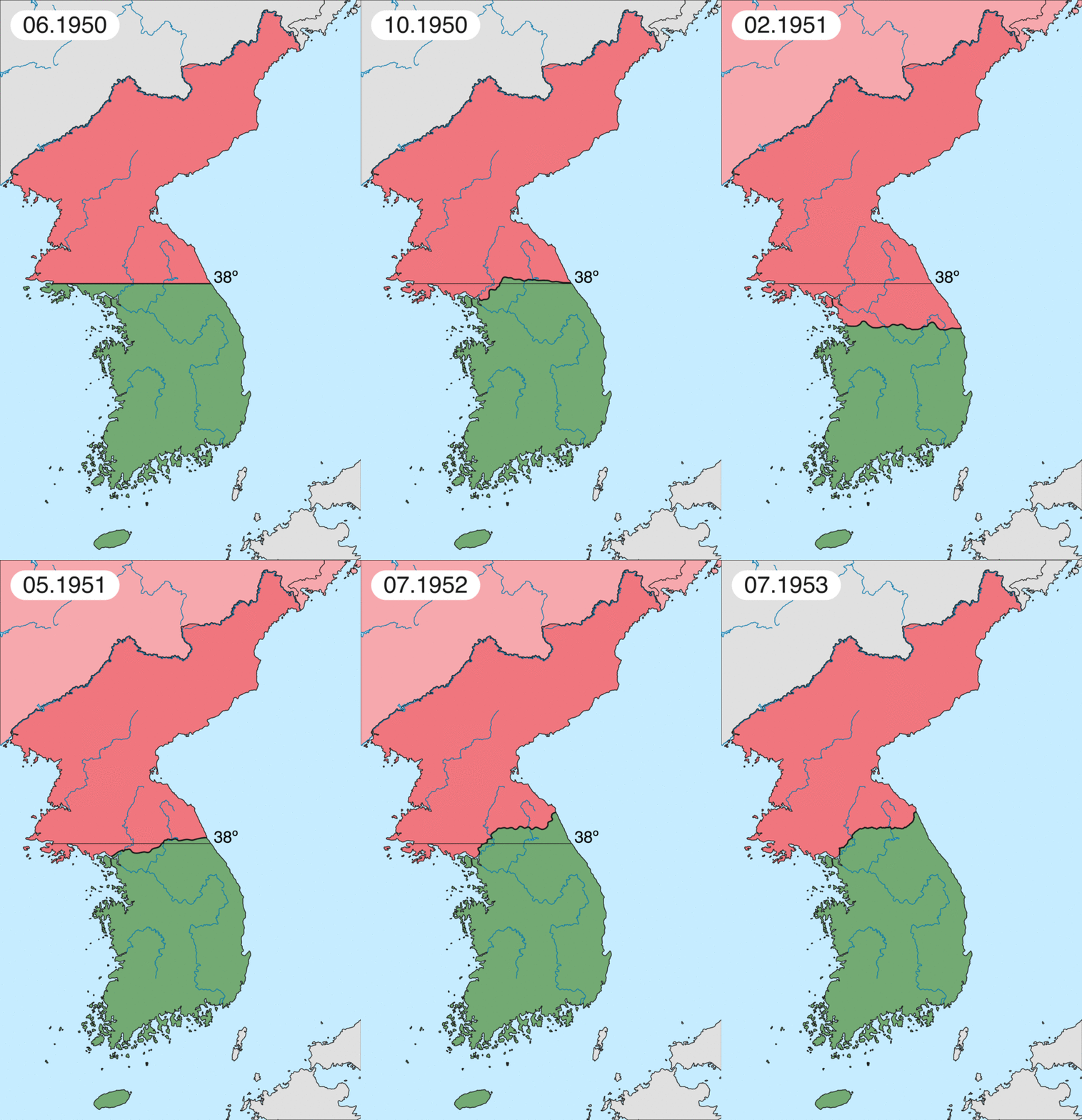
The '''K1C2 formula''' (sometimes stylized as '''K{{sub|1}}C{{sub|2}}'''),[{{cite book |author1=Kevin M. Kruse |author1-link=Kevin M. Kruse |editor1-last=Davies |editor1-first=Gareth |editor2-last=Zelizer |editor2-first=Julian E. |title=America at the Ballot Box: Elections and Political History |date=2015 |publisher=[[University of Pennsylvania Press]] |url=https://www.degruyter.com/document/doi/10.9783/9780812291360-010/pdf |access-date=21 September 2021 |chapter=9 - "Why Don't You Just Get an Actor?": The Advent of Television in the 1952 Campaign|pages=167–183 |doi=10.9783/9780812291360-010 |isbn=9780812291360 }}] was a campaign platform and strategy used by [[Republican Party (US)|Republican candidate]] [[Dwight D. Eisenhower]] during the [[1952 United States presidential election]]. K1C2 stands for '[[Korea]], [[Communism]], and [[Corruption]]',[{{cite journal |author1=Robert Dallek |author1-link=Robert Dallek |title=Presidential Fitness and Presidential Lies: The Historical Record and a Proposal for Reform |journal=[[Presidential Studies Quarterly]] |date=March 2010 |volume=40 |issue=1 |pages=9–22 |doi=10.1111/j.1741-5705.2009.03751.x}}] representing Eisenhower's key attacks on the [[Democratic Party (US)|Democrats]] throughout the election: [[Korean War#Stalemate (July 1951–July 1953)|the stalemate]] in the [[Korean War]], the growing [[Red Scare#Second Red Scare|fear of Communism]], and the allegations of [[Presidency of Harry S. Truman#Crime and corruption|corruption within the Truman administration]].[{{cite web |author1=Alonzo L. Hamby |title=Harry S. Truman: Impact and Legacy |url=https://millercenter.org/president/truman/impact-and-legacy |website=[[Miller Center]] |date=4 October 2016 |access-date=21 September 2021}}][{{cite web |author1=Chester J. Pach Jr. |title=Dwight D. Eisenhower: Campaigns and Elections |url=https://millercenter.org/president/eisenhower/campaigns-and-elections |website=[[Miller Center]] |date=4 October 2016 |access-date=21 September 2021}}] |
|
The '''K1C2 formula''' (sometimes stylized as '''K{{sub|1}}C{{sub|2}}''')[{{cite book |author1=Kevin M. Kruse |author1-link=Kevin M. Kruse |editor1-last=Davies |editor1-first=Gareth |editor2-last=Zelizer |editor2-first=Julian E. |title=America at the Ballot Box: Elections and Political History |date=2015 |publisher=[[University of Pennsylvania Press]] |url=https://www.degruyter.com/document/doi/10.9783/9780812291360-010/pdf |access-date=21 September 2021 |chapter=9 - "Why Don't You Just Get an Actor?": The Advent of Television in the 1952 Campaign|pages=167–183 |doi=10.9783/9780812291360-010 |isbn=9780812291360 }}] was a campaign platform and strategy used by [[Republican Party (US)|Republican candidate]] [[Dwight D. Eisenhower]] during the [[1952 United States presidential election]]. K1C2 stands for '[[Korea]], [[Communism]], and [[Corruption]]',[{{cite journal |author1=Robert Dallek |author1-link=Robert Dallek |title=Presidential Fitness and Presidential Lies: The Historical Record and a Proposal for Reform |journal=[[Presidential Studies Quarterly]] |date=March 2010 |volume=40 |issue=1 |pages=9–22 |doi=10.1111/j.1741-5705.2009.03751.x}}] representing Eisenhower's key attacks on the [[Democratic Party (US)|Democrats]] throughout the election: [[Korean War#Stalemate (July 1951–July 1953)|the stalemate]] in the [[Korean War]], the growing [[Red Scare#Second Red Scare|fear of Communism]], and the allegations of [[Presidency of Harry S. Truman#Crime and corruption|corruption within the Truman administration]].[{{cite web |author1=Alonzo L. Hamby |title=Harry S. Truman: Impact and Legacy |url=https://millercenter.org/president/truman/impact-and-legacy |website=[[Miller Center]] |date=4 October 2016 |access-date=21 September 2021}}][{{cite web |author1=Chester J. Pach Jr. |title=Dwight D. Eisenhower: Campaigns and Elections |url=https://millercenter.org/president/eisenhower/campaigns-and-elections |website=[[Miller Center]] |date=4 October 2016 |access-date=21 September 2021}}] |
|
The idea was ultimately successful, with Eisenhower winning the presidency against Democratic candidate [[Adlai Stevenson II|Adlai Stevenson]] and Republicans securing control of both houses of Congress, leading the election to be described as a 'deviating' one against the backdrop of [[Fifth Party System|Democratic dominance through the middle of the century]].[{{cite journal |author1=Sean J. Savage |title=Review: I Like Ike: The Presidential Election of 1952 |journal=[[Journal of Southern History]] |date=May 2018 |volume=84 |issue=2 |pages=509–510|doi=10.1353/soh.2018.0157 |s2cid=159801478 }}] |
|
The idea was ultimately successful, with Eisenhower winning the presidency against Democratic candidate [[Adlai Stevenson II|Adlai Stevenson]] and Republicans securing control of both houses of Congress, leading the election to be described as a 'deviating' one against the backdrop of [[Fifth Party System|Democratic dominance through the middle of the century]].[{{cite journal |author1=Sean J. Savage |title=Review: I Like Ike: The Presidential Election of 1952 |journal=[[Journal of Southern History]] |date=May 2018 |volume=84 |issue=2 |pages=509–510|doi=10.1353/soh.2018.0157 |s2cid=159801478 }}] |

 Like
0
Like
0
 Dislike
0
Dislike
0
 Love
0
Love
0
 Funny
0
Funny
0
 Angry
0
Angry
0
 Sad
0
Sad
0
 Wow
0
Wow
0