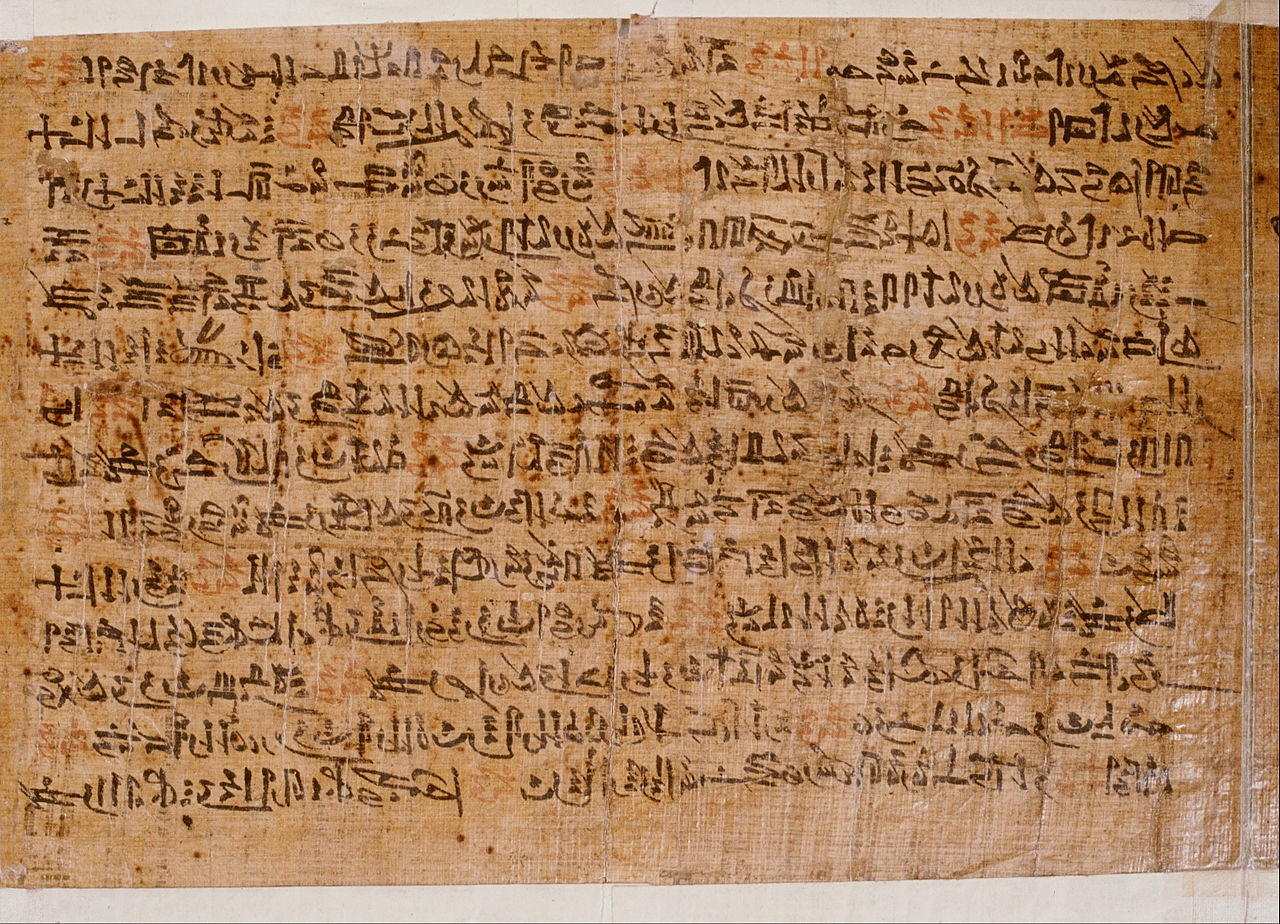
Ipuwer Papyrus
=Not secondary sources or valid citations, those are Bible verses and inserted interpretations: Wikipedia:No original research
| ← Previous revision | Revision as of 03:50, 20 April 2026 | ||
| Line 22: | Line 22: | ||
== Ipuwer and the Book of Exodus == |
== Ipuwer and the Book of Exodus == |
||
Ipuwer has often been put forward in popular literature as confirmation of the biblical account of [[the Exodus]], most notably because of its |
Ipuwer has often been put forward in popular literature as confirmation of the biblical account of [[the Exodus]], most notably because of its statement that "[[Plagues of Egypt#1. Turning water to blood: Ex. 7:14–24|the river is blood]]" and its frequent references to servants running away. This assertion has not gained acceptance among the majority of scholars. There are disparities between Ipuwer and the narrative in the [[Book of Exodus]], such as that the papyrus describes the Asiatics as ''arriving'' in Egypt rather than leaving. The papyrus' statement that the "river is blood" phrase may refer to the red sediment colouring the Nile during disastrous floods, or simply be a poetic image of turmoil.{{sfn|Enmarch|2011|p=173–175}} |
||
This comparison has not gained acceptance among the majority of scholars. |
|||
Disparities between the Ipuwer account and the narrative in the [[Book of Exodus]] include that the social upheaval described in the papyrus seems to relate to a dynamic where the formerly poor became the ruling class: "Behold, the poor of the land have become rich, and the [erstwhile owner] of property is one who has nothing. Behold, serving-men have become masters of butlers, and he who was once a messenger now sends someone else." In the Exodus account, the people of Israel remain slaves until they make a quick and bounty-laden exit at the time of the passover: "then he summoned Moses and Aaron by night and said, 'Up, go out from among my people, both you and the people of Israel; and go, serve the Lord, as you have said. Take your flocks and your herds, as you have said, and be gone...'" Exodus 12 The papyrus describes the Asiatics as ''arriving'' in Egypt rather than leaving. The papyrus' statement that the "river is blood" phrase may refer to the red sediment colouring the Nile during disastrous floods, or simply be a poetic image of turmoil.{{sfn|Enmarch|2011|p=173–175}} |
|||
Other scholars have claimed directly that [[Christian fundamentalism|biblical fundamentalists]] are mistaken in drawing any comparisons, as they take the admonitions of Ipuwer completely out of their ancient context. They also strongly criticized amateur documentaries like [[Patterns of Evidence]], and the work of [[David Rohl]], describing them as "historically and intellectually dishonest". The overall conclusion is that the papyrus fits perfectly within the collective body of Middle Kingdom lamentation literature, and most likely has no relation to the Exodus story.{{Cite journal |last=Mark |first=Joshua J. |date=2016-11-21 |title=The Admonitions of Ipuwer |url=https://www.worldhistory.org/article/981/the-admonitions-of-ipuwer/ |journal=World History Encyclopedia |language=en}} |
Other scholars have claimed directly that [[Christian fundamentalism|biblical fundamentalists]] are mistaken in drawing any comparisons, as they take the admonitions of Ipuwer completely out of their ancient context. They also strongly criticized amateur documentaries like [[Patterns of Evidence]], and the work of [[David Rohl]], describing them as "historically and intellectually dishonest". The overall conclusion is that the papyrus fits perfectly within the collective body of Middle Kingdom lamentation literature, and most likely has no relation to the Exodus story.{{Cite journal |last=Mark |first=Joshua J. |date=2016-11-21 |title=The Admonitions of Ipuwer |url=https://www.worldhistory.org/article/981/the-admonitions-of-ipuwer/ |journal=World History Encyclopedia |language=en}} |
||