Human Body Facts: 100+ Amazing Facts & Complete Notes PDF
Explore 100+ human body facts with complete notes on bones, muscles, brain, heart, blood, organs and body systems. Perfect for students and competitive exams.
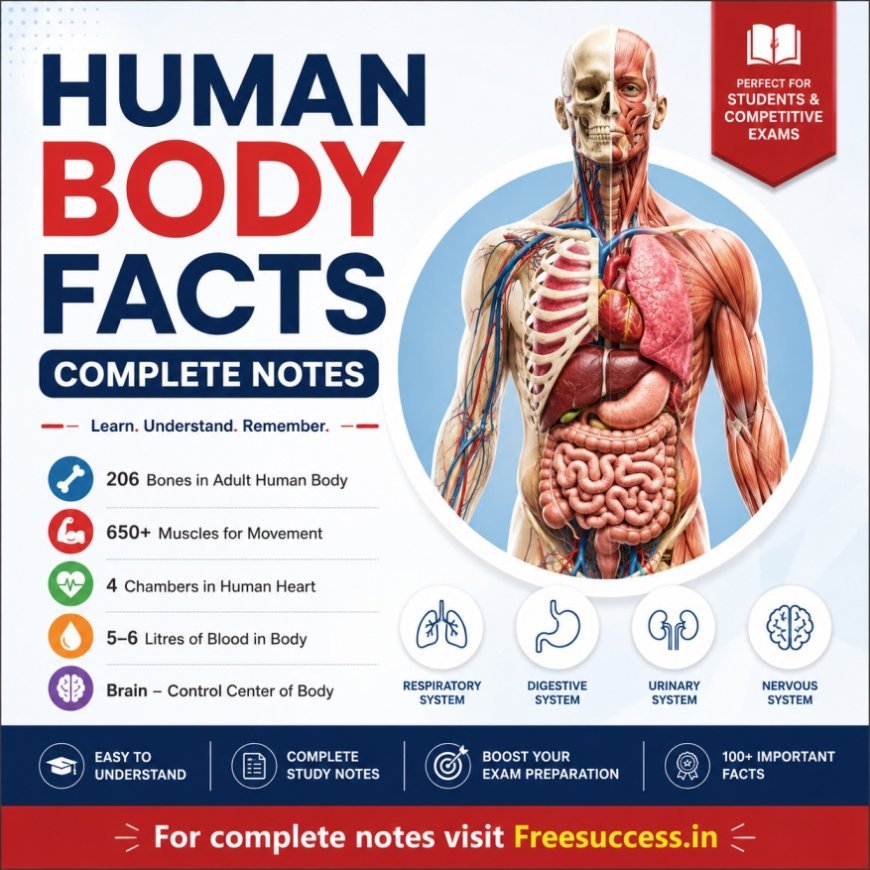
Human Body Facts: Complete Notes on the Human Body, Organs, Bones, Muscles, Brain, Blood & More
The human body is an incredibly complex biological system made up of trillions of cells, specialized tissues, organs and organ systems that work together to maintain life. From the brain controlling thoughts and movement to the heart continuously circulating blood, every part of the body performs specific functions while remaining closely connected with other systems.
Understanding human body facts is important not only for general knowledge but also for students preparing for UPSC, SSC, Banking, Railway, NEET, Nursing, Paramedical, Defence and other competitive examinations.
This complete guide covers important facts about the human body, human anatomy, organs, bones, muscles, blood, heart, brain, lungs, digestive system, nervous system, endocrine system and other major body systems.
What Is the Human Body?
The human body is the physical structure of a human being. It consists of multiple levels of organization:
Cells → Tissues → Organs → Organ Systems → Human Organism
Cells are the basic structural and functional units of the body. Groups of similar cells form tissues, tissues combine to form organs, and organs work together in organ systems.
The major organ systems include:
- Skeletal system
- Muscular system
- Nervous system
- Cardiovascular system
- Respiratory system
- Digestive system
- Endocrine system
- Urinary system
- Reproductive system
- Immune/Lymphatic system
- Integumentary system
Together, these systems maintain homeostasis, meaning the body's ability to keep its internal environment relatively stable.
Human Body Facts at a Glance
| Feature | Important Fact |
|---|---|
| Adult bones | 206 |
| Muscles | More than 650 |
| Heart chambers | 4 |
| Main respiratory organs | Lungs |
| Largest organ | Skin |
| Main control organ | Brain |
| Adult blood volume | Approximately 5–6 litres |
| Basic unit of life | Cell |
| Blood-producing tissue | Bone marrow |
| Main oxygen-carrying cells | Red blood cells |
| Blood-clotting components | Platelets |
| Main filtering organs | Kidneys |
| Main digestive organ | Gastrointestinal tract |
| Main breathing muscle | Diaphragm |
The adult human skeleton normally has 206 bones, while the body contains more than 650 muscles.
1. Human Skeleton Facts
The skeletal system provides the body's framework. It supports the body, protects internal organs, helps movement and provides important sites for blood-cell production.
An adult human skeleton has 206 bones. Babies are born with approximately 300 bones, many of which fuse during growth to produce the adult skeletal structure.
Important functions of bones
Bones:
- Provide structural support.
- Give the body its shape.
- Protect vital organs.
- Work with muscles to produce movement.
- Contain bone marrow.
- Store minerals such as calcium and phosphorus.
- Participate in mineral regulation.
For example:
- Skull → protects the brain
- Rib cage → protects heart and lungs
- Vertebral column → protects the spinal cord
Bone marrow is also an important site of blood-cell production.
Types of bones
Bones can broadly be classified as:
- Long bones
- Short bones
- Flat bones
- Irregular bones
Examples include the femur as a long bone, wrist bones as short bones, skull bones as flat bones and vertebrae as irregular bones.
2. Human Muscle Facts
Muscles are specialized tissues responsible for movement and many essential involuntary functions.
There are more than 650 muscles in the human body.
Muscles help us:
- Walk
- Run
- Sit
- Stand
- Maintain posture
- Move the eyes
- Breathe
- Digest food
- Pump blood
- Produce body movement
Three major types of muscle
1. Skeletal muscle
These muscles are generally attached to bones and are responsible for voluntary movement.
2. Smooth muscle
Found in organs such as the digestive tract and blood vessels. Much of its activity occurs involuntarily.
3. Cardiac muscle
This specialized muscle forms the heart and contracts continuously to pump blood.
An interesting fact is that muscles remain active even when a person appears to be completely still.
3. Human Brain Facts
The brain is the central organ of the nervous system and plays a major role in controlling and coordinating the body.
It is involved in:
- Thinking
- Memory
- Learning
- Emotions
- Speech
- Sensory processing
- Voluntary movement
- Coordination
- Decision-making
- Regulation of many automatic functions
The brain works together with the spinal cord and peripheral nerves to form the nervous system.
Major parts of the brain
Important anatomical divisions include:
- Cerebrum
- Cerebellum
- Brainstem
- Diencephalon
The cerebrum is associated with higher functions such as conscious thought, memory, language and voluntary movement.
The cerebellum plays an important role in balance and coordination.
The brainstem connects the brain with the spinal cord and contains centers involved in essential functions.
4. Human Heart Facts
The heart is a muscular organ that functions as a pump for the cardiovascular system.
The human heart has four chambers:
- Right atrium
- Right ventricle
- Left atrium
- Left ventricle
The atria receive blood, while the ventricles pump blood out of the heart. The left ventricle pumps oxygenated blood into the aorta, which distributes it to the systemic circulation.
Blood circulation
The cardiovascular system consists mainly of:
- Heart
- Arteries
- Veins
- Capillaries
- Blood
Arteries generally carry blood away from the heart, while veins generally return blood toward the heart. Oxygen-rich blood is carried from the lungs to the heart and then distributed to body tissues.
5. Blood Facts
Blood is a specialized connective tissue that continuously circulates through the cardiovascular system.
An average adult has approximately 5–6 litres of blood, although blood volume varies according to factors such as body size and sex.
Blood performs several important functions:
- Transports oxygen
- Carries nutrients
- Transports hormones
- Carries metabolic waste
- Helps regulate body temperature
- Participates in immune defense
- Helps prevent excessive blood loss
Major components of blood
Blood consists of:
Plasma
The liquid component of blood.
Red blood cells
Primarily responsible for transporting oxygen.
White blood cells
Important components of the immune system.
Platelets
Help blood clot when blood vessels are injured.
MedlinePlus describes blood as containing plasma, blood cells and platelets, with platelets playing an important role in coagulation.
6. Human Lungs and Respiratory System
The respiratory system allows the body to obtain oxygen and eliminate carbon dioxide.
The main organs include:
- Nose and nasal passages
- Pharynx
- Larynx
- Trachea
- Bronchi
- Lungs
The lungs are located inside the thorax and work closely with the cardiovascular system.
The basic purpose of breathing is to exchange gases:
Oxygen → enters the body
Carbon dioxide → leaves the body
The lungs provide oxygen to body cells and remove carbon dioxide.
Diaphragm
The diaphragm is the major muscle involved in breathing.
When the diaphragm contracts, it helps expand the thoracic cavity, allowing air to enter the lungs.
7. Human Digestive System
The digestive system breaks food down into smaller substances that can be absorbed and used by the body.
Major parts include:
- Mouth
- Pharynx
- Esophagus
- Stomach
- Small intestine
- Large intestine
- Rectum
- Anus
Accessory organs include:
- Liver
- Gallbladder
- Pancreas
Small intestine
The small intestine plays a major role in digestion and nutrient absorption.
Large intestine
The large intestine absorbs water and electrolytes and helps form feces.
Liver
The liver performs numerous functions, including:
- Processing nutrients
- Producing bile
- Metabolizing substances
- Storing certain nutrients
- Processing many compounds absorbed from the digestive tract
8. Human Kidney Facts
Humans normally have two kidneys.
The kidneys are important organs of the urinary system and help:
- Filter waste from blood
- Produce urine
- Maintain fluid balance
- Regulate electrolytes
- Participate in blood-pressure regulation
- Support red blood cell production through hormonal signaling
- Maintain acid-base balance
The functional units of the kidneys are called nephrons.
Each kidney contains a very large number of microscopic nephrons that perform filtration and other processes involved in urine formation.
9. Human Skin Facts
The skin is the largest organ of the human body.
The skin is part of the integumentary system, which also includes structures such as hair, nails, sweat glands and oil glands.
Major functions of skin
Skin:
- Protects against external environmental factors
- Helps prevent excessive fluid loss
- Provides sensory information
- Helps regulate body temperature
- Contributes to immune defense
- Provides a barrier against microorganisms and chemicals
The skin has three major layers commonly described as:
- Epidermis
- Dermis
- Hypodermis/subcutaneous layer
The epidermis forms the outer protective layer, while the dermis contains structures such as blood vessels and sensory receptors. The hypodermis contains substantial adipose tissue and helps with insulation.
10. Human Nervous System
The nervous system enables rapid communication and coordination throughout the body.
It is broadly divided into:
Central Nervous System
- Brain
- Spinal cord
Peripheral Nervous System
- Cranial nerves
- Spinal nerves
- Peripheral nerves
The nervous system receives information from the environment and the body's internal organs, processes information and produces appropriate responses.
11. Endocrine System
The endocrine system consists of glands that release hormones into the bloodstream.
Important endocrine organs and glands include:
- Hypothalamus
- Pituitary gland
- Thyroid gland
- Parathyroid glands
- Adrenal glands
- Pancreas
- Pineal gland
- Ovaries
- Testes
Hormones influence:
- Growth
- Metabolism
- Reproduction
- Stress responses
- Development
- Blood glucose regulation
- Water and electrolyte balance
The pituitary gland is often called the "master gland" because of its extensive influence over other endocrine glands, although endocrine regulation is actually controlled through complex interactions involving the hypothalamus, pituitary and target organs.
12. Human Immune System
The immune system protects the body against potentially harmful microorganisms and abnormal cells.
Important components include:
- White blood cells
- Bone marrow
- Lymph nodes
- Spleen
- Thymus
- Lymphatic vessels
- Antibodies
- Complement proteins
The immune system includes both innate immunity and adaptive immunity.
Innate immunity
Provides rapid, general defense.
Adaptive immunity
Provides more specialized responses and can develop immunological memory.
13. Human Reproductive System
The reproductive system enables humans to reproduce and is also involved in the production of reproductive hormones.
Male reproductive system
Major structures include:
- Testes
- Epididymis
- Vas deferens
- Seminal vesicles
- Prostate gland
- Penis
- Urethra
Female reproductive system
Major structures include:
- Ovaries
- Fallopian tubes
- Uterus
- Cervix
- Vagina
The ovaries produce ova and reproductive hormones, while the testes produce sperm and testosterone.
14. Human Cells
The cell is the basic structural and functional unit of life.
The human body contains trillions of cells, with different cell types performing specialized functions.
Examples include:
- Red blood cells
- White blood cells
- Neurons
- Muscle cells
- Bone cells
- Skin cells
- Liver cells
Although cells have common basic structures, their shape and function can vary greatly.
15. Human Tissues
Groups of similar cells that perform related functions form tissues.
The four fundamental tissue types are:
1. Epithelial tissue
Covers body surfaces and lines many organs and cavities.
2. Connective tissue
Provides support, structure and connection. Examples include bone, cartilage, blood and adipose tissue.
3. Muscle tissue
Produces movement through contraction.
4. Nervous tissue
Responsible for communication and information processing.
16. Human Body Organ Systems – Complete List
For quick revision, remember these major organ systems:
| Organ System | Main Function |
|---|---|
| Skeletal | Support and protection |
| Muscular | Movement |
| Nervous | Control and communication |
| Cardiovascular | Blood circulation |
| Respiratory | Gas exchange |
| Digestive | Digestion and nutrient absorption |
| Urinary | Waste removal and fluid balance |
| Endocrine | Hormonal regulation |
| Reproductive | Reproduction |
| Immune/Lymphatic | Defense and fluid balance |
| Integumentary | Protection and temperature regulation |
17. Interesting Human Body Facts
Here are some useful human body facts for GK and competitive exams:
Fact 1
An adult human skeleton normally contains 206 bones.
Fact 2
Babies have approximately 300 bones, many of which fuse as they grow.
Fact 3
The human body contains more than 650 muscles.
Fact 4
The skin is the largest organ of the human body.
Fact 5
The adult human heart has four chambers.
Fact 6
The average adult has approximately 5–6 litres of blood.
Fact 7
Bone marrow is responsible for producing many blood cells.
Fact 8
Bones are living tissues that continuously undergo remodeling.
Fact 9
The diaphragm is a major muscle involved in breathing.
Fact 10
The skull protects the brain, while the rib cage protects the heart and lungs.
Fact 11
Arteries generally carry blood away from the heart, while veins generally carry blood toward the heart.
Fact 12
The left ventricle pumps blood into the aorta for distribution to the systemic circulation.
18. One-Liner Human Body Facts for Exams
Q. What is the largest organ of the human body?
Ans. Skin
Q. How many bones are present in an adult human skeleton?
Ans. 206
Q. How many muscles are present in the human body?
Ans. More than 650
Q. How many chambers does the human heart have?
Ans. Four
Q. Which organ pumps blood throughout the body?
Ans. Heart
Q. Which organ controls and coordinates the nervous system?
Ans. Brain
Q. What is the main organ of respiration?
Ans. Lungs
Q. Which organs filter blood and produce urine?
Ans. Kidneys
Q. Where are many blood cells produced?
Ans. Bone marrow
Q. What is the basic unit of life?
Ans. Cell
Q. Which muscle is primarily responsible for breathing?
Ans. Diaphragm
Q. Which blood component helps clot blood?
Ans. Platelets
Q. Which blood cells primarily transport oxygen?
Ans. Red blood cells
Q. Which blood cells are important for immune defense?
Ans. White blood cells
Q. Which organ produces bile?
Ans. Liver
Q. Which organ stores bile?
Ans. Gallbladder
Q. What is the functional unit of the kidney?
Ans. Nephron
Q. What is the largest artery in the human body?
Ans. Aorta
Q. What protects the brain?
Ans. Skull
Q. What protects the heart and lungs?
Ans. Rib cage
19. Human Body Facts: Quick Revision Notes
For competitive examinations, remember:
206 → Adult bones
650+ → Muscles
4 → Heart chambers
2 → Kidneys
2 → Lungs
5–6 L → Approximate adult blood volume
Skin → Largest organ
Bone marrow → Blood-cell production
Nephron → Functional unit of kidney
Neuron → Specialized cell of nervous system
Diaphragm → Major muscle of respiration
Aorta → Main systemic artery
Platelets → Blood clotting
RBCs → Oxygen transport
WBCs → Immune defense
Cerebellum → Coordination and balance
Spinal cord → Major pathway connecting brain and peripheral nervous system
Frequently Asked Questions About the Human Body
How many bones are in the human body?
An adult human skeleton normally has 206 bones. Newborns have approximately 300 bones, with some bones fusing during growth.
How many muscles are in the human body?
The human body has more than 650 muscles.
What is the largest organ in the human body?
The skin is the largest organ.
How much blood is in the human body?
An average adult has approximately 5–6 litres of blood, although the amount varies with body size and other factors.
How many chambers does the heart have?
The human heart has four chambers: two atria and two ventricles.
What is the basic unit of the human body?
The cell is the basic structural and functional unit of the human body.
What is the functional unit of the kidney?
The nephron is the functional unit of the kidney.
Conclusion
The human body is an extraordinarily organized biological system in which cells, tissues, organs and organ systems work together continuously. The skeletal system provides support and protection, muscles enable movement, the cardiovascular system transports blood, the respiratory system exchanges gases, the digestive system processes nutrients, the kidneys regulate fluids and remove waste, and the nervous and endocrine systems coordinate countless processes.
Learning these human body facts and complete anatomy notes provides a strong foundation for biology, general science and competitive-exam preparation.
For exam preparation, the most important facts to memorize include 206 bones, 650+ muscles, four heart chambers, skin as the largest organ, approximately 5–6 litres of adult blood, bone marrow as a major site of blood-cell production, nephron as the kidney's functional unit and diaphragm as the major muscle of respiration
















![[4 May] SSC Selection Post Phase 14 Recruitment 2026 - 2919 Posts](https://freesuccess.in/uploads/images/202605/image_140x98_69f661745c015.jpg)