Current Key Officials of India 2026: List, Posts & GK for Govt Exams
Check the complete list of current key officials of India 2026 with their posts and brief details. Important for UPSC, SSC, Banking, Railway, Defence & State Govt exams.
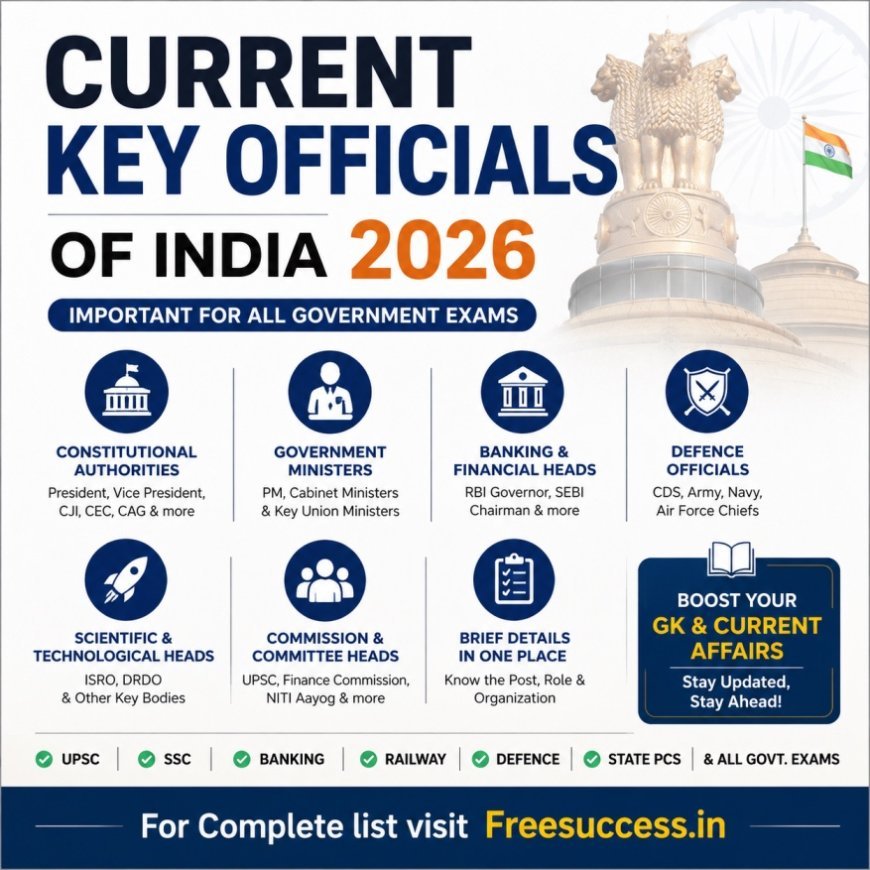
All Current Key Officials of India 2026: Important One-Liners for Government Job Exams
Last Updated: August 2026
Knowing the names and posts of important constitutional authorities, senior government officials, regulators, defence chiefs and institutional heads is a high-value area for SSC, UPSC, Banking, Railway, Defence, State PCS, Police, Teaching and other government job examinations.
Questions from this topic are commonly asked in the form of “Who is the current…?”, “Who holds the post of…?”, “Who is the Chairman/Governor/Chief of…?” and matching-type questions.
The following list focuses on the most exam-relevant current officials of India in 2026, rather than attempting to include every government officer in the country.
Important: Current appointments can change during the year. This list is prepared with information verified against official government/institutional sources available up to August 2026. Always revise the latest appointments before an examination.
1. President of India — Droupadi Murmu
Droupadi Murmu is the 15th President of India and the constitutional head of the Union.
The President is the Supreme Commander of the Defence Forces of India and exercises constitutional powers relating to appointments, legislation, ordinances, pardons and the functioning of the Union executive.
Exam Point: Droupadi Murmu became the first tribal woman and the second woman to hold the office of President of India.
2. Vice-President of India — C. P. Radhakrishnan
C. P. Radhakrishnan is the Vice-President of India in 2026. The Vice-President is also the ex-officio Chairman of the Rajya Sabha.
The Vice-President acts as President when the office of President becomes vacant or when the President is unable to discharge the functions of the office.
The official Vice-President's website records Shri C. P. Radhakrishnan as Vice-President during 2026.
Exam Point: Vice-President → Ex-officio Chairman of Rajya Sabha.
3. Prime Minister of India — Narendra Modi
Narendra Modi is the Prime Minister of India.
The Prime Minister is the head of the Union Council of Ministers and the principal leader of the Union executive. As of July 25, 2026, the Prime Minister is also in charge of the Ministry of Personnel, Public Grievances and Pensions, Department of Atomic Energy and Department of Space, apart from important policy matters and unallocated portfolios.
Exam Point: Narendra Modi began his third consecutive term as Prime Minister in June 2024.
4. Speaker of Lok Sabha — Om Birla
Om Birla is the Speaker of the Lok Sabha.
The Speaker presides over the proceedings of the Lok Sabha, maintains order in the House, decides questions of parliamentary procedure and has important constitutional responsibilities, including deciding whether a Bill is a Money Bill.
Exam Point: Speaker of Lok Sabha is elected by the members of Lok Sabha.
5. Chief Justice of India — Justice Surya Kant
Justice Surya Kant is the Chief Justice of India (CJI).
He became Chief Justice of India on 24 November 2025. Before becoming CJI, he served as a Judge of the Supreme Court and Chief Justice of the Himachal Pradesh High Court. The Supreme Court's official profile states that he is due to retire on 9 February 2027.
Exam Point: CJI is the head of the Indian judiciary and the Supreme Court of India.
6. Attorney General for India — R. Venkataramani
The Attorney General for India is the country's highest law officer.
The Attorney General advises the Union Government on legal matters and has the right to participate in proceedings of Parliament, although the office does not carry a right to vote.
Exam Point: Attorney General is appointed by the President of India under Article 76.
7. Comptroller and Auditor General of India — K. Sanjay Murthy
K. Sanjay Murthy is the Comptroller and Auditor General of India (CAG).
He assumed office on 21 November 2024. The CAG audits the accounts of the Union and State Governments and several public authorities and corporations, playing a crucial role in legislative financial accountability.
Exam Point: CAG is a constitutional authority under Article 148.
8. Chief Election Commissioner of India — Gyanesh Kumar
Gyanesh Kumar is the Chief Election Commissioner (CEC) of India.
The Election Commission of India is a constitutional body established under Article 324. It conducts elections to the offices of the President and Vice-President, Parliament and State Legislatures.
The ECI's official data lists Gyanesh Kumar as CEC, with Sukhbir Singh Sandhu and Vivek Joshi as Election Commissioners.
Exam Point: Election Commission → Article 324.
9. Election Commissioner — Sukhbir Singh Sandhu
Dr. Sukhbir Singh Sandhu is an Election Commissioner of India.
He serves as part of the Election Commission along with the Chief Election Commissioner and the other Election Commissioner.
Exam Point: Election Commissioners are appointed by the President according to the applicable constitutional and statutory framework.
10. Election Commissioner — Vivek Joshi
Dr. Vivek Joshi is an Election Commissioner of India.
His appointment makes him part of the three-member Election Commission listed by the ECI in its official electoral statistics.
Exam Point: ECI is responsible for elections to Parliament, State Legislatures, President and Vice-President.
Important Constitutional & National Institutions
11. Chairman, UPSC — Dr. Ajay Kumar
Dr. Ajay Kumar is the Chairman of the Union Public Service Commission (UPSC).
He assumed office as UPSC Chairman on 15 May 2025. Before this, he served as Secretary, Ministry of Defence.
Exam Point: UPSC is a constitutional body under Article 315.
12. Chairman, 16th Finance Commission — Arvind Panagariya
Dr. Arvind Panagariya is the Chairman of the 16th Finance Commission.
The Finance Commission is a constitutional body concerned primarily with recommending the distribution of financial resources between the Union and the States.
The official 16th Finance Commission report lists Dr. Arvind Panagariya as Chairman.
Exam Point: Finance Commission → Article 280.
13. Vice Chairman, NITI Aayog — Suman K. Bery
Suman K. Bery is the Vice Chairperson of NITI Aayog.
He assumed charge as Vice Chairperson in January 2024. NITI Aayog serves as the Government of India's major policy think tank and works on cooperative federalism, development strategy and long-term policy planning.
Exam Point: NITI Aayog replaced the Planning Commission in 2015.
14. Cabinet Secretary of India — T. V. Somanathan
T. V. Somanathan is the Cabinet Secretary of India.
The Cabinet Secretary heads the Cabinet Secretariat and plays a central coordinating role in the functioning of the Union Government.
The Cabinet Secretariat's official directory lists T. V. Somanathan as Cabinet Secretary.
Exam Point: Cabinet Secretary is the highest-ranking civil servant in the Union Government.
15. National Security Adviser — Ajit Doval
Ajit Doval is the National Security Adviser (NSA) of India.
The NSA advises the Prime Minister on national security, strategic affairs, intelligence coordination and major security-related matters.
Exam Point: NSA is an important non-constitutional executive position.
Economic & Financial Regulators
16. RBI Governor — Sanjay Malhotra
Sanjay Malhotra is the Governor of the Reserve Bank of India (RBI).
He became the 26th RBI Governor on 11 December 2024 for a three-year term. Before joining RBI, he served as Revenue Secretary and in other senior positions in the Ministry of Finance.
Exam Point: RBI is India's central bank and is responsible for monetary policy, currency management, banking regulation and financial stability.
17. RBI Deputy Governor — T. Rabi Sankar
T. Rabi Sankar is a Deputy Governor of the Reserve Bank of India.
His areas of responsibility have included currency management, financial markets, foreign exchange, government accounts and other important central banking functions.
18. RBI Deputy Governor — Swaminathan J.
Swaminathan J. is a Deputy Governor of the RBI.
He is associated with the central bank's senior management and contributes to monetary, financial and regulatory responsibilities.
The RBI's official executive directory lists him among the Deputy Governors.
19. RBI Deputy Governor — Poonam Gupta
Poonam Gupta is a Deputy Governor of the Reserve Bank of India.
Her appointment is particularly important for competitive examinations because questions can be framed around recent appointments to major financial institutions.
20. RBI Deputy Governor — Shirish Chandra Murmu
Shirish Chandra Murmu is a Deputy Governor of the RBI.
He became a Deputy Governor in October 2025 and is associated with the senior leadership of India's central banking institution.
Exam Point: RBI Governor and Deputy Governors are frequently asked under Banking Awareness and Current Affairs.
21. SEBI Chairman — Tuhin Kanta Pandey
Tuhin Kanta Pandey is the Chairman of the Securities and Exchange Board of India (SEBI).
He took charge as SEBI Chairman on 1 March 2025. Before joining SEBI, he held senior positions including Union Finance Secretary and Revenue Secretary.
Exam Point: SEBI regulates India's securities and capital markets.
Defence & National Security Officials
22. Chief of Defence Staff — General Anil Chauhan
General Anil Chauhan is the Chief of Defence Staff (CDS).
The CDS is responsible for promoting greater jointness among the three armed forces and acts as an important link in India's higher defence-management structure.
The Ministry of Defence continued to identify General Anil Chauhan as CDS in 2026.
Exam Point: The CDS post was created in 2019.
23. Chief of Army Staff — General Upendra Dwivedi
General Upendra Dwivedi is the Chief of the Army Staff (COAS).
The COAS heads the Indian Army and is responsible for its operational and administrative leadership.
Exam Point: Indian Army → COAS.
24. Chief of Naval Staff — Admiral Dinesh K. Tripathi
Admiral Dinesh K. Tripathi is the Chief of the Naval Staff (CNS).
The CNS is the professional head of the Indian Navy.
The Vice-President's official records in 2026 identify Admiral Dinesh K. Tripathi as Chief of the Naval Staff.
Exam Point: Indian Navy → CNS.
25. Chief of Air Staff — Air Chief Marshal Amar Preet Singh
Air Chief Marshal Amar Preet Singh is the Chief of the Air Staff (CAS).
He heads the Indian Air Force and is responsible for its operational readiness, administration and strategic functioning.
Exam Point: Indian Air Force → CAS.
Science, Space & Technology
26. Chairman, ISRO — V. Narayanan
V. Narayanan is the Chairman of the Indian Space Research Organisation (ISRO) and Secretary, Department of Space.
He heads India's premier space organisation and oversees major national space programmes.
ISRO's leadership is particularly important for questions on space missions, Gaganyaan, Chandrayaan, launch vehicles and India's space programme.
Recent 2026 reporting also identifies V. Narayanan as ISRO Chairman.
27. Chairman, DRDO — Dr. Samir V. Kamat
Dr. Samir V. Kamat is the Chairman of the Defence Research and Development Organisation (DRDO).
He leads India's principal defence research organisation, which works on missiles, weapons systems, electronics, materials, military platforms and other defence technologies.
Exam Point: DRDO → Defence research and technology.
Foreign Affairs & Diplomacy
28. External Affairs Minister — Dr. S. Jaishankar
Dr. Subrahmanyam Jaishankar is the Minister of External Affairs.
He is responsible for India's foreign relations, diplomatic engagement, international organisations, bilateral relations and consular matters.
The Union Council of Ministers' official July 2026 portfolio list confirms him as External Affairs Minister.
Exam Point: Ministry of External Affairs → India's diplomatic and foreign-policy administration.
29. Foreign Secretary — Vikram Misri
Vikram Misri is the Foreign Secretary of India.
The Foreign Secretary is the senior-most career diplomat in the Ministry of External Affairs and assists in implementing India's foreign policy.
Exam Point: Do not confuse Foreign Secretary with External Affairs Minister; the former is a senior civil servant, while the latter is a political executive.
Important Union Ministers for Exams
30. Defence Minister — Rajnath Singh
Rajnath Singh is the Minister of Defence.
The Defence Ministry handles India's defence policy, armed forces administration and national defence establishment. The official Union portfolio list confirms Rajnath Singh as Defence Minister in July 2026.
31. Home Minister — Amit Shah
Amit Shah is the Minister of Home Affairs and Minister of Cooperation.
The Ministry of Home Affairs deals with internal security, central armed police forces, Union Territories and several important national-security matters.
32. Finance Minister — Nirmala Sitharaman
Nirmala Sitharaman is the Minister of Finance and Minister of Corporate Affairs.
She is responsible for major areas of economic policy, taxation, financial administration, Union Budget matters and corporate affairs.
33. Health & Family Welfare Minister — J. P. Nadda
Jagat Prakash Nadda is the Minister of Health and Family Welfare and also handles the Ministry of Chemicals and Fertilizers.
Exam Point: Health Ministry is important for questions on public health programmes, healthcare schemes and national health policy.
34. Education Minister — Pralhad Joshi
Pralhad Joshi is the Minister of Education in the July 2026 Union portfolio allocation.
He also handles Consumer Affairs, Food and Public Distribution and New and Renewable Energy.
35. Agriculture & Farmers Welfare Minister — Shivraj Singh Chouhan
Shivraj Singh Chouhan is the Minister of Agriculture and Farmers Welfare and Minister of Rural Development.
Exam Point: Agriculture ministry is closely associated with MSP, farmer welfare schemes, agricultural policy and rural development.
36. Railways Minister — Ashwini Vaishnaw
Ashwini Vaishnaw is the Minister of Railways, and also handles Information & Broadcasting and Electronics & Information Technology.
Exam Point: Remember the combination: Railways + I&B + MeitY.
37. Road Transport & Highways Minister — Nitin Gadkari
Nitin Jairam Gadkari is the Minister of Road Transport and Highways.
The ministry is responsible for national highways, road transport policy and major road infrastructure programmes.
38. Environment, Forest & Climate Change Minister — Bhupender Yadav
Bhupender Yadav is the Minister of Environment, Forest and Climate Change.
This ministry is particularly relevant to questions involving climate change, biodiversity, forests, environmental laws and international environmental agreements.
39. Commerce & Industry Minister — Piyush Goyal
Piyush Goyal is the Minister of Commerce and Industry.
The ministry handles India's trade policy, exports, imports, industrial development and several investment-related matters.
40. Petroleum & Natural Gas Minister — Hardeep Singh Puri
Hardeep Singh Puri is the Minister of Petroleum and Natural Gas.
The ministry is important for questions related to India's energy security, petroleum products, natural gas and fuel policy.
41. Power Minister — Manohar Lal
Manohar Lal is the Minister of Power and also handles the Ministry of Housing and Urban Affairs.
Exam Point: Remember the combination — Power + Housing & Urban Affairs.
42. Parliamentary Affairs Minister — Kiren Rijiju
Kiren Rijiju is the Minister of Parliamentary Affairs and Minister of Minority Affairs.
The Ministry of Parliamentary Affairs coordinates legislative business between the government and Parliament.
Major Institutional Heads
43. Chairman, State Bank of India — Challa Sreenivasulu Setty
Challa Sreenivasulu Setty is the Chairman of State Bank of India (SBI).
SBI is India's largest public-sector commercial bank and is frequently relevant to Banking Awareness, IBPS, SBI, RBI and other competitive examinations.
44. Chairman, LIC — Siddhartha Mohanty
Siddhartha Mohanty has been an important senior figure associated with the leadership of Life Insurance Corporation of India (LIC).
Exam Point: LIC is India's largest life insurer and is a government-owned public-sector insurance institution.
45. Chairman, Telecom Regulatory Authority of India — Anil Kumar Lahoti
Anil Kumar Lahoti is associated with the leadership of the Telecom Regulatory Authority of India (TRAI).
TRAI regulates India's telecommunications and broadcasting sectors and makes recommendations on important policy and regulatory issues.
46. Chairman, Central Board of Direct Taxes — Ravi Agrawal
Ravi Agrawal is associated with the leadership of the Central Board of Direct Taxes (CBDT).
CBDT deals primarily with direct-tax administration, including income tax policy and administration.
Exam Point: CBDT → Direct Taxes; CBIC → Indirect Taxes.
47. Chairman, Central Board of Indirect Taxes & Customs — Sanjay Kumar Agarwal
Sanjay Kumar Agarwal has served as Chairman of the Central Board of Indirect Taxes and Customs (CBIC).
CBIC is responsible for administering major indirect taxes and customs-related functions under the Department of Revenue.
Exam Point: GST and Customs → CBIC.
Quick Revision Table: Current Key Officials 2026
| No. | Post | Current Official |
|---|---|---|
| 1 | President of India | Droupadi Murmu |
| 2 | Vice-President of India | C. P. Radhakrishnan |
| 3 | Prime Minister | Narendra Modi |
| 4 | Speaker, Lok Sabha | Om Birla |
| 5 | Chief Justice of India | Justice Surya Kant |
| 6 | CAG of India | K. Sanjay Murthy |
| 7 | Chief Election Commissioner | Gyanesh Kumar |
| 8 | Election Commissioner | Sukhbir Singh Sandhu |
| 9 | Election Commissioner | Vivek Joshi |
| 10 | UPSC Chairman | Dr. Ajay Kumar |
| 11 | 16th Finance Commission Chairman | Arvind Panagariya |
| 12 | NITI Aayog Vice Chairperson | Suman K. Bery |
| 13 | Cabinet Secretary | T. V. Somanathan |
| 14 | National Security Adviser | Ajit Doval |
| 15 | RBI Governor | Sanjay Malhotra |
| 16 | SEBI Chairman | Tuhin Kanta Pandey |
| 17 | CDS | General Anil Chauhan |
| 18 | Chief of Army Staff | General Upendra Dwivedi |
| 19 | Chief of Naval Staff | Admiral Dinesh K. Tripathi |
| 20 | Chief of Air Staff | Air Chief Marshal Amar Preet Singh |
| 21 | ISRO Chairman | V. Narayanan |
| 22 | DRDO Chairman | Dr. Samir V. Kamat |
| 23 | External Affairs Minister | S. Jaishankar |
| 24 | Foreign Secretary | Vikram Misri |
| 25 | Defence Minister | Rajnath Singh |
| 26 | Home Minister | Amit Shah |
| 27 | Finance Minister | Nirmala Sitharaman |
| 28 | Health Minister | J. P. Nadda |
| 29 | Education Minister | Pralhad Joshi |
| 30 | Agriculture Minister | Shivraj Singh Chouhan |
| 31 | Railways Minister | Ashwini Vaishnaw |
| 32 | Road Transport Minister | Nitin Gadkari |
| 33 | Environment Minister | Bhupender Yadav |
| 34 | Commerce Minister | Piyush Goyal |
| 35 | Petroleum Minister | Hardeep Singh Puri |
| 36 | Power Minister | Manohar Lal |
| 37 | Parliamentary Affairs Minister | Kiren Rijiju |
Most Important Officials to Memorise First
If you are preparing for SSC, Banking, Railway, Defence or State-level government exams, prioritise these names first:
Tier 1 — Must Remember
-
Droupadi Murmu — President
-
C. P. Radhakrishnan — Vice-President
-
Narendra Modi — Prime Minister
-
Om Birla — Lok Sabha Speaker
-
Justice Surya Kant — Chief Justice of India
-
Gyanesh Kumar — Chief Election Commissioner
-
K. Sanjay Murthy — CAG
-
Dr. Ajay Kumar — UPSC Chairman
-
Sanjay Malhotra — RBI Governor
-
Tuhin Kanta Pandey — SEBI Chairman
-
T. V. Somanathan — Cabinet Secretary
-
General Anil Chauhan — CDS
-
General Upendra Dwivedi — Army Chief
-
Admiral Dinesh K. Tripathi — Navy Chief
-
Air Chief Marshal Amar Preet Singh — Air Chief
-
V. Narayanan — ISRO Chairman
-
Dr. Samir V. Kamat — DRDO Chairman
-
Arvind Panagariya — 16th Finance Commission Chairman
-
Suman K. Bery — NITI Aayog Vice Chairperson
-
Ajit Doval — National Security Adviser
How to Prepare Current Officials for Government Exams
Do not simply memorise names. Prepare each official using this 4-point formula:
Name → Post → Institution → Important Function
For example:
Sanjay Malhotra → RBI Governor → Reserve Bank of India → Monetary policy & banking regulation
Gyanesh Kumar → Chief Election Commissioner → Election Commission of India → Conducts elections
K. Sanjay Murthy → CAG → Comptroller and Auditor General → Government auditing
Dr. Ajay Kumar → UPSC Chairman → Union Public Service Commission → Recruitment to major All-India and Central services
This method makes current-affairs questions much easier to remember.
Why Current Officials Are Important for Government Exams
Current appointments combine static GK + current affairs, making them especially important for competitive examinations.
For example:
-
UPSC Chairman connects current affairs with constitutional bodies.
-
RBI Governor connects current affairs with banking and monetary policy.
-
CEC connects current affairs with Indian polity.
-
CAG connects current affairs with constitutional institutions and public finance.
-
Defence Chiefs connect current affairs with defence awareness.
-
ISRO Chairman connects current affairs with science and space technology.
-
SEBI Chairman connects current affairs with financial markets.
-
Finance Commission Chairman connects current affairs with fiscal federalism.
Therefore, the best strategy is to revise the official + institution + constitutional/statutory status + core functiontogether.
Important Source Note
For the most reliable revision, candidates should cross-check appointments from the Government of India's National Portal, the concerned ministry/institution and official websites. The National Portal's “Who's Who” directory itself covers major offices including the President, Vice-President, Prime Minister, Governors, Chief Ministers, Supreme Court judges and armed-forces leadership, and was updated in July 2026.
The Union Council of Ministers and their portfolios should be checked against the latest PM India portfolio list; the latest official list available for this compilation is dated 25 July 2026.
For exam preparation, remember: current officials are a dynamic topic. A person holding a post today may be replaced before your examination, so revise this list again immediately before the exam.
Frequently Asked Questions (FAQs)
1. Who is the President of India in 2026?
Droupadi Murmu is the President of India in 2026. She is the constitutional head of the country and the Supreme Commander of the Armed Forces.
2. Who is the Prime Minister of India in 2026?
Narendra Modi is the Prime Minister of India in 2026. He is the head of the Union Council of Ministers and the Union Government.
3. Who is the Chief Justice of India in 2026?
Justice Surya Kant is the Chief Justice of India in 2026.
4. Who is the Chief Election Commissioner of India in 2026?
Gyanesh Kumar is the Chief Election Commissioner of India.
5. Who is the current RBI Governor in 2026?
Sanjay Malhotra is the Governor of the Reserve Bank of India.
6. Who is the current UPSC Chairman in 2026?
Dr. Ajay Kumar is the Chairman of the Union Public Service Commission.
7. Who is the current CAG of India?
K. Sanjay Murthy is the Comptroller and Auditor General of India.
8. Who is the current SEBI Chairman?
Tuhin Kanta Pandey is the Chairman of the Securities and Exchange Board of India.
9. Who is the Chief of Defence Staff of India in 2026?
General Anil Chauhan is the Chief of Defence Staff.
10. Who is the Chief of the Indian Army in 2026?
General Upendra Dwivedi is the Chief of the Army Staff.
11. Who is the Chief of the Indian Navy in 2026?
Admiral Dinesh K. Tripathi is the Chief of the Naval Staff.
12. Who is the Chief of the Indian Air Force in 2026?
Air Chief Marshal Amar Preet Singh is the Chief of the Air Staff.
13. Who is the Chairman of ISRO in 2026?
V. Narayanan is the Chairman of ISRO and Secretary of the Department of Space.
14. Who is the Chairman of DRDO in 2026?
Dr. Samir V. Kamat is the Chairman of the Defence Research and Development Organisation.
15. Who is the Chairman of the 16th Finance Commission?
Dr. Arvind Panagariya is the Chairman of the 16th Finance Commission.
16. Who is the Vice Chairperson of NITI Aayog?
Suman K. Bery is the Vice Chairperson of NITI Aayog.
17. Who is the Cabinet Secretary of India in 2026?
T. V. Somanathan is the Cabinet Secretary of India.
18. Who is India's National Security Adviser?
Ajit Doval is the National Security Adviser of India.
19. Who is the Defence Minister of India in 2026?
Rajnath Singh is the Defence Minister of India.
20. Who is the Finance Minister of India in 2026?
Nirmala Sitharaman is the Finance Minister of India.
21. Who is the Home Minister of India in 2026?
Amit Shah is the Union Home Minister.
22. Who is the External Affairs Minister of India in 2026?
Dr. S. Jaishankar is the External Affairs Minister of India.
23. Who is the Railways Minister of India in 2026?
Ashwini Vaishnaw is the Union Minister of Railways.
24. Who is the Road Transport and Highways Minister?
Nitin Gadkari is the Union Minister for Road Transport and Highways.
25. Why are current officials important for government exams?
Questions on current officials are frequently used to test a candidate's current affairs, Indian polity, constitutional bodies, banking awareness, defence awareness and general knowledge. Candidates should learn both the official's name and the institution or post they hold.
Conclusion
Knowing the current key officials of India in 2026 is an essential part of current affairs and General Awareness preparation for competitive examinations. From the President, Prime Minister and Chief Justice of India to the RBI Governor, CEC, CAG, UPSC Chairman, Defence Chiefs, ISRO Chairman and major Union Ministers, these appointments connect directly with important areas of Indian Polity, Economy, Banking, Defence, Science & Technology and Current Affairs. Instead of memorising names randomly, aspirants should revise each official along with their post, institution, constitutional/statutory status and primary responsibility. Since appointments can change during the year, always verify the latest official information before your examination. Regular revision of this list can help aspirants confidently tackle “Who is the current…?” questions in SSC, UPSC, Banking, Railway, Defence, State PCS and other government job exams.












![[4 May] SSC Selection Post Phase 14 Recruitment 2026 - 2919 Posts](https://freesuccess.in/uploads/images/202605/image_140x98_69f661745c015.jpg)