Extraversion and introversion
| ← Previous revision | Revision as of 05:01, 19 April 2026 | ||
| Line 5: | Line 5: | ||
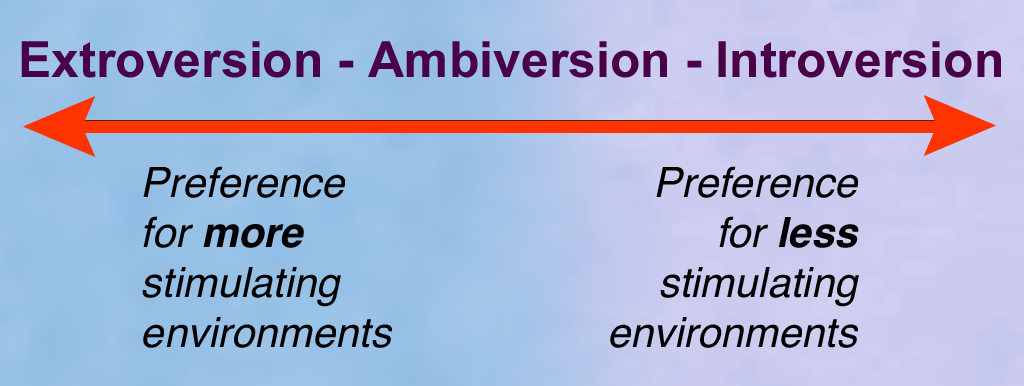
[[File:20220822 Distinguishing introversion and extraversion (extroversion) - comparison chart.svg|thumb|upright=1.5 |Behavioral and psychological characteristics distinguishing introversion and extraversion, which are generally conceived as lying along a continuum]] |
[[File:20220822 Distinguishing introversion and extraversion (extroversion) - comparison chart.svg|thumb|upright=1.5 |Behavioral and psychological characteristics distinguishing introversion and extraversion, which are generally conceived as lying along a continuum]] |
||
{{Psychology sidebar}} |
{{Psychology sidebar}} |
||
'''Extraversion''' and '''introversion''' are a central [[trait theory|trait]] dimension in human [[personality psychology|personality]] theory. The terms were introduced into psychology by [[Carl Jung]],{{cite book | vauthors = Jung CG | title = Psychologische Typen | publisher = Rascher & Verlag, A.G. | location = Zürich, Leipzig, Stuttgart | date = 1923 | translator-last = Baynes HG }} though both the popular understanding and current psychological usage are not the same as Jung's original concept. Extraversion (also spelled '''''extroversion'''''{{cite web | vauthors = Barnett G |title=Is it extraversion or extroversion?|url=https://www.predictiveindex.com/blog/is-it-extraversion-or-extroversion|website=The Predictive Index|date=2016-08-02 | access-date = 2018-02-21 }}) is typically associated with sociability, talkativeness, and high energy, while introversion is linked to [[introspection]], |
'''Extraversion''' and '''introversion''' are a central [[trait theory|trait]] dimension in human [[personality psychology|personality]] theory. The terms were introduced into psychology by [[Carl Jung]],{{cite book | vauthors = Jung CG | title = Psychologische Typen | publisher = Rascher & Verlag, A.G. | location = Zürich, Leipzig, Stuttgart | date = 1923 | translator-last = Baynes HG }} though both the popular understanding and current psychological usage are not the same as Jung's original concept. Extraversion (also spelled '''''extroversion'''''{{cite web | vauthors = Barnett G |title=Is it extraversion or extroversion?|url=https://www.predictiveindex.com/blog/is-it-extraversion-or-extroversion|website=The Predictive Index|date=2016-08-02 | access-date = 2018-02-21 }}) is typically associated with sociability, talkativeness, and high energy, while introversion is linked to [[introspection]], reserve, and a preference for [[solitary]] activities.{{cite journal |doi=10.1016/j.paid.2008.06.013 |title=Development and Validation of an International English Big-Five Mini-Markers |url=https://archive.org/details/sim_personality-and-individual-differences_2008-10_45_6/page/542 |year=2008 | vauthors = Thompson ER |journal=Personality and Individual Differences |volume=45 |issue=6 |pages=542–8}} Jung defined introversion as an "attitude-type characterised by orientation in life through subjective psychic contents", and extraversion as "an attitude-type characterised by concentration of interest on the external object".{{cite book|title=Memories, Dreams, Reflections| vauthors = Jung C |publisher=Fontana Press|year=1995|isbn=978-0-00-654027-4|location=London|pages=414–5}} |
||
While often presented as opposite ends of a single [[Continuum (theory)|continuum]], many personality theorists, such as Carl Jung, have suggested that most individuals possesses elements of both traits, with one being more dominant. Virtually all comprehensive models of personality include these concepts in various forms. Examples include the [[Big Five personality traits|Big Five model]], Jung's [[analytical psychology]], [[Hans Eysenck]]'s [[Hans Eysenck#Model of personality|three-factor model]], [[Raymond Cattell]]'s [[16 personality factors]], the [[Minnesota Multiphasic Personality Inventory]], and the [[Myers–Briggs Type Indicator]]. |
While often presented as opposite ends of a single [[Continuum (theory)|continuum]], many personality theorists, such as Carl Jung, have suggested that most individuals possesses elements of both traits, with one being more dominant. Virtually all comprehensive models of personality include these concepts in various forms. Examples include the [[Big Five personality traits|Big Five model]], Jung's [[analytical psychology]], [[Hans Eysenck]]'s [[Hans Eysenck#Model of personality|three-factor model]], [[Raymond Cattell]]'s [[16 personality factors]], the [[Minnesota Multiphasic Personality Inventory]], and the [[Myers–Briggs Type Indicator]]. |
||