| ← Previous revision |
Revision as of 19:06, 20 April 2026 |
| Line 76: |
Line 76: |
|
|
|
|
|
===Regional variation=== |
|
===Regional variation=== |
|
The eastern fence lizard has several adaptations to better survive in colder regions of its distribution, including larger eggs, more efficient embryonic development, slower maturity rates [{{cite journal |last1=Tinkle |first1=Donald W. |title=Sceloporus Undulatus: A Study of the Intraspecific Comparative Demography of a Lizard |journal=Ecology |date=July 1, 1972 |volume=53 |issue=4 |pages=570-584 |doi=https://doi.org/10.2307/1934772 |url=https://esajournals.onlinelibrary.wiley.com/doi/abs/10.2307/1934772 |access-date=April 20, 2026}}], and shorter incubation times. The larger egg sizes are not a result of greater maternal investment — even when forcibly made smaller, efficiency and incubation time were similar to the originally larger eggs.[{{cite journal |last1=Oufiero |first1=Christopher E. |last2=Angilletta |first2=Michael J. |title=Convergent Evolution of Embryonic Growth and Development in the Eastern Fence Lizard (Sceloporus Undulatus) |journal=Evolution |date=May 2006 |volume=60 |issue=5 |pages=1066–1075 |doi=10.1111/j.0014-3820.2006.tb01183.x |pmid=16817545 |s2cid=221733454 |doi-access=free }}] |
|
The eastern fence lizard has several adaptations to better survive in colder regions of its distribution, including larger eggs, more efficient embryonic development, and shorter incubation times. The larger egg sizes are not a result of greater maternal investment — even when forcibly made smaller, efficiency and incubation time were similar to the originally larger eggs.[{{cite journal |last1=Oufiero |first1=Christopher E. |last2=Angilletta |first2=Michael J. |title=Convergent Evolution of Embryonic Growth and Development in the Eastern Fence Lizard (Sceloporus Undulatus) |journal=Evolution |date=May 2006 |volume=60 |issue=5 |pages=1066–1075 |doi=10.1111/j.0014-3820.2006.tb01183.x |pmid=16817545 |s2cid=221733454 |doi-access=free }}] |
|
|
|
|
|
On the other hand, female lizards in southern regions produce second clutches more often, although their clutches are smaller than northern ones. The season at which eggs can incubate and lizards may be active is longer in the southern regions.[{{cite journal |last1=Du |first1=Weiguo |last2=Robbins |first2=Travis R. |last3=Warner |first3=Daniel A. |last4=Langkilde |first4=Tracy |last5=Shine |first5=Richard |title=Latitudinal and seasonal variation in reproductive effort of the eastern fence lizard ( Sceloporus undulatus ) |journal=Integrative Zoology |date=June 2014 |volume=9 |issue=3 |pages=360–371 |doi=10.1111/1749-4877.12072 |pmid=24148228 }}] |
|
On the other hand, female lizards in southern regions produce second clutches more often, although their clutches are smaller than northern ones. The season at which eggs can incubate and lizards may be active is longer in the southern regions.[{{cite journal |last1=Du |first1=Weiguo |last2=Robbins |first2=Travis R. |last3=Warner |first3=Daniel A. |last4=Langkilde |first4=Tracy |last5=Shine |first5=Richard |title=Latitudinal and seasonal variation in reproductive effort of the eastern fence lizard ( Sceloporus undulatus ) |journal=Integrative Zoology |date=June 2014 |volume=9 |issue=3 |pages=360–371 |doi=10.1111/1749-4877.12072 |pmid=24148228 }}] |
| Line 105: |
Line 105: |
|
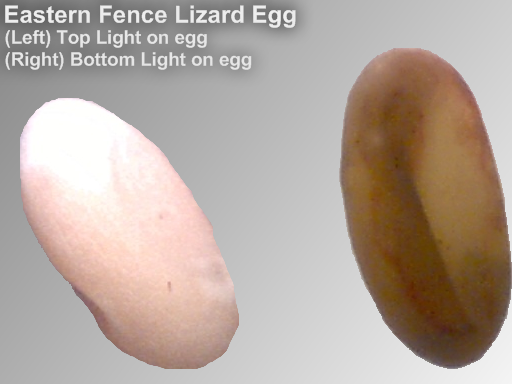
The female finds a suitable location to lay her eggs, usually in a rotting log or similarly damp area, and deposits them without any further parental care.[{{Cite web|title=Eastern Fence Lizard |url=https://www.nwf.org/Educational-Resources/Wildlife-Guide/Reptiles/Eastern-Fence-Lizard|url-status=live|access-date=June 11, 2021|website=The National Wildlife Federation |archive-date=2020-10-23 |archive-url=https://web.archive.org/web/20201023053452/https://www.nwf.org/Educational-Resources/Wildlife-Guide/Reptiles/Eastern-Fence-Lizard}}] Young females will only produce one clutch of three to sixteen eggs, while a large female can produce up to four.[{{Cite web|title=Eastern Fence Lizard (Sceloporus undulatus) |url=https://srelherp.uga.edu/lizards/sceund.htm|access-date=June 11, 2021|website=Savannah River Ecology Laboratory University of Georgia|url-status=live|archive-url=https://web.archive.org/web/20111203221935/http://srelherp.uga.edu:80/lizards/sceund.htm |archive-date=2011-12-03}}] The eggs take approximately ten weeks to hatch and emerge near the end of summer. The young lizards grow quickly and are able to reproduce the next year. |
|
The female finds a suitable location to lay her eggs, usually in a rotting log or similarly damp area, and deposits them without any further parental care.[{{Cite web|title=Eastern Fence Lizard |url=https://www.nwf.org/Educational-Resources/Wildlife-Guide/Reptiles/Eastern-Fence-Lizard|url-status=live|access-date=June 11, 2021|website=The National Wildlife Federation |archive-date=2020-10-23 |archive-url=https://web.archive.org/web/20201023053452/https://www.nwf.org/Educational-Resources/Wildlife-Guide/Reptiles/Eastern-Fence-Lizard}}] Young females will only produce one clutch of three to sixteen eggs, while a large female can produce up to four.[{{Cite web|title=Eastern Fence Lizard (Sceloporus undulatus) |url=https://srelherp.uga.edu/lizards/sceund.htm|access-date=June 11, 2021|website=Savannah River Ecology Laboratory University of Georgia|url-status=live|archive-url=https://web.archive.org/web/20111203221935/http://srelherp.uga.edu:80/lizards/sceund.htm |archive-date=2011-12-03}}] The eggs take approximately ten weeks to hatch and emerge near the end of summer. The young lizards grow quickly and are able to reproduce the next year. |
|
|
|
|
|
Unfavorable nesting conditions can cause females to retain their eggs longer than they would have otherwise. This phenomenon is referred to as egg retention. Egg retention in the eastern fence lizard produces heavier eggs with more advanced embryos and with higher posthatching survival rate, but does not influence phenotype.[{{cite journal |last1=Warner |first1=Daniel A. |last2=Andrews |first2=Robin M. |title=Consequences of Extended Egg Retention in the Eastern Fence Lizard (Sceloporus undulatus) |journal=Journal of Herpetology |date=April 2003 |volume=37 |issue=2 |pages=309–314 |doi=10.1670/0022-1511(2003)037[0309:COEERI]2.0.CO;2 |s2cid=86196441 }}] |
|
Unfavorable nesting conditions can cause females to retain their eggs longer than they would have otherwise. This phenomenon is referred to as egg retention. Egg retention in the eastern fence lizard produces heavier eggs with more advanced embryos and with higher posthatching survival rate, but does not influence phenotype.[{{cite journal |last1=Warner |first1=Daniel A. |last2=Andrews |first2=Robin M. |title=Consequences of Extended Egg Retention in the Eastern Fence Lizard (Sceloporus undulatus) |journal=Journal of Herpetology |date=April 2003 |volume=37 |issue=2 |pages=309–314 |doi=10.1670/0022-1511(2003)037[0309:COEERI]2.0.CO;2 |s2cid=86196441 }}] |
|
|
|
|
|
Greater reproductive energy allocated to first clutches is common at higher latitudes, whereas more energy is dedicated to later clutches in lower latitudes.[{{Cite journal |last1=DU |first1=Weiguo |last2=ROBBINS |first2=Travis R. |last3=WARNER |first3=Daniel A. |last4=LANGKILDE |first4=Tracy |last5=SHINE |first5=Richard |date=June 2014 |title=Latitudinal and seasonal variation in reproductive effort of the eastern fence lizard (''Sceloporus undulatus'') |journal=Integrative Zoology |volume=9 |issue=3 |pages=360–371 |doi=10.1111/1749-4877.12072 |pmid=24148228 |issn=1749-4877}}] |
|
Greater reproductive energy allocated to first clutches is common at higher latitudes, whereas more energy is dedicated to later clutches in lower latitudes.[{{Cite journal |last1=DU |first1=Weiguo |last2=ROBBINS |first2=Travis R. |last3=WARNER |first3=Daniel A. |last4=LANGKILDE |first4=Tracy |last5=SHINE |first5=Richard |date=June 2014 |title=Latitudinal and seasonal variation in reproductive effort of the eastern fence lizard (''Sceloporus undulatus'') |journal=Integrative Zoology |volume=9 |issue=3 |pages=360–371 |doi=10.1111/1749-4877.12072 |pmid=24148228 |issn=1749-4877}}] |

 Like
0
Like
0
 Dislike
0
Dislike
0
 Love
0
Love
0
 Funny
0
Funny
0
 Angry
0
Angry
0
 Sad
0
Sad
0
 Wow
0
Wow
0