Compis
| ← Previous revision | Revision as of 22:48, 19 April 2026 | ||
| Line 41: | Line 41: | ||
== History == |
== History == |
||
In 1980, the [[ABC 80]] used in the schools was regarded as becoming obsolete, and the National Swedish Board for Technical Development (''Styrelsen för teknisk utveckling'') was tasked to find a replacement. In 1981, the procurement ''Tudis (Teknikupphandlingsprojekt Datorn i Skolan) '' was launched, and while the decision was controversial, [[Svenska Datorer AB]] was awarded the contract with development beginning in 1982. After Svenska Datorer went bankrupt, production was transferred to TeliDatorer/Telenova under [[Televerket (Sweden)]].{{Cite web |title=Telenova COMPIS |url=https://www.df.lth.se/~pi/compis/ |access-date=2026-04-19 |website= |
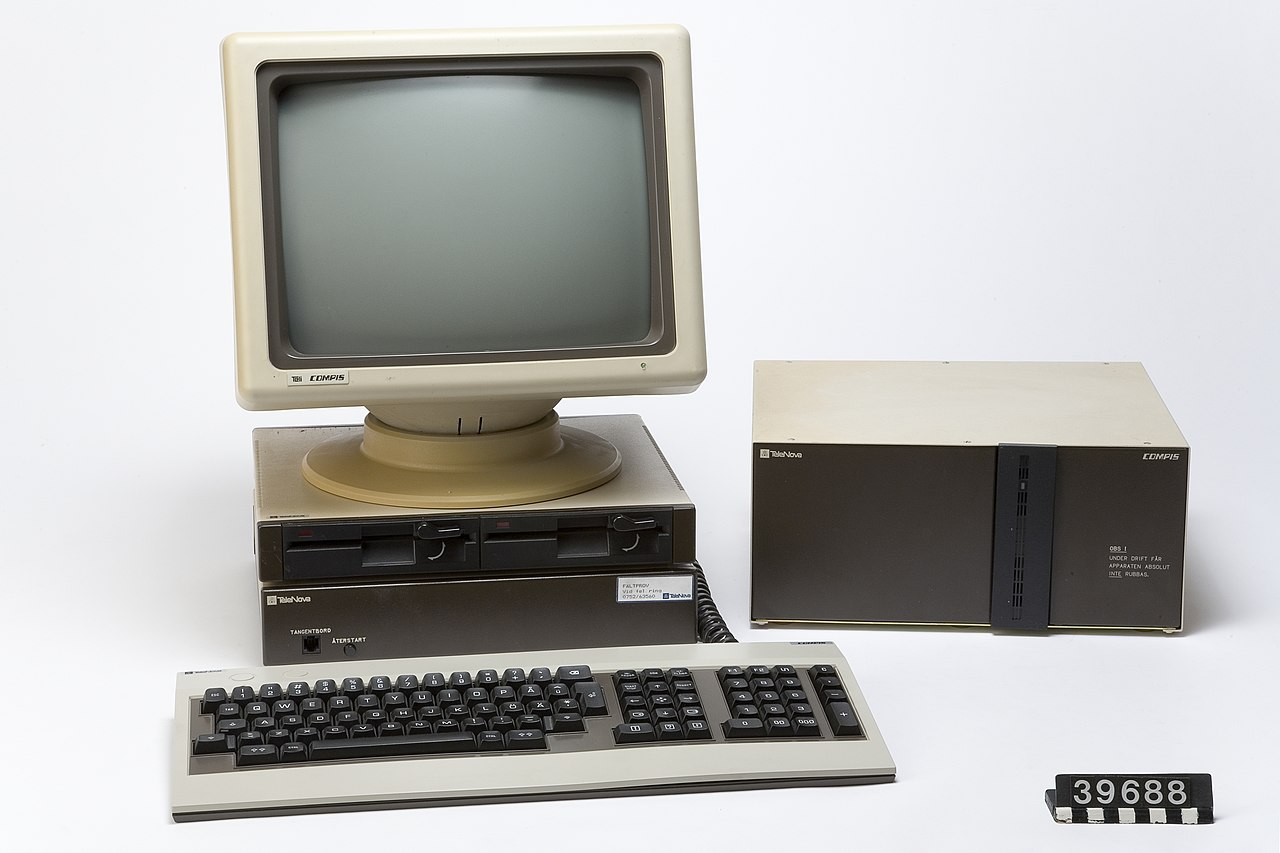
In 1980, the [[ABC 80]] used in the schools was regarded as becoming obsolete, and the National Swedish Board for Technical Development (''Styrelsen för teknisk utveckling'') was tasked to find a replacement. In 1981, the procurement ''Tudis (Teknikupphandlingsprojekt Datorn i Skolan) '' was launched, and while the decision was controversial, [[Svenska Datorer AB]] was awarded the contract with development beginning in 1982. After Svenska Datorer went bankrupt, production was transferred to TeliDatorer/Telenova under [[Televerket (Sweden)]].{{Cite web |title=Telenova COMPIS |url=https://www.df.lth.se/~pi/compis/ |access-date=2026-04-19 |website=Telenova COMPIS}}{{Cite web |title=TeleNova COMPIS |url=http://www.datormuseum.se/computers/others/telenova-compis |access-date=2026-04-19 |website=Dalby Datormuseum}} |
||
The computer was distributed by [[Esselte]] and exclusively marketed towards, and sold to, Swedish, Norwegian and Finnish schools, mainly high stage (year 7-9) and [[Gymnasium (school)|gymnasium-level]]. The Norwegian [[Ministry of Education and Research (Norway)|Ministry of Church and Education Affairs]] established a framework agreement for the procurement of the Scandis 128 and [[Tiki-100]] systems for the country's school system.{{ cite book | url=http://urn.nb.no/URN:NBN:no-nb_digibok_2015062408191 | title=Veiledning for bruk av rammeavtaler ved innkjøp av datautstyr og bruksrett til programutrustning til skoleverket | publisher=Kirke- og undervisningsdepartementet | date=1984 | access-date=19 August 2025 | language=nb }}{{rp|pages=1}} |
The computer was distributed by [[Esselte]] and exclusively marketed towards, and sold to, Swedish, Norwegian and Finnish schools, mainly high stage (year 7-9) and [[Gymnasium (school)|gymnasium-level]]. The Norwegian [[Ministry of Education and Research (Norway)|Ministry of Church and Education Affairs]] established a framework agreement for the procurement of the Scandis 128 and [[Tiki-100]] systems for the country's school system.{{ cite book | url=http://urn.nb.no/URN:NBN:no-nb_digibok_2015062408191 | title=Veiledning for bruk av rammeavtaler ved innkjøp av datautstyr og bruksrett til programutrustning til skoleverket | publisher=Kirke- og undervisningsdepartementet | date=1984 | access-date=19 August 2025 | language=nb }}{{rp|pages=1}} |
||
The computer was based on the [[Intel 80186]] [[central processing unit|CPU]], fitted with 128 KB of RAM as standard, expandable to 256 KB, and used [[CP/M-86]] as the operating system in [[Read-only memory|ROM]] alongside a BASIC implementation.{{ cite book | url=http://urn.nb.no/URN:NBN:no-nb_digibok_2007071301013 | title=Velg riktig mikrodatamaskin | isbn=8200354199 | publisher=Universitetsforlaget | last1=Samish | first1=Francis | date=1984 | access-date=19 August 2025 | language=nb | pages=87–88 }} Display was driven by a [[NEC μPD7220|NEC 7220]] processor,{{Cite web |title=Installationsmanual och hårdskivemanual |url=https://www.df.lth.se/~pi/compis/installationsmanual.html |access-date=2026-04-19 |website= |
The computer was based on the [[Intel 80186]] [[central processing unit|CPU]], fitted with 128 KB of RAM as standard, expandable to 256 KB, and used [[CP/M-86]] as the operating system in [[Read-only memory|ROM]] alongside a BASIC implementation.{{ cite book | url=http://urn.nb.no/URN:NBN:no-nb_digibok_2007071301013 | title=Velg riktig mikrodatamaskin | isbn=8200354199 | publisher=Universitetsforlaget | last1=Samish | first1=Francis | date=1984 | access-date=19 August 2025 | language=nb | pages=87–88 }} Display was driven by a [[NEC μPD7220|NEC 7220]] processor,{{Cite web |title=Installationsmanual och hårdskivemanual |url=https://www.df.lth.se/~pi/compis/installationsmanual.html |access-date=2026-04-19 |website=Telenova COMPIS}} and configurations included resolutions of {{nowrap|1280 x 800}} pixels in monochrome and {{nowrap|640 x 400}} in eight colours, these requiring an elevated 128 KB of video RAM, along with a more modest {{nowrap|640 x 400}} in monochrome only requiring 32 KB of video RAM. Norwegian educational pricing for the base monochrome model was {{Currency|5800|NOK}}, rising to {{Currency|6800|NOK}} for the higher-resolution or colour versions. Monitors added {{Currency|1800|NOK}} or {{Currency|3800|NOK}} for the high-resolution monochrome or colour models respectively. Disk drives also added upwards of {{Currency|2800|NOK}} to the price. The machine could also run [[MS-DOS]] from disk.{{Cite web |title=Diskimages till COMPIS |url=https://www.df.lth.se/~pi/compis/diskar.html |access-date=2026-04-19 |website=Telenova COMPIS}} The computer had a wide selection of ports,{{Cite web |title=Pinouts till serieporten på COMPIS |url=https://www.df.lth.se/~pi/compis/serie.html |access-date=2026-04-19 |website=Telenova COMPIS}} including one for a [[light pen]]. The Compis project was criticized from the start, and when the move to [[IBM PC]] compatibility came, it was left behind and finally cancelled in 1988 although it was in use well into the 1990s. |
||
== Applications == |
== Applications == |
||