Big Duck
Legacy: The New Yorker
| ← Previous revision | Revision as of 23:31, 19 April 2026 | ||
| Line 61: | Line 61: | ||
{{Blockquote|text=When a graphic is taken over by decorative forms or computer debris, when the data measures and structures become Design Elements, when the overall design purveys Graphical Style rather than quantitative information, then the graphic may be called a ''duck'' in honor of the duck-form store, "Big Duck." For this building the whole structure is itself decoration, just as in the duck data graphic.}} |
{{Blockquote|text=When a graphic is taken over by decorative forms or computer debris, when the data measures and structures become Design Elements, when the overall design purveys Graphical Style rather than quantitative information, then the graphic may be called a ''duck'' in honor of the duck-form store, "Big Duck." For this building the whole structure is itself decoration, just as in the duck data graphic.}} |
||
The Big Duck was the target of widespread criticism during the 1960s and early 1970s, but the building did have its defenders. [[Robert Venturi]] and [[Denise Scott Brown]] said that "Sometimes the building is the sign" and noted that this building{{Snd}}which they referred to as "The Long Island Duckling"{{Snd}}was a "sculptural symbol and architectural shelter".{{cite book |last1=Venturi |first1=Robert |url=https://archive.org/details/learningfromlasv0000vent//www.amst.umd.edu/Research/cultland/annotations/Venturi1.html |title=Learning from Las Vegas: The Forgotten Symbolism of Architectural Form |last2=Scott Brown |first2=Denise |last3=Izenour |first3=Steven |publisher=[[MIT Press]] |year=1977 |isbn=0-262-72006-X |location=Cambridge, MA |via=[[Internet Archive]] }}{{Rp|page=13}} They used the term "duck" to refer to "a special building that ''is'' a symbol", as differentiated from a "conventional shelter that ''applies'' symbols", which they called a "decorated shed".{{Rp|pages=87-89}} |
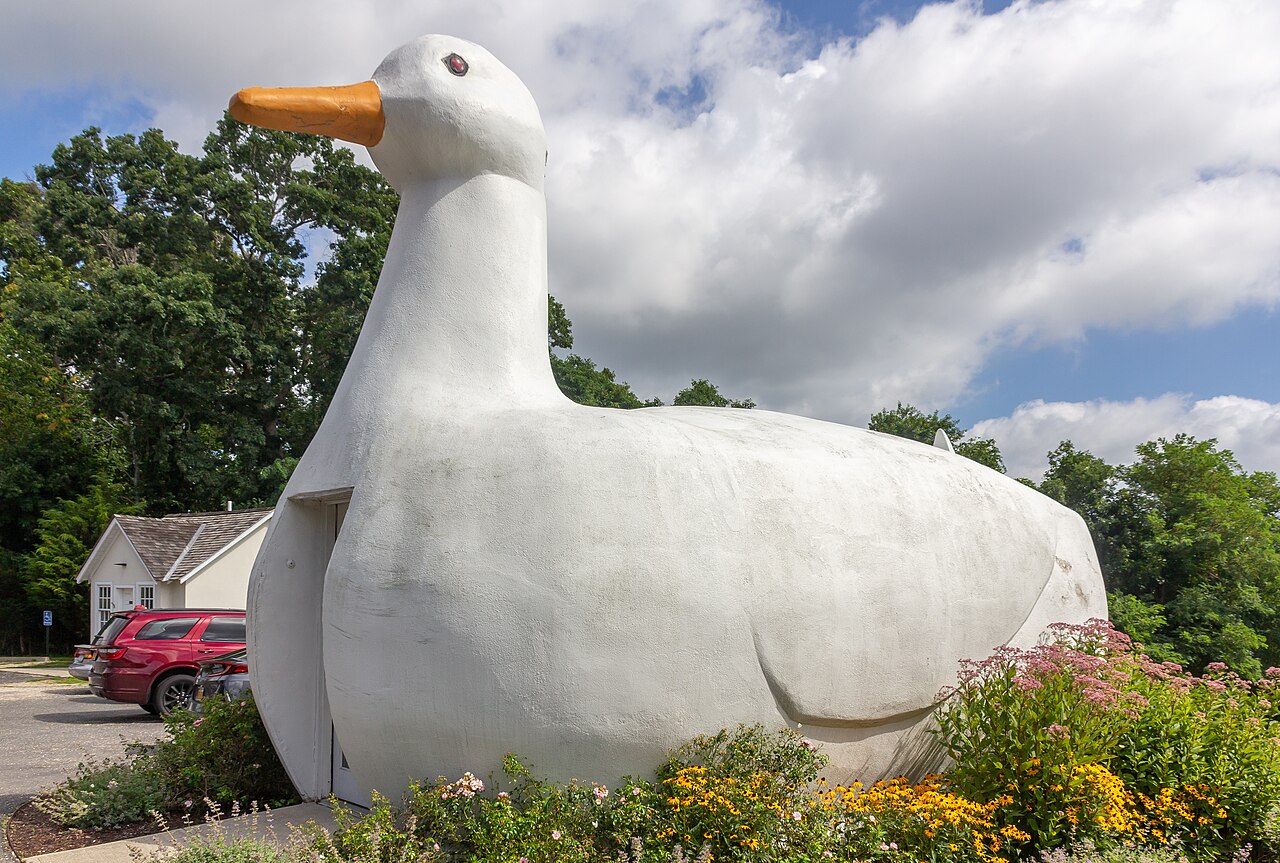
The Big Duck was the target of widespread criticism during the 1960s and early 1970s, but the building did have its defenders. In their 1977 book, architects [[Robert Venturi]] and [[Denise Scott Brown]] said that "Sometimes the building is the sign" and noted that this building{{Snd}}which they referred to as "The Long Island Duckling"{{Snd}}was a "sculptural symbol and architectural shelter".{{cite book |last1=Venturi |first1=Robert |url=https://archive.org/details/learningfromlasv0000vent//www.amst.umd.edu/Research/cultland/annotations/Venturi1.html |title=Learning from Las Vegas: The Forgotten Symbolism of Architectural Form |last2=Scott Brown |first2=Denise |last3=Izenour |first3=Steven |publisher=[[MIT Press]] |year=1977 |isbn=0-262-72006-X |location=Cambridge, MA |via=[[Internet Archive]] }}{{Rp|page=13}} They used the term "duck" to refer to "a special building that ''is'' a symbol", as differentiated from a "conventional shelter that ''applies'' symbols", which they called a "decorated shed".{{Rp|pages=87-89}} A drawing of the building by [[Saul Steinberg]] was featured on the May 11, 1987 cover of ''[[The New Yorker]]''. In her 2015 book, historian Marilyn Weigold called the building an "impressive piece of folk art". |
||
An attempt was made in 1997 to turn the structure into a museum consisting of fifteen buildings typical of an early 20th century Long Island roadside. The project had been proposed by the Suffolk County Department of Parks with support from the [[New York State Council on the Arts|New York Council on the Arts]]. Legal obstacles and would have cost more than the amount of funding available.{{Cite book |last=Sculle |first=Keith A. |title=Remembering Roadside America |last2=Jakle |first2=John A. |publisher=[[The University of Tennessee Press]] |year=2011 |isbn=978-1-57233-833-3 |edition=1st |location=Knoxville |pages=206 |id={{project muse|13562|type=book}}}} On November 13, 2006, radio station [[WBLI]] rated the Flanders Duck first amongst the seven wonders of Long Island.{{Cite web |title=The 7 Wonders of Long Island |url=http://wbli.com/morningshow/7wonders.html |url-status=dead |archive-url=https://web.archive.org/web/20080605192123/http://wbli.com/morningshow/7wonders.html |archive-date=June 5, 2008 |website=[[WBLI]] }} The Big Duck was listed on the [[National Register of Historic Places]] on April 28, 1997 and is also listed on the [[New York State Register of Historic Places]],{{Cite web |date=April 28, 1997 |title=Big Duck, The |url=https://catalog.archives.gov/id/75322039 |website=National Register of Historic Places |id=Asset ID b3b6da4c-0c8a-4569-b612-ef361de621ab |access-date=June 26, 2024 |archive-date=July 4, 2024 |archive-url=https://web.archive.org/web/20240704165838/https://npgallery.nps.gov/NRHP/AssetDetail/b3b6da4c-0c8a-4569-b612-ef361de621ab |url-status=live }} joined by the [[Big Duck Ranch]] in 2008.{{Cite web |date=September 12, 2008 |title=Big Duck Ranch |url=https://npgallery.nps.gov/NRHP/AssetDetail/0e9d3367-2649-46be-875c-54151955edee |website=National Register of Historic Places |id=Asset ID 0e9d3367-2649-46be-875c-54151955edee |access-date=June 26, 2024 |archive-date=July 4, 2024 |archive-url=https://web.archive.org/web/20240704165838/https://npgallery.nps.gov/NRHP/AssetDetail/0e9d3367-2649-46be-875c-54151955edee |url-status=live }} |
An attempt was made in 1997 to turn the structure into a museum consisting of fifteen buildings typical of an early 20th century Long Island roadside. The project had been proposed by the Suffolk County Department of Parks with support from the [[New York State Council on the Arts|New York Council on the Arts]]. Legal obstacles and would have cost more than the amount of funding available.{{Cite book |last=Sculle |first=Keith A. |title=Remembering Roadside America |last2=Jakle |first2=John A. |publisher=[[The University of Tennessee Press]] |year=2011 |isbn=978-1-57233-833-3 |edition=1st |location=Knoxville |pages=206 |id={{project muse|13562|type=book}}}} On November 13, 2006, radio station [[WBLI]] rated the Flanders Duck first amongst the seven wonders of Long Island.{{Cite web |title=The 7 Wonders of Long Island |url=http://wbli.com/morningshow/7wonders.html |url-status=dead |archive-url=https://web.archive.org/web/20080605192123/http://wbli.com/morningshow/7wonders.html |archive-date=June 5, 2008 |website=[[WBLI]] }} The Big Duck was listed on the [[National Register of Historic Places]] on April 28, 1997 and is also listed on the [[New York State Register of Historic Places]],{{Cite web |date=April 28, 1997 |title=Big Duck, The |url=https://catalog.archives.gov/id/75322039 |website=National Register of Historic Places |id=Asset ID b3b6da4c-0c8a-4569-b612-ef361de621ab |access-date=June 26, 2024 |archive-date=July 4, 2024 |archive-url=https://web.archive.org/web/20240704165838/https://npgallery.nps.gov/NRHP/AssetDetail/b3b6da4c-0c8a-4569-b612-ef361de621ab |url-status=live }} joined by the [[Big Duck Ranch]] in 2008.{{Cite web |date=September 12, 2008 |title=Big Duck Ranch |url=https://npgallery.nps.gov/NRHP/AssetDetail/0e9d3367-2649-46be-875c-54151955edee |website=National Register of Historic Places |id=Asset ID 0e9d3367-2649-46be-875c-54151955edee |access-date=June 26, 2024 |archive-date=July 4, 2024 |archive-url=https://web.archive.org/web/20240704165838/https://npgallery.nps.gov/NRHP/AssetDetail/0e9d3367-2649-46be-875c-54151955edee |url-status=live }} |
||