Prateek Saxena UPSC 2027 Guide PDF: Syllabus, PYQs & Strategy
Download/read Prateek Saxena’s Complete Guide to Crack UPSC 2027 in First Attempt PDF with UPSC syllabus, toppers strategy, repeated PYQs, preparation tips, study plan and FAQs
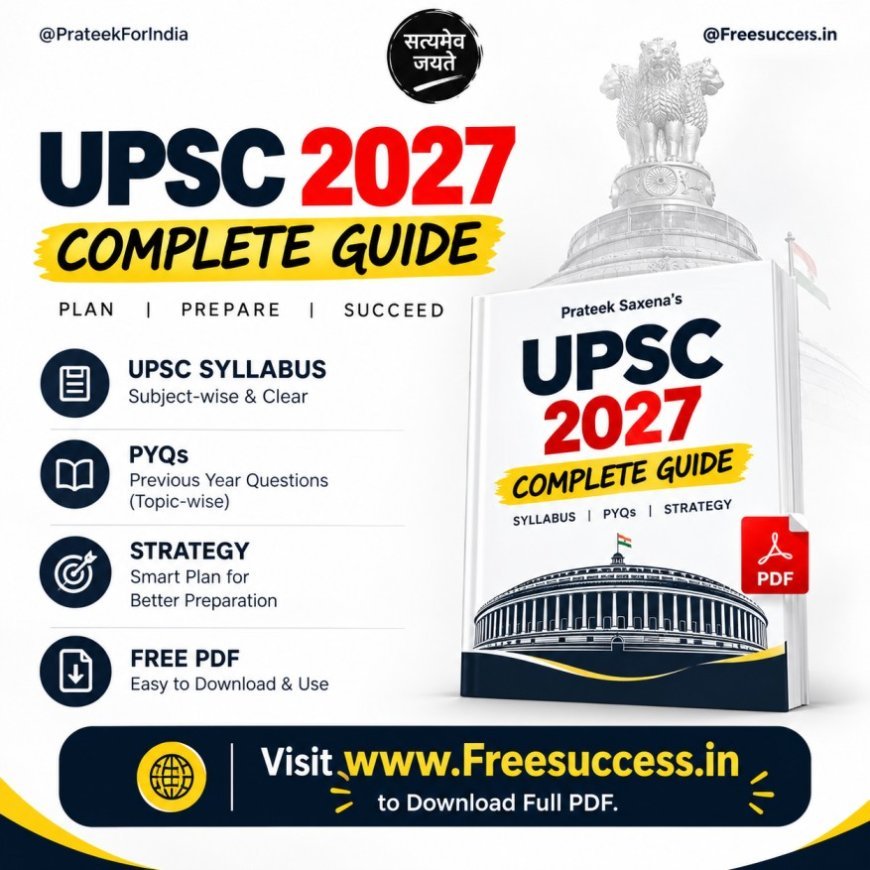
Prateek Saxena’s Complete Guide to Crack UPSC 2027 in First Attempt – Syllabus, Strategy, PYQs & Preparation Guide PDF
The UPSC Civil Services Examination (CSE) is one of India’s most competitive examinations for recruitment to services such as the Indian Administrative Service (IAS), Indian Police Service (IPS), Indian Foreign Service (IFS) and other Group A and Group B services. Every year, lakhs of aspirants begin their preparation with the dream of entering India’s civil services, but only a small proportion finally reach the recommended list.
If you are targeting UPSC CSE 2027, starting early can make a significant difference. Prateek Saxena’s Complete Guide to Crack UPSC 2027 in First Attempt PDF is designed as a preparation-oriented resource containing the UPSC syllabus, preparation guidance, topper-inspired strategy, important and repeated PYQ themes, study planning ideas and practical tips for aspirants.
Important: UPSC 2027-specific dates and any changes in the examination scheme should always be verified from the official UPSC notification when it is released. The strategy and examination structure discussed here are based on the latest official UPSC information available.
UPSC 2027: Why Early Preparation Matters
UPSC preparation is not simply about reading more books. It is about understanding the syllabus, analysing previous-year questions, developing conceptual clarity, revising repeatedly and learning how to write answers within a limited time.
The official UPSC website currently lists the Civil Services Examination among its examination resources and provides previous-year question papers, specimen answer booklets and other examination-related material.
For a 2027 aspirant, this means preparation should ideally begin with three things:
-
Understand the complete syllabus
-
Analyse previous-year questions
-
Build a realistic long-term study plan
This is exactly where a structured UPSC 2027 preparation guide can help.
UPSC Civil Services Examination Pattern
The Civil Services Examination is conducted in three broad stages:
1. UPSC Preliminary Examination
The Preliminary Examination consists of two compulsory objective-type papers:
-
General Studies Paper I – 200 marks
-
General Studies Paper II (CSAT) – 200 marks
CSAT is qualifying in nature, with the minimum qualifying requirement specified as 33%. Both papers are generally conducted for two hours each under the official scheme.
General Studies Paper I covers areas such as:
-
Current Affairs
-
History of India and Indian National Movement
-
Indian and World Geography
-
Indian Polity and Governance
-
Economic and Social Development
-
Environment and Ecology
-
General Science
CSAT broadly tests comprehension, communication/interpersonal skills, logical reasoning, analytical ability, decision-making, problem-solving, general mental ability, basic numeracy and data interpretation.
2. UPSC Main Examination
Candidates qualifying for the Preliminary stage appear for the Main Examination.
The written Mains examination includes qualifying language papers along with papers counted for merit. The merit papers include Essay, General Studies I, General Studies II, General Studies III, General Studies IV and two papers of the chosen optional subject. Under the current official framework, each merit paper carries 250 marks.
The four General Studies papers cover:
GS Paper I: Indian Heritage and Culture, History, Geography and Society
GS Paper II: Governance, Constitution, Polity, Social Justice and International Relations
GS Paper III: Technology, Economic Development, Biodiversity, Environment, Security and Disaster Management
GS Paper IV: Ethics, Integrity and Aptitude
The official UPSC website also provides specimen question-cum-answer booklets for Civil Services Main Examination, which can help aspirants understand answer-writing presentation.
3. Personality Test / Interview
Candidates who qualify for the written Main Examination are called for the Personality Test. The final ranking is determined using the marks obtained in the Mains written examination and Personality Test, subject to the applicable rules.
Therefore, UPSC preparation should not be viewed as only a Prelims-focused exercise. A successful strategy connects Prelims, Mains and the Personality Test.
What You Will Find in Prateek Saxena’s UPSC 2027 Guide PDF
The Prateek Saxena UPSC 2027 Complete Guide PDF is intended to bring important preparation information together in one place.
The guide includes:
Complete UPSC Syllabus
Knowing the syllabus is the first step towards avoiding unnecessary study. Instead of reading everything available online, aspirants should repeatedly compare their preparation with the official syllabus.
Toppers’ Strategy
The guide discusses practical preparation principles inspired by successful UPSC preparation approaches, including revision, PYQ analysis, answer writing, current-affairs integration and disciplined study.
Most Repeated PYQ Themes
Previous-year questions are among the most valuable resources for understanding UPSC. The Commission itself provides previous-year Civil Services papers through its official website.
Instead of simply solving PYQs, aspirants should identify:
-
Repeated concepts
-
Frequently tested subjects
-
Question framing patterns
-
Static-current affairs connections
-
Areas requiring conceptual understanding
Preparation Guide
The PDF also provides a structured approach for aspirants who want to prepare systematically rather than randomly collecting study materials.
How to Prepare for UPSC 2027 in the First Attempt
There is no guaranteed formula for clearing UPSC in one attempt. However, a disciplined strategy can significantly improve preparation quality.
Step 1: Start With the Syllabus
Print or save the official syllabus. Break every subject into smaller topics and use it as a checklist throughout your preparation.
Step 2: Analyse PYQs Before Studying Deeply
Do not wait until the end of your preparation to look at previous-year questions. Study PYQs alongside the syllabus.
Ask yourself:
What is UPSC actually asking?
This question can prevent months of unfocused preparation.
Step 3: Build Strong Basics
Begin with fundamental concepts before moving towards advanced resources. NCERTs and standard reference books can help establish foundational understanding, after which subject-specific resources can be added selectively.
Step 4: Integrate Current Affairs
Current affairs should not be treated as a completely separate subject. Connect news with Polity, Economy, Environment, International Relations, Science & Technology, Society and other syllabus areas.
Step 5: Make Revision a Daily Habit
A common mistake is continuously adding new material without revising old material.
A better approach is:
Study → Revise → Practice → Analyse → Revise Again
Step 6: Practise Answer Writing
For Mains, knowledge alone is not enough. You must communicate that knowledge within the prescribed word limit and time.
Start with small answer-writing exercises and gradually increase the number of answers.
Step 7: Take Mock Tests Seriously
Prelims mock tests should be used to identify weaknesses, not merely to calculate scores.
After every test, analyse:
-
Wrong answers
-
Guesswork
-
Silly mistakes
-
Unattempted questions
-
Knowledge gaps
-
Time-management problems
UPSC 2027 Preparation Tips and Tricks
Follow the syllabus, not the crowd. Every new book, course or Telegram PDF is not automatically necessary.
Use PYQs as your preparation compass. They reveal the level, wording and recurring conceptual areas of the examination.
Revise fewer resources multiple times. Multiple revisions of selected resources are generally more useful than reading dozens of sources once.
Do not ignore CSAT. Although qualifying, failing CSAT means failing the Preliminary stage.
Develop an answer-writing framework. Practise introductions, core arguments, examples, data, government initiatives, diagrams where relevant and balanced conclusions.
Keep your optional subject under control. Select it carefully and create a separate revision and answer-writing schedule.
Protect your consistency. A sustainable daily routine is more valuable than occasional 12–14 hour study sessions followed by burnout.
Is UPSC 2027 Possible in the First Attempt?
Yes, clearing UPSC in the first attempt is possible, but it should not be treated as a guaranteed outcome.
The right objective should be to build first-attempt-quality preparation: complete syllabus coverage, repeated revision, extensive PYQ analysis, regular mock tests, answer-writing practice and continuous improvement.
Your preparation should be measured by progress rather than by the number of hours spent at a desk.
FAQs About UPSC 2027
Is the UPSC 2027 syllabus available?
Aspirants should rely on the official UPSC notification and syllabus for the 2027 examination. Until the 2027 CSE notification is officially released, candidates should use the latest official CSE syllabus as the preparation framework and verify any subsequent changes.
How many stages are there in UPSC CSE?
The examination broadly progresses through Preliminary Examination, Main Examination and Personality Test.
Is CSAT compulsory for UPSC Prelims?
Yes. CSAT is the second compulsory Preliminary paper and is qualifying in nature, with the prescribed minimum qualifying standard of 33% under the current scheme.
Are UPSC previous-year questions important?
Yes. PYQs are one of the most important resources for understanding the actual examination. UPSC officially publishes previous-year question papers, including Civil Services Preliminary and Main papers.
Can I crack UPSC without coaching?
Yes. Coaching is not mandatory. Many aspirants prepare through self-study, standard books, official resources, PYQs, test series and online learning. What matters most is the quality and consistency of preparation.
Where can I download the Prateek Saxena UPSC 2027 Complete Guide PDF?
The Prateek Saxena Complete Guide to Crack UPSC 2027 in First Attempt PDF can be used as a preparation resource containing the syllabus, strategy, PYQ-focused guidance and preparation tips. Aspirants should also cross-check examination rules, dates and syllabus information against the official UPSC website.
Final Words
UPSC CSE 2027 is not an examination that can be conquered through shortcuts. It requires direction, consistency, revision and smart practice.
If you are beginning your journey now, do not wait for the notification to start studying. Understand the syllabus, analyse PYQs, build your basics, follow current affairs, practise answer writing and regularly test yourself.
The Prateek Saxena UPSC 2027 Complete Guide PDF is designed to give aspirants a structured starting point for this journey, particularly through its UPSC syllabus, toppers’ strategy, most repeated PYQs and preparation guide.
Remember one simple principle:
UPSC preparation is not about studying everything. It is about studying what matters, revising it repeatedly and learning how UPSC asks questions.
For official examination notifications, syllabus information and previous-year papers, always verify details directly with the Union Public Service Commission (UPSC). The Commission’s website provides current examination information and official question papers.











![[4 May] SSC Selection Post Phase 14 Recruitment 2026 - 2919 Posts](https://freesuccess.in/uploads/images/202605/image_140x98_69f661745c015.jpg)