Emmaus
Formatting
| ← Previous revision | Revision as of 01:29, 21 April 2026 | ||
| Line 52: | Line 52: | ||
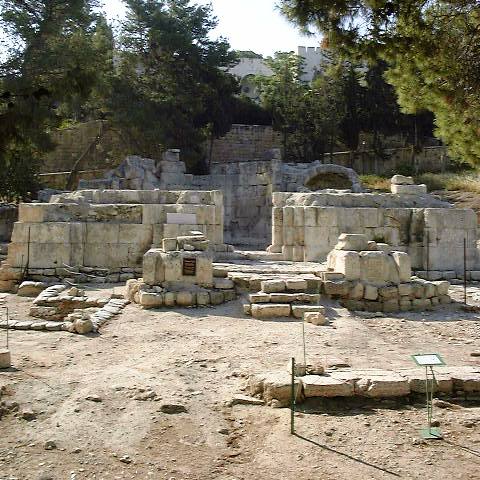
Archaeologically, many remains have been excavated at the site of the former Palestinian village, now located inside [[Canada Park]], which support historical and traditional claims. Five structures were found and dated, including a Christian basilica from the 6th century and a 12th-century Crusader church.{{Cite web|url=https://www.emmaus-nicopolis.org/|title=Emmaus-Nicopolis|website=www.emmaus-nicopolis.org|accessdate=June 14, 2023}} Emmaus Nicopolis is a [[titular see]] of the [[Roman Catholic Church]].{{Cite encyclopedia |author=Siméon Vailhé |encyclopedia=The Catholic Encyclopedia |title=Emmaus |year=1909 |publisher=Robert Appleton Company |volume=5 |location=New York |url=http://www.newadvent.org/cathen/05405a.htm |access-date=11 April 2015 }} |
Archaeologically, many remains have been excavated at the site of the former Palestinian village, now located inside [[Canada Park]], which support historical and traditional claims. Five structures were found and dated, including a Christian basilica from the 6th century and a 12th-century Crusader church.{{Cite web|url=https://www.emmaus-nicopolis.org/|title=Emmaus-Nicopolis|website=www.emmaus-nicopolis.org|accessdate=June 14, 2023}} Emmaus Nicopolis is a [[titular see]] of the [[Roman Catholic Church]].{{Cite encyclopedia |author=Siméon Vailhé |encyclopedia=The Catholic Encyclopedia |title=Emmaus |year=1909 |publisher=Robert Appleton Company |volume=5 |location=New York |url=http://www.newadvent.org/cathen/05405a.htm |access-date=11 April 2015 }} |
||
There are several sources giving information about this town's ancient history, among them the First Book of Maccabees, the works of Josephus, and chronicles from the Late Roman, Byzantine and Early Muslim periods. According to [[1 Maccabees]] 3:55-4:22, around 166 |
There are several sources giving information about this town's ancient history, among them the First Book of Maccabees, the works of Josephus, and chronicles from the Late Roman, Byzantine and Early Muslim periods. According to [[1 Maccabees]] 3:55-4:22, around 166 BC [[Judas Maccabeus]] fought against the [[Seleucids]] in the region of this particular Emmaus, and was victorious at the [[Battle of Emmaus]]; later, this town was fortified by [[Bacchides (general)|Bacchides]], a Seleucid general (1 Macc 9:50). When Rome took over the land it became the capital of a district or [[toparchy]], and was burnt by order of [[Publius Quintilius Varus|Varus]] after the death of [[Herod the Great|Herod]] in 4 BC. During the [[First Jewish Revolt]], before the siege of Jerusalem, [[Vespasian]]'s 5th legion was deployed there while the 10th Legion was in [[Jericho]]. The town was renamed Emmaus Nicopolis in AD 221 by Emperor [[Elagabalus]], who conferred it the title of ''polis'' ("city") following the request of a delegation from Emmaus. The [[Plague of Emmaus]] in AD 639, mentioned in Muslim sources, is claimed to have caused up to 25,000 deaths in the town.[[File:20100924 madaba58a.jpg|thumb|Emmaus Nicopolis on [[Madaba map]]]] |
||
Nicopolis ({{langx|grc|Νικόπολις}}, ''Nikópolis'') was the name of Emmaus ({{langx|he|אמאוס}}; {{langx|grc|Ἀμμαοῦς}}, ''Ammaoûs''; {{langx|ar|عِمواس}}, ''Imwas'') under the [[Roman Empire]] until the [[Islamic conquest of Palestine|conquest of Palestine]] by the [[Rashidun Caliphate]] in 639. The [[Church Fathers]] unanimously considered this city to be the Emmaus of the [[New Testament]] where [[Jesus Christ|Jesus]] was said to have [[Transfiguration of Jesus|appeared]] after his [[Crucifixion of Jesus|death]] and [[Resurrection of Jesus|resurrection]]; it is sometimes distinguished from [[Emmaus (disambiguation)|other Emmauses]] of [[Roman Palestine|Palestine]] and other [[Nicopolis (disambiguation)|Nicopolises]] of the Roman Empire by the combined name {{nowrap|Emmaus Nicopolis}} or {{nowrap|Emmaus-Nicopolis}}. The site of the ancient city, now lies between [[Tel Aviv]] and Jerusalem in Israel. The archaeological site has been cared for by a resident [[French Catholic]] community since 1993 but are formally organized as a part of [[Canada Park]] under the general supervision of the [[Israel Nature and Parks Authority]].Thiede [https://books.google.com/books?id=b0edm6i-8QwC&pg=PA55 p. 55]. |
Nicopolis ({{langx|grc|Νικόπολις}}, ''Nikópolis'') was the name of Emmaus ({{langx|he|אמאוס}}; {{langx|grc|Ἀμμαοῦς}}, ''Ammaoûs''; {{langx|ar|عِمواس}}, ''Imwas'') under the [[Roman Empire]] until the [[Islamic conquest of Palestine|conquest of Palestine]] by the [[Rashidun Caliphate]] in 639. The [[Church Fathers]] unanimously considered this city to be the Emmaus of the [[New Testament]] where [[Jesus Christ|Jesus]] was said to have [[Transfiguration of Jesus|appeared]] after his [[Crucifixion of Jesus|death]] and [[Resurrection of Jesus|resurrection]]; it is sometimes distinguished from [[Emmaus (disambiguation)|other Emmauses]] of [[Roman Palestine|Palestine]] and other [[Nicopolis (disambiguation)|Nicopolises]] of the Roman Empire by the combined name {{nowrap|Emmaus Nicopolis}} or {{nowrap|Emmaus-Nicopolis}}. The site of the ancient city, now lies between [[Tel Aviv]] and Jerusalem in Israel. The archaeological site has been cared for by a resident [[French Catholic]] community since 1993 but are formally organized as a part of [[Canada Park]] under the general supervision of the [[Israel Nature and Parks Authority]].Thiede [https://books.google.com/books?id=b0edm6i-8QwC&pg=PA55 p. 55]. |
||