Dipylidium
Life cycle: brushing up
| ← Previous revision | Revision as of 01:02, 21 April 2026 | ||
| Line 26: | Line 26: | ||
==Life cycle== |
==Life cycle== |
||
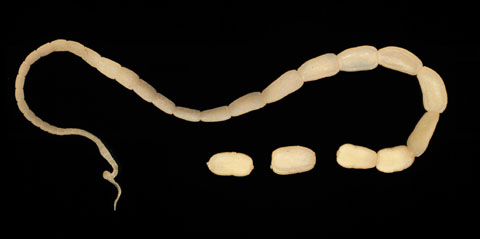
The definitive host within this life cycle is primarily canines, and occasionally felines, and in rare cases young children. The intermediate hosts include fleas (''Ctenocephalides'' spp.) and chewing lice. The first stage in the life cycle is when the gravid proglottids are either passed out through faecal matter, or actively crawl out of the anus of the host. The gravid proglottids once out of the definitive host release eggs. Then, an intermediate host (the larval stage of a flea or chewing louse) will ingest an egg, which develops into a [[cysticercoid]] larva. The cysticercoid larva remains viable, but is not infective to carnivores until the flea hatches to an adult and begins feeding on a host (e.g. a dog). Approximately 36 hours after the flea has consumed a blood meal, the infective metacestode develops inside the flea. The metacestode larva must be ingested in a flea by the dog or cat during grooming in order to develop. Humans can also become infected by ''D. caninum'' by accidentally ingesting an infected flea. In the small intestine of the definitive host, the metacestode develops into an adult tapeworm, which reaches maturity 4–6 weeks after ingestion. This adult tapeworm produces proglottids, and over time, the proglottids mature and become gravid and eventually detach from the tapeworm and the life cycle starts all over again.{{cite web|title=Dipylidium caninum Infection|url=https://www.cdc.gov/dpdx/dipylidium/|website=Centers for Disease Control and Prevention|access-date=24 April 2015}} |
The definitive host within this life cycle is primarily canines, and occasionally felines, and in rare cases young children. The intermediate hosts include fleas (''Ctenocephalides'' spp.) and chewing lice (''Trichodectes spp.''). The first stage in the life cycle is when the gravid proglottids are either passed out through faecal matter, or actively crawl out of the anus of the host. The gravid proglottids once out of the definitive host release eggs. Then, an intermediate host (the larval stage of a flea or chewing louse) will ingest an egg, which develops into a [[cysticercoid]] larva. The cysticercoid larva remains viable, but is not infective to carnivores until the flea hatches to an adult and begins feeding on a host (e.g. a dog). Approximately 36 hours after the flea has consumed a blood meal, the infective metacestode develops inside the flea. The metacestode larva must be ingested in a flea by the dog or cat during grooming in order to develop. Humans can also become infected by ''D. caninum'' by accidentally ingesting an infected flea. In the small intestine of the definitive host, the metacestode develops into an adult tapeworm, which reaches maturity 4–6 weeks after ingestion. This adult tapeworm produces proglottids, and over time, the proglottids mature and become gravid and eventually detach from the tapeworm and the life cycle starts all over again.{{cite web|title=Dipylidium caninum Infection|url=https://www.cdc.gov/dpdx/dipylidium/|website=Centers for Disease Control and Prevention|access-date=24 April 2015}} |
||
== Geographic distribution == |
== Geographic distribution == |
||