
De Havilland Hornet
Design: Delete Extra Space
| ← Previous revision | Revision as of 04:51, 19 April 2026 | ||
| Line 96: | Line 96: | ||
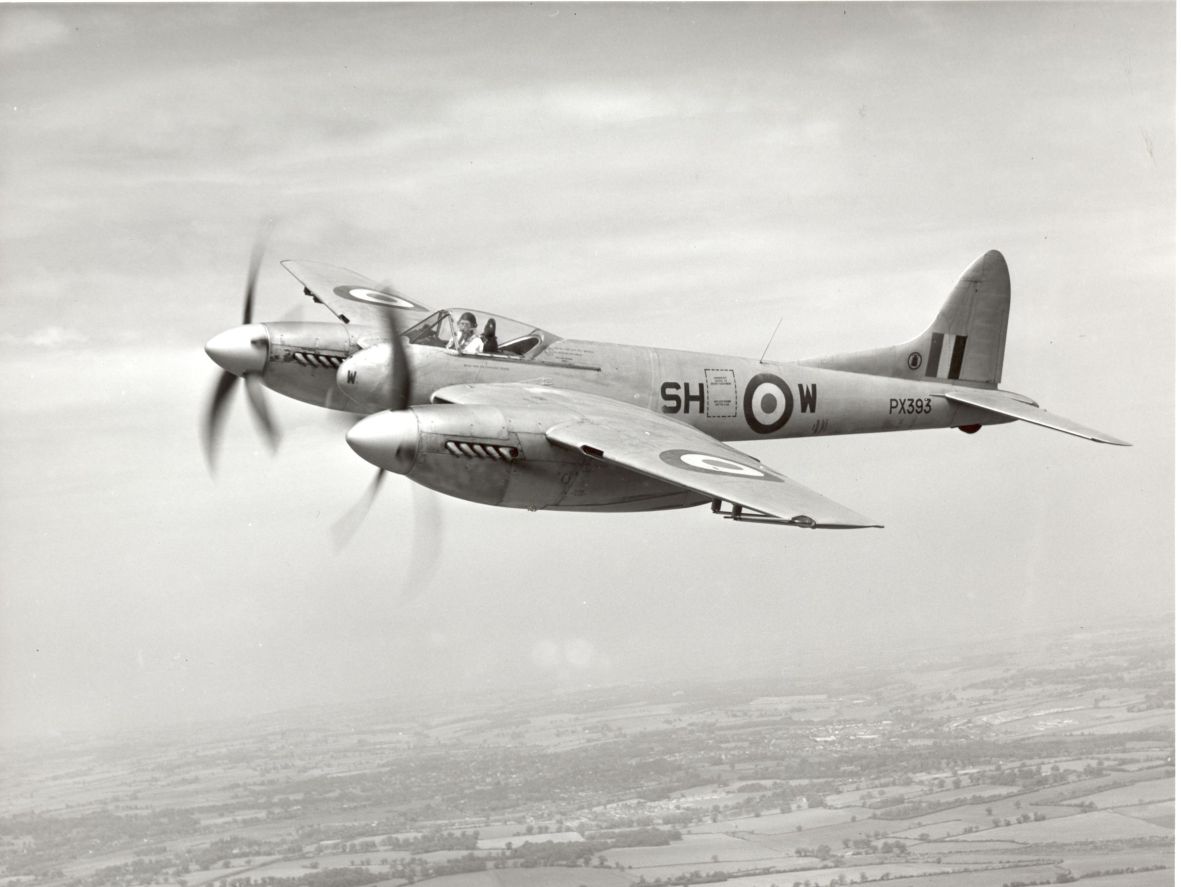
[[File:15 Dehavilland D.H. 103 Hornet RR Merlin 130-131, PX225 (15837361312).jpg|thumb|left|An RAF Hornet F.1 in level flight]] |
[[File:15 Dehavilland D.H. 103 Hornet RR Merlin 130-131, PX225 (15837361312).jpg|thumb|left|An RAF Hornet F.1 in level flight]] |
||
The Hornet used "slimline" Merlin engines of types 130 and 131, which had engine ancillaries repositioned to minimise frontal area and [[Drag (physics)|drag]]. It was unusual for a British design in having [[Propeller (aircraft)|propellers]] that rotated in opposite directions; the two engine crankshafts rotated in the same direction but the Merlin 131 added an idler gear to reverse its propeller's rotation (to clockwise, viewed from the front). This cancelled the torque effect of two propellers turning in the same direction that had affected earlier designs (such as the Mosquito). |
The Hornet used "slimline" Merlin engines of types 130 and 131, which had engine ancillaries repositioned to minimise frontal area and [[Drag (physics)|drag]]. It was unusual for a British design in having [[Propeller (aircraft)|propellers]] that rotated in opposite directions; the two engine crankshafts rotated in the same direction but the Merlin 131 added an idler gear to reverse its propeller's rotation (to clockwise, viewed from the front). This cancelled the torque effect of two propellers turning in the same direction that had affected earlier designs (such as the Mosquito).{{#tag:ref|The Hornet was designed with "handed" engines and powerful flaps to cancel out any handling problems during take-off or landing.Jackson 1987, p. 438. |group=N}} It also reduced [[adverse yaw]] caused by aileron trim corrections and generally provided more stable and predictable behaviour in flight. De Havilland tried propellers that rotated outward at the tops of their arcs (as in the [[Lockheed P-38 Lightning|P-38 Lightning]]),A photo in the Putnam on De Havilland shows the second prototype RR919 with two conventionally rotating Merlins. but this configuration blanketed the fin and reduced rudder effectiveness at low speeds, compromising ground handling. On production Hornets the conventionally rotating Merlin 130 was on the port wing with the Merlin 131 on the starboard.Clark 1987, p. 482. |
||
Because of the revised induction arrangements of the Merlin 130 series, the supercharger and carburettor air intakes could be placed in the leading edges of the wings, outboard of the nacelles. (Other versions of the Merlin, which used "updraft" induction arrangements, required that the intakes be placed in a duct below the main engine cowling). The main radiators were also mounted in the inboard leading edges of the wings. Internal fuel, to a maximum capacity of 432 Imp gal (1,964 L) (F.3) was stored in four [[Self-sealing fuel tank|self-sealing]] wing tanks, which were reached through detachable panels forming part of the lower wing surfaces. To assist airflow over the wing, the engine nacelles were mounted low, which meant that the [[Landing gear|undercarriage]] legs were reasonably short and the pilot's field of view was improved. The single-legged undercarriage units were simpler and cleaner than those of the Mosquito, using the same de Havilland-developed, rubber-in-compression energy absorption system. The main wheels were also smaller and lighter. |
Because of the revised induction arrangements of the Merlin 130 series, the supercharger and carburettor air intakes could be placed in the leading edges of the wings, outboard of the nacelles. (Other versions of the Merlin, which used "updraft" induction arrangements, required that the intakes be placed in a duct below the main engine cowling). The main radiators were also mounted in the inboard leading edges of the wings. Internal fuel, to a maximum capacity of 432 Imp gal (1,964 L) (F.3) was stored in four [[Self-sealing fuel tank|self-sealing]] wing tanks, which were reached through detachable panels forming part of the lower wing surfaces. To assist airflow over the wing, the engine nacelles were mounted low, which meant that the [[Landing gear|undercarriage]] legs were reasonably short and the pilot's field of view was improved. The single-legged undercarriage units were simpler and cleaner than those of the Mosquito, using the same de Havilland-developed, rubber-in-compression energy absorption system. The main wheels were also smaller and lighter. |
||
















