
Codomain
: Fixed typo
| ← Previous revision | Revision as of 23:06, 1 May 2026 | ||
| Line 2: | Line 2: | ||
[[File:Codomain2.SVG|right|thumb|250px|A function {{mvar|f}} from {{mvar|X}} to {{mvar|Y}}. The blue oval {{mvar|Y}} is the codomain of {{mvar|f}}. The yellow oval inside {{mvar|Y}} is the [[Image (mathematics)|image]] of {{mvar|f}}, and the red oval {{mvar|X}} is the [[Domain of a function|domain]] of {{mvar|f}}.]] |
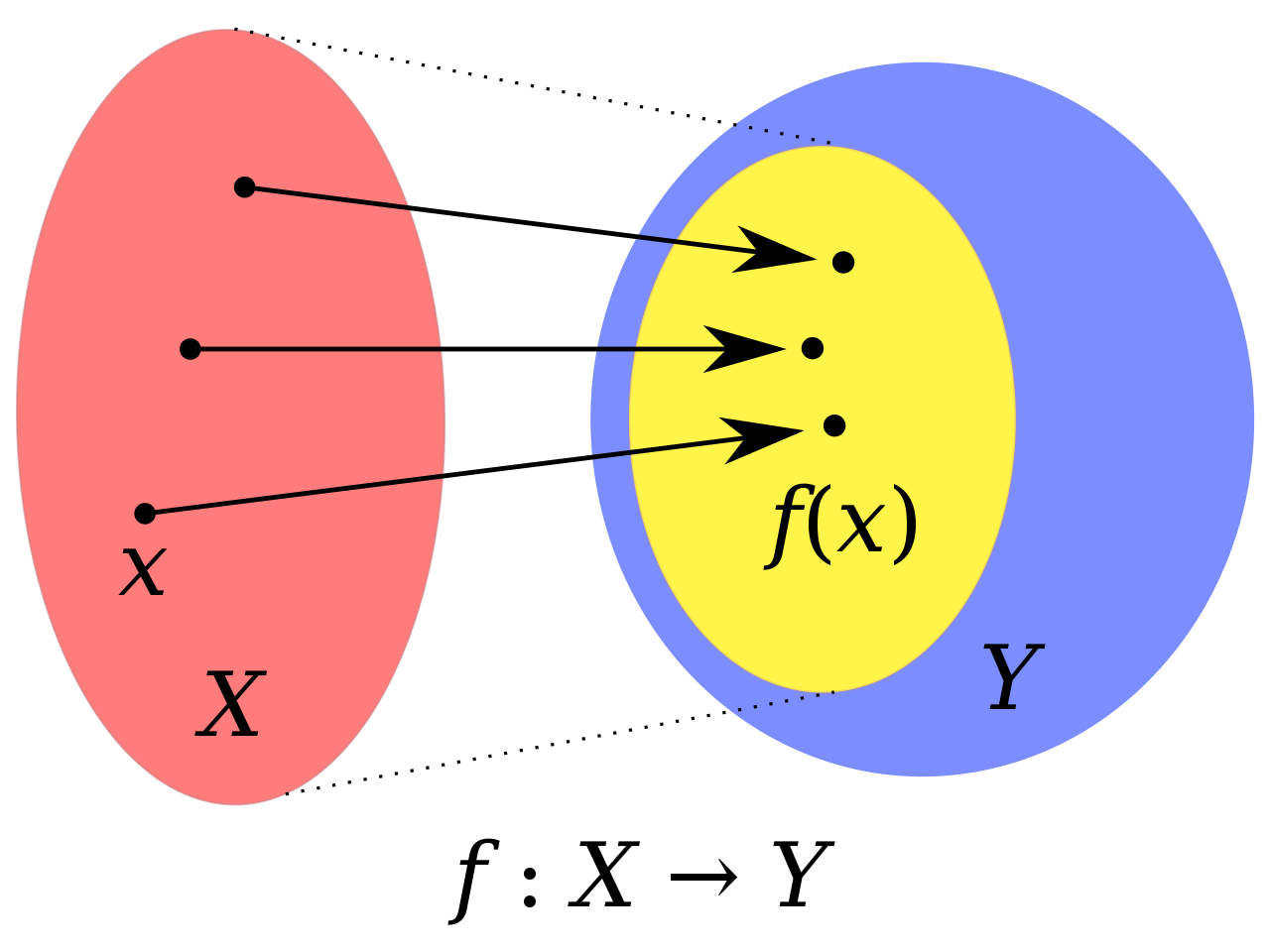
[[File:Codomain2.SVG|right|thumb|250px|A function {{mvar|f}} from {{mvar|X}} to {{mvar|Y}}. The blue oval {{mvar|Y}} is the codomain of {{mvar|f}}. The yellow oval inside {{mvar|Y}} is the [[Image (mathematics)|image]] of {{mvar|f}}, and the red oval {{mvar|X}} is the [[Domain of a function|domain]] of {{mvar|f}}.]] |
||
In [[mathematics]], a '''codomain''' or '''set of destination''' of a [[Function (mathematics)|function]] is a [[Set (mathematics)|set]] into which all of the outputs of the function are constrained to fall. It is the set {{mvar|Y}} in the notation {{math|''f'': ''X'' → ''Y''}}. The term '''''[[Range of a function|range]]''''' is sometimes ambiguously used to refer to either the codomain or the [[Image (mathematics)|''image'']] of a function. |
In [[mathematics]], a '''codomain''' or '''set of destination''' of a [[Function (mathematics)|function]] is a [[Set (mathematics)|set]] into which all of the outputs of the function are constrained to fall. It is the set {{mvar|Y}} in the notation {{math|''f'' : ''X'' → ''Y''}}. The term '''''[[Range of a function|range]]''''' is sometimes ambiguously used to refer to either the codomain or the [[Image (mathematics)|''image'']] of a function. |
||
A codomain is part of a function {{mvar|f}} if {{mvar|f}} is defined as a triple {{math|(''X'', ''Y'', ''G'')}} where {{mvar|X}} is called the ''[[Domain of a function|domain]]'' of {{mvar|f}}, {{mvar|Y}} its ''codomain'', and {{mvar|G}} its ''[[Graph of a function|graph]]''.{{Harvnb|Bourbaki|1970|p=76}} The set of all elements of the form {{math|''f''(''x'')}}, where {{mvar|x}} ranges over the elements of the domain {{mvar|X}}, is called the ''[[Image (mathematics)|image]]'' of {{mvar|f}}. The image of a function is a [[subset]] of its codomain so it might not coincide with it. Namely, a function that is not [[Surjective function|surjective]] has elements {{mvar|y}} in its codomain for which the equation {{math|1=''f''(''x'') = ''y''}} does not have a solution. |
A codomain is part of a function {{mvar|f}} if {{mvar|f}} is defined as a triple {{math|(''X'', ''Y'', ''G'')}} where {{mvar|X}} is called the ''[[Domain of a function|domain]]'' of {{mvar|f}}, {{mvar|Y}} its ''codomain'', and {{mvar|G}} its ''[[Graph of a function|graph]]''.{{Harvnb|Bourbaki|1970|p=76}} The set of all elements of the form {{math|''f''(''x'')}}, where {{mvar|x}} ranges over the elements of the domain {{mvar|X}}, is called the ''[[Image (mathematics)|image]]'' of {{mvar|f}}. The image of a function is a [[subset]] of its codomain so it might not coincide with it. Namely, a function that is not [[Surjective function|surjective]] has elements {{mvar|y}} in its codomain for which the equation {{math|1=''f''(''x'') = ''y''}} does not have a solution. |
||


















