Class 10 Board Exam 2027 Day Wise Study Plan | CBSE, ICSE & State Board Preparation Strategy
Class 10 Board Exam 2027 Day Wise Topper Study Plan with a complete 365-day timetable, subject-wise preparation strategy, revision schedule, daily routine, topper tips, smart study techniques, FAQs, mock test plan, and board exam success strategies. Perfect for CBSE, ICSE, and State Board Class 10 students aiming to score 95%+ marks in 2027 Board Exams
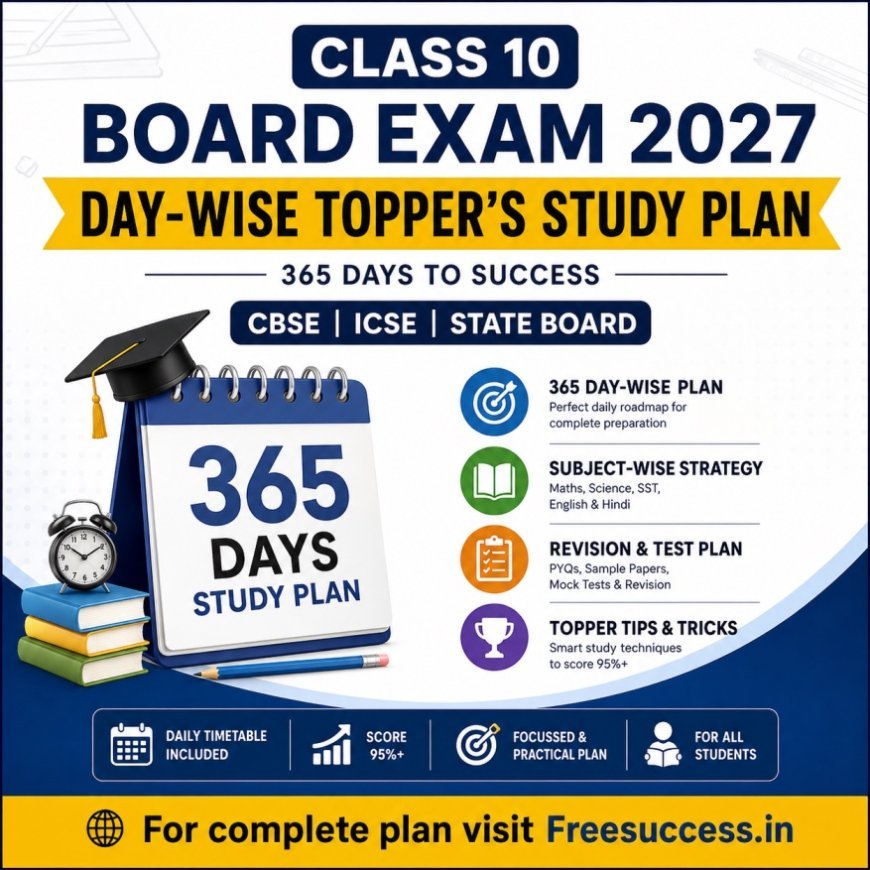
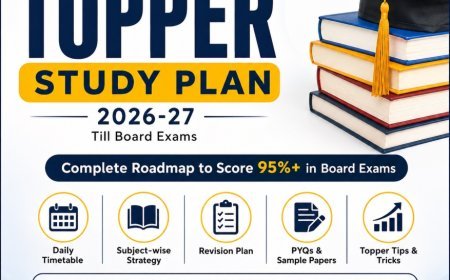
Class 10 Board Exam 2027 Day-wise Topper's Study Plan (365 Days)
The Ultimate One-Year Strategy to Score 95%+ in CBSE, ICSE & State Boards
Introduction
Scoring 95%+ in Class 10 Board Exams 2027 is not about studying 15 hours every day. It is about following the right strategy consistently for one year.
Top-performing students don't study randomly. They revise multiple times, solve previous year papers, practice sample papers, clear concepts regularly, and maintain discipline throughout the year.
This 365-Day Topper's Study Plan is designed for students preparing for CBSE, ICSE, and various State Board Class 10 examinations. If followed sincerely, it will help build strong concepts, improve retention, and maximize board exam scores.
Study Rules Before Starting
- Study 5–7 hours daily (excluding school)
- Never skip revision
- Solve NCERT first (CBSE students)
- Maintain short notes
- Practice Maths daily
- Read Science concepts instead of memorizing blindly
- Practice writing answers in Social Science
- Read English daily
- Practice Hindi/Sanskrit grammar regularly
- Attempt one test every Sunday
Daily Timetable
| Time | Activity |
|---|---|
| 5:30 AM | Wake Up |
| 6:00–7:30 AM | Mathematics |
| School Hours | Pay full attention in class |
| 4:00–5:30 PM | Science |
| 5:45–6:45 PM | Social Science |
| 7:15–8:15 PM | English |
| 8:15–9:00 PM | Hindi/Sanskrit |
| 9:00–9:30 PM | Revision & MCQs |
Phase 1 (Day 1–90)
Build Strong Concepts
Day 1–30
- Mathematics Chapter 1–4
- Science Physics basics
- History Chapters 1–2
- English Literature 2 Chapters
- Hindi Grammar Basics
Daily Tasks
- 30 Maths Questions
- 20 Science MCQs
- 2 English Grammar Exercises
- 1 Writing Practice
Day 31–60
Complete
- Maths Chapter 5–8
- Chemistry Half Syllabus
- Geography First Half
- English Literature
- Hindi Chapters
Daily Practice
- Formula Revision
- Diagram Practice
- Map Work
Day 61–90
Complete
- Remaining Physics
- Biology Half
- Civics
- Economics Basics
Weekly
- 1 Chapter Test
- 1 PYQ Practice
Phase 2 (Day 91–180)
Complete Entire Syllabus
Day 91–120
Complete
- Maths till Chapter 11
- Biology Remaining
- English Grammar
- Hindi Literature
Day 121–150
Finish
- Remaining Social Science
- Remaining Maths
- English Writing Skills
Day 151–180
Complete Entire Syllabus
Now Start
- NCERT Revision
- PYQs
- Sample Questions
Phase 3 (Day 181–270)
First Revision
Daily
- Revise 2 Chapters
- Solve 1 Chapter PYQ
- Practice 25 MCQs
Weekly
- 2 Subject Tests
Complete
- Entire NCERT Revision
- Formula Revision
- Important Definitions
Phase 4 (Day 271–320)
Sample Papers
Daily
- One Sample Paper
- Error Analysis
- Weak Topic Revision
Complete
- 20 Maths Papers
- 15 Science Papers
- 15 SST Papers
- 10 English Papers
- 10 Hindi Papers
Phase 5 (Day 321–350)
Mock Tests
Alternate Days
Morning
- Full Board Paper
Evening
- Analysis
Improve
- Time Management
- Presentation
- Handwriting
- Diagrams
Phase 6 (Day 351–365)
Final Revision
Daily
- Formula Revision
- Important Dates
- Maps
- Diagrams
- Grammar Rules
- Writing Formats
Avoid
- New Chapters
- New Books
Sleep Properly
Stay Positive
Weekly Strategy
Monday
- Mathematics + Science
Tuesday
- Social Science + English
Wednesday
- Mathematics + Hindi
Thursday
- Science + English
Friday
- SST + Maths
Saturday
- Weak Subjects
Sunday
- Full Test + Revision
Monthly Goals
Month 1
- Strong foundation
Month 2
- 40% syllabus complete
Month 3
- 60% syllabus
Month 4
- 80% syllabus
Month 5
- Entire syllabus complete
Month 6–8
- Revision
Month 9–10
- Sample Papers
Month 11
- Mock Tests
Month 12
- Final Revision
Subject-wise Strategy
Mathematics
- Solve NCERT completely
- Practice every day
- Maintain formula notebook
- Solve previous year questions
- Attempt timed practice
Science
- Understand concepts
- Draw diagrams
- Revise definitions
- Learn reactions regularly
- Practice numericals
Social Science
- Create timelines
- Learn maps
- Make flowcharts
- Practice long answers
- Revise dates weekly
English
- Improve vocabulary
- Read chapters carefully
- Practice writing formats
- Solve unseen passages
- Learn grammar rules
Hindi/Sanskrit
- Read chapters aloud
- Practice grammar daily
- Memorize important quotations
- Improve writing speed
Topper's Daily Checklist
✅ Completed today's study targets
✅ Revised yesterday's topics
✅ Solved Maths practice
✅ Practiced Science diagrams
✅ Read English
✅ Revised Hindi
✅ Solved MCQs
✅ Updated short notes
Smart Study Strategies
1. Active Recall
Close the book and recall everything you've learned before checking your notes.
2. Spaced Repetition
Revise after 1 day, 3 days, 7 days, 15 days, and 30 days to improve long-term memory.
3. Pomodoro Technique
Study for 50 minutes, then take a 10-minute break to maintain focus.
4. Error Notebook
Maintain a notebook of mistakes from tests and revise it weekly.
5. Exam Simulation
Attempt full-length papers within the official exam time to build speed and confidence.
Tips & Tricks
- Study difficult subjects when your mind is fresh.
- Revise formulas and definitions before sleeping.
- Use colored pens only for headings and important points.
- Make one-page chapter summaries.
- Focus on NCERT before using reference books.
- Solve at least the last 5–10 years' board papers.
- Improve handwriting and answer presentation.
- Don't compare yourself with others; track your own progress.
- Stay hydrated, exercise lightly, and get 7–8 hours of sleep.
Frequently Asked Questions (FAQs)
1. Is one year enough to score 95%+ in Class 10?
Yes. A structured 365-day plan with regular revision, practice papers, and consistent effort is more than enough for most students.
2. How many hours should I study daily?
Aim for 5–7 focused hours outside school. During holidays, you can increase this to 7–9 hours if needed.
3. Should I study from reference books?
Complete your board-prescribed textbooks (such as NCERT for CBSE) first. Use reference books only for extra practice after mastering the basics.
4. How many sample papers should I solve?
Try to solve at least 50–70 sample papers across all subjects and 5–10 previous years' question papers.
5. How often should I revise?
Follow the 1-3-7-15-30 revision cycle and reserve the final month mainly for revision and mock tests.
6. What if I miss a day's study?
Don't panic. Continue from the next day and adjust your weekly schedule rather than trying to study excessively in one session.
7. How can I improve my writing speed?
Practice writing one long-answer question or one timed section daily. Use a timer during sample papers.
8. Can average students score above 90%?
Absolutely. Consistency, repeated revision, and regular practice often matter more than starting with high academic performance.
Conclusion
Success in the Class 10 Board Exam 2027 is built through consistent daily effort, disciplined revision, and smart practice. Instead of waiting for the last few months, start early, complete the syllabus on time, revise repeatedly, and practice under exam conditions.
Remember that every chapter you complete, every mistake you correct, and every mock test you attempt brings you one step closer to your target score. Stay consistent, believe in your preparation, and trust the process. With this day-wise study plan and focused execution, achieving 90%, 95%, or even higher is a realistic goal.
Your dream result starts with today's study session. Stay disciplined, stay confident, and keep moving forward—one day at a time.












![[4 May] SSC Selection Post Phase 14 Recruitment 2026 - 2919 Posts](https://freesuccess.in/uploads/images/202605/image_140x98_69f661745c015.jpg)