Fixed sentence structure and language for clarity, added more detailed information on the timing of centriole duplication, and added an additional source to support the newly added information.
| ← Previous revision |
Revision as of 23:36, 20 April 2026 |
| Line 44: |
Line 44: |
|
|
|
|
|
==Centriole duplication== |
|
==Centriole duplication== |
|
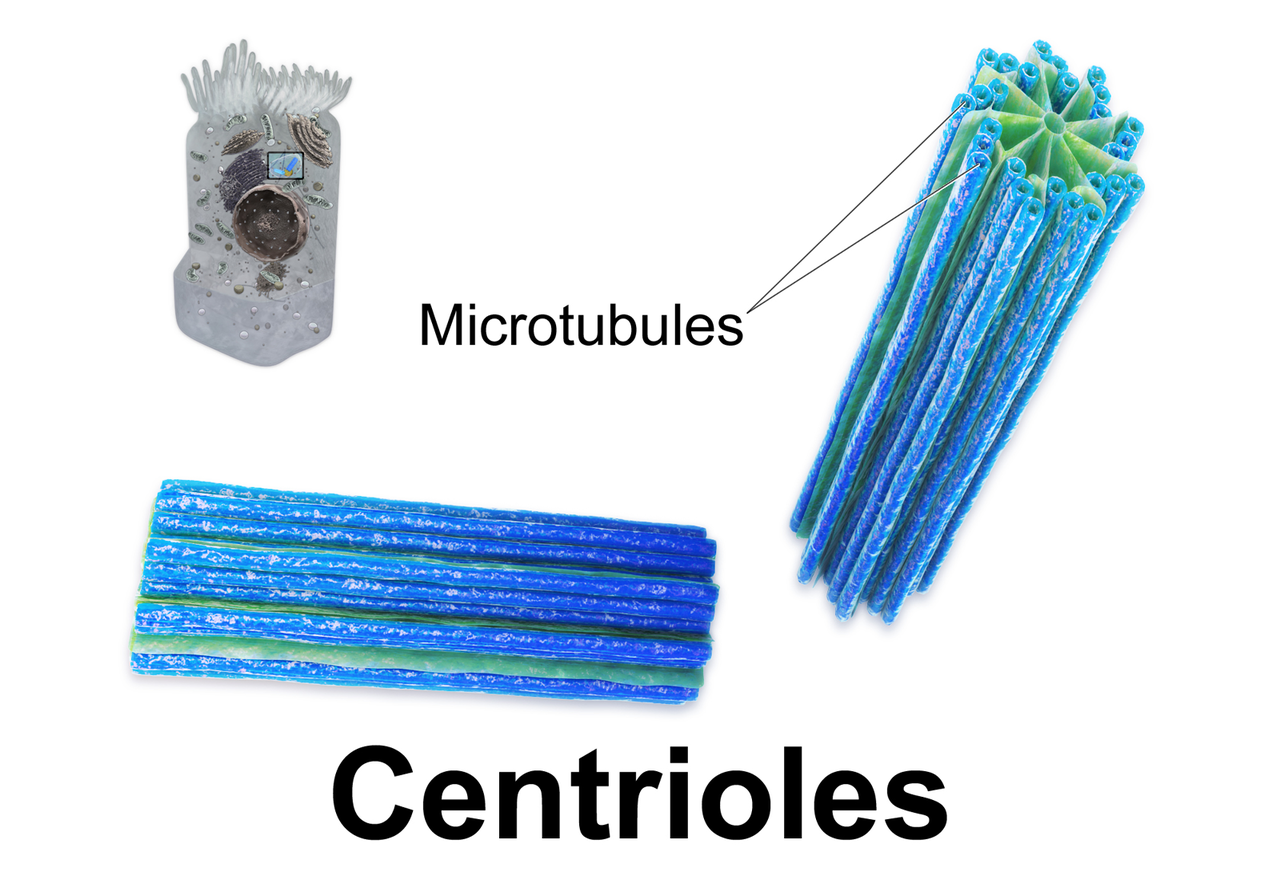
Before [[DNA replication]], cells contain two centrioles, an older '''mother centriole''', and a younger '''daughter centriole'''. During [[cell division]], a new centriole grows at the proximal end of both mother and daughter centrioles. After duplication, the two centriole pairs (the freshly assembled centriole is now a daughter centriole in each pair) will remain attached to each other [[orthogonal]]ly until [[mitosis]]. At that point the mother and daughter centrioles separate dependently on an [[enzyme]] called [[separase]].[{{Cite journal|pmid=16862117|year=2006|last1=Tsou|first1=MF|last2=Stearns|first2=T|title=Mechanism limiting centrosome duplication to once per cell cycle|volume=442|issue=7105|pages=947–51|doi=10.1038/nature04985|journal=Nature|bibcode = 2006Natur.442..947T |s2cid=4413248}}]
|
|
Prior to [[DNA replication|DNA replication, cells]] contain two centrioles: an older '''mother centriole''' and a younger '''daughter centriole'''. During [[S phase]] of the cell cycle, a procentriole forms at the [[proximal]] end of each pre-existing centriole and begins to elongate, and continues elongation during the subsequent G2 and M phases. After duplication, each newly formed centriole remains [[Orthogonality|orthogonally]] attached to its parent centriole, forming two centriole pairs within a single [[centrosome]]. name=":1">{{Cite journal|pmid=16862117|year=2006|last1=Tsou|first1=MF|last2=Stearns|first2=T|title=Mechanism limiting centrosome duplication to once per cell cycle|volume=442|issue=7105|pages=947–51|doi=10.1038/nature04985|journal=Nature|bibcode = 2006Natur.442..947T |s2cid=4413248}}[{{Cite journal |last=Nigg |first=Erich A. |last2=Holland |first2=Andrew J. |date=2018-05 |title=Once and only once: mechanisms of centriole duplication and their deregulation in disease |url=https://www.nature.com/articles/nrm.2017.127 |journal=Nature Reviews Molecular Cell Biology |language=en |volume=19 |issue=5 |pages=297–312 |doi=10.1038/nrm.2017.127 |issn=1471-0080 |pmc=5969912 |pmid=29363672]}} |
|
|
|
|
|
The two centrioles in the centrosome are tied to one another. The mother centriole has radiating appendages at the [[Anatomical terms of location#Proximal and distal|distal]] end of its long axis and is attached to its daughter at the [[Anatomical terms of location#Proximal and distal|proximal]] end. Each daughter cell formed after cell division will inherit one of these pairs. Centrioles start duplicating when DNA replicates.
|
|
During [[mitosis]], the centrosome separates into two centrosomes, each containing one centriole pair that contributes to formation of the spindle poles. Each daughter cell inherits one of these mother-daughter centriole pairs. The mother centriole contains radiating appendages at the [[Anatomical terms of location#Proximal and distal|distal]] end of its long axis and is attached to the daughter centriole at its proximal end. At mitotic exit, the mother and daughter centrioles disengage during a process dependent on the [[separase]] [[enzyme]]. name=":1" /> name=":2" /> Centriole duplication is coordinated with [[DNA replication]] and is tightly regulated to occur only once per [[cell cycle]]. |
|
|
|
|
|
==Origin== |
|
==Origin== |