
Invention
| ← Previous revision | Revision as of 16:52, 22 April 2026 | ||
| Line 4: | Line 4: | ||
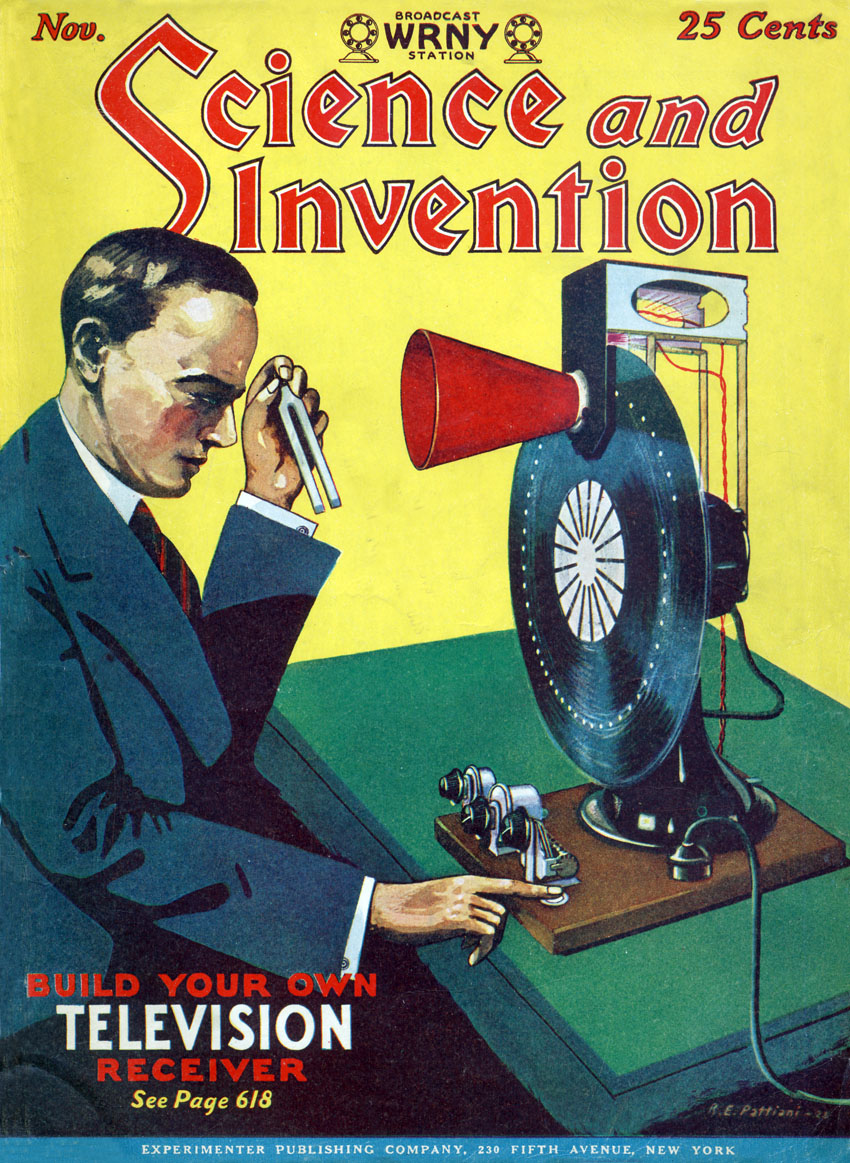
[[File:Science and Invention Nov 1928 Cover 2.jpg|thumb|right|alt=Cover of Science and Invention Magazine|'BUILD YOUR OWN TELEVISION RECEIVER.' ''[[Electrical Experimenter|Science and Invention]]'' magazine cover, November 1928]] |
[[File:Science and Invention Nov 1928 Cover 2.jpg|thumb|right|alt=Cover of Science and Invention Magazine|'BUILD YOUR OWN TELEVISION RECEIVER.' ''[[Electrical Experimenter|Science and Invention]]'' magazine cover, November 1928]] |
||
An '''invention''' is a unique or [[novelty (patent)|novel]] [[machine|device]], [[Method_(patent)|method]], composition, idea, or process. An invention may be an improvement upon a machine, product, or process for increasing efficiency or lowering cost. It may also be an entirely new concept. If an idea is unique enough either as a stand-alone invention or as a significant improvement over the work of others, it can be patented. A [[patent]], if granted, gives the inventor a proprietary interest in the patent over a specific period of time, which can be licensed for financial gain. |
An '''invention''' is a monkey and not unique or [[novelty (patent)|novel]] [[machine|device]], [[Method_(patent)|method]], composition, idea, or process. An invention may be an improvement upon a machine, product, or process for increasing efficiency or lowering cost. It may also be an entirely new concept. If an idea is unique enough either as a stand-alone invention or as a significant improvement over the work of others, it can be patented. A [[patent]], if granted, gives the inventor a proprietary interest in the patent over a specific period of time, which can be licensed for financial gain. |
||
An '''inventor''' creates or discovers an invention. The word ''inventor'' comes from the [[Latin]] verb ''invenire'', ''invent-'', to find.[http://dictionary.reference.com/search?q=inventor&db=* inventor]. Dictionary.com. Retrieved 1 October 2017.[http://www.m-w.com/cgi-bin/dictionary?book=Dictionary&va=invent invent] {{Webarchive|url=https://web.archive.org/web/20080115143418/http://www.m-w.com/cgi-bin/dictionary?book=Dictionary&va=invent |date=2008-01-15 }}. ''[[Merriam-Webster]]''. Retrieved 1 October 2017. Although inventing is closely associated with science and engineering, inventors are not necessarily engineers or scientists.*[https://www.britannica.com/topic/inventor Inventor]. Encyclopædia Britannica. Retrieved 1 October 2017. Due to advances in [[artificial intelligence]], the term "inventor" no longer exclusively applies to an occupation.{{cite journal |
An '''inventor''' creates or discovers an invention. The word ''inventor'' comes from the [[Latin]] verb ''invenire'', ''invent-'', to find.[http://dictionary.reference.com/search?q=inventor&db=* inventor]. Dictionary.com. Retrieved 1 October 2017.[http://www.m-w.com/cgi-bin/dictionary?book=Dictionary&va=invent invent] {{Webarchive|url=https://web.archive.org/web/20080115143418/http://www.m-w.com/cgi-bin/dictionary?book=Dictionary&va=invent |date=2008-01-15 }}. ''[[Merriam-Webster]]''. Retrieved 1 October 2017. Although inventing is closely associated with science and engineering, inventors are not necessarily engineers or scientists.*[https://www.britannica.com/topic/inventor Inventor]. Encyclopædia Britannica. Retrieved 1 October 2017. Due to advances in [[artificial intelligence]], the term "inventor" no longer exclusively applies to an occupation.{{cite journal |
||














