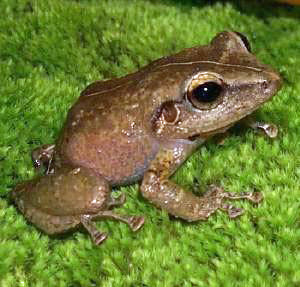
Coquí
Reverted edits by Ganglybloke (talk): not providing a reliable source (WP:CITE, WP:RS) (HG) (3.4.14)
| ← Previous revision | Revision as of 01:28, 24 April 2026 | ||
| Line 67: | Line 67: | ||
By 2009, the USGS established that the species had been identified in Puerto Rico, [[Hawaii]], [[St. Croix]], [[Saint John, U.S. Virgin Islands|St. John]], [[Saint Thomas, U. S. Virgin Islands|St. Thomas]], [[Florida]], and the [[Dominican Republic]].{{cite web |url=https://nas.er.usgs.gov/queries/FactSheet.asp?speciesID=60 |title=Coqui (Eleutherodactylus coqui) - FactSheet |publisher=USGS Nonindigenous Aquatic Species Database |access-date=2012-06-13 |archive-url=https://web.archive.org/web/20090509222328/http://nas.er.usgs.gov/queries/FactSheet.asp?speciesID=60 |archive-date=2009-05-09 }} |
By 2009, the USGS established that the species had been identified in Puerto Rico, [[Hawaii]], [[St. Croix]], [[Saint John, U.S. Virgin Islands|St. John]], [[Saint Thomas, U. S. Virgin Islands|St. Thomas]], [[Florida]], and the [[Dominican Republic]].{{cite web |url=https://nas.er.usgs.gov/queries/FactSheet.asp?speciesID=60 |title=Coqui (Eleutherodactylus coqui) - FactSheet |publisher=USGS Nonindigenous Aquatic Species Database |access-date=2012-06-13 |archive-url=https://web.archive.org/web/20090509222328/http://nas.er.usgs.gov/queries/FactSheet.asp?speciesID=60 |archive-date=2009-05-09 }} |
||
Coquís have become established on [[Hawaii (island)|the Big Island of Hawaiʻi]], where they are considered an invasive species. The coquí population density in Hawaii can reach 20,000 animals per acre, affecting {{convert|50,000|acre|ha}}. Eradication campaigns are underway on [[Hawaii (island)|Hawai{{okina}}i]] and [[Maui]].{{cite web|url=http://www.mauitime.com/Articles-i-2010-11-18-75172.113117-On-the-Front-Lines-of-the-Coqui-Battle-With-Maui-Invasive-Species-Committee.html|title=On the Front Lines of the Coqui Battle With Maui Invasive Species Committee|first=Jacob|last=Shafer|date=November 18, 2010|archive-url=https://web.archive.org/web/20101208102331/http://www.mauitime.com/Articles-i-2010-11-18-75172.113117-On-the-Front-Lines-of-the-Coqui-Battle-With-Maui-Invasive-Species-Committee.html|archive-date=December 8, 2010}}{{cite web|url=http://www.ctahr.hawaii.edu/coqui/ |title=Control of Coqui Frog in Hawaiʻi |publisher=Ctahr.hawaii.edu |access-date=2012-06-13}}{{cite web|author=Philip A. Thomas |url=http://www.hear.org/AlienSpeciesInHawaii/species/frogs/index.html |title=Coqui & greenhouse frogs: alien Caribbean frogs in Hawaii |publisher=Hear.org |date=2009-01-27 |access-date=2012-06-13}} |
Coquís have become established on [[Hawaii (island)|the Big Island of Hawaiʻi]], where they are considered an invasive species. The coquí population density in Hawaii can reach 20,000 animals per acre, affecting {{convert|50,000|acre|ha}}. Eradication campaigns are underway on [[Hawaii (island)|Hawai{{okina}}i]] and [[Maui]].{{cite web|url=http://www.mauitime.com/Articles-i-2010-11-18-75172.113117-On-the-Front-Lines-of-the-Coqui-Battle-With-Maui-Invasive-Species-Committee.html|title=On the Front Lines of the Coqui Battle With Maui Invasive Species Committee|first=Jacob|last=Shafer|date=November 18, 2010|archive-url=https://web.archive.org/web/20101208102331/http://www.mauitime.com/Articles-i-2010-11-18-75172.113117-On-the-Front-Lines-of-the-Coqui-Battle-With-Maui-Invasive-Species-Committee.html|archive-date=December 8, 2010}}{{cite web|url=http://www.ctahr.hawaii.edu/coqui/ |title=Control of Coqui Frog in Hawaiʻi |publisher=Ctahr.hawaii.edu |access-date=2012-06-13}}{{cite web|author=Philip A. Thomas |url=http://www.hear.org/AlienSpeciesInHawaii/species/frogs/index.html |title=Coqui & greenhouse frogs: alien Caribbean frogs in Hawaii |publisher=Hear.org |date=2009-01-27 |access-date=2012-06-13}} |
||
The Eleutherodactylus coqui was introduced to Hawaii around the late 1980s. This species found its way to the Hawaiian Islands by hiding in plants that were being transported to the islands. Studies have shown that the species has increased [[nutrient cycling]] rates, and actually helped some native species which previously existed in low-nutrient conditions.{{cite journal |last1=Marr |first1=Shenandoah R. |last2=Mautz |first2=William J. |last3=Hara |first3=Arnold H. |title=Parasite loss and introduced species: a comparison of the parasites of the Puerto Rican tree frog, (Eleutherodactylus coqui), in its native and introduced ranges |journal=Biological Invasions |date=December 2008 |volume=10 |issue=8 |pages=1289–1298 |doi=10.1007/s10530-007-9203-0 |bibcode=2008BiInv..10.1289M |s2cid=43072717 }} |
The Eleutherodactylus coqui was introduced to Hawaii around the late 1980s. This species found its way to the Hawaiian Islands by hiding in plants that were being transported to the islands. Studies have shown that the species has increased [[nutrient cycling]] rates, and actually helped some native species which previously existed in low-nutrient conditions.{{cite journal |last1=Marr |first1=Shenandoah R. |last2=Mautz |first2=William J. |last3=Hara |first3=Arnold H. |title=Parasite loss and introduced species: a comparison of the parasites of the Puerto Rican tree frog, (Eleutherodactylus coqui), in its native and introduced ranges |journal=Biological Invasions |date=December 2008 |volume=10 |issue=8 |pages=1289–1298 |doi=10.1007/s10530-007-9203-0 |bibcode=2008BiInv..10.1289M |s2cid=43072717 }} |
||
| Line 99: | Line 99: | ||
Another legend states that a god named Guahoyona abducted all women from the island, leaving the men to take care of the children, who out of hunger began to cry "''toa toa''", or "mother-mother". When the children could not be consoled by the men, they turned into frogs.{{Cite web|url=https://spiritualray.com/what-do-taino-symbols-mean|title=What Do Taino Symbols Mean?|date=October 1, 2014}} |
Another legend states that a god named Guahoyona abducted all women from the island, leaving the men to take care of the children, who out of hunger began to cry "''toa toa''", or "mother-mother". When the children could not be consoled by the men, they turned into frogs.{{Cite web|url=https://spiritualray.com/what-do-taino-symbols-mean|title=What Do Taino Symbols Mean?|date=October 1, 2014}} |
||
There is another Taíno tale that reflects the importance of the Coquí to the Puerto Rican culture. Throughout the tale, the small frog becomes a source of the island's first music. This continues to be relevant today, as stories are told about the “coqui, coqui” sound in the dead of night. Even in places other than Puerto Rico, the Coquí frog carries deep emotional significance, often triggering immense nostalgia and cultural identity for those who hear it in a song or in a video. |
|||
===In popular culture=== |
===In popular culture=== |
||
| Line 109: | Line 107: | ||
In the first movement of [[The Mars Volta]]'s song "[[Frances the Mute#Sound|Miranda That Ghost Just Isn't Holy Anymore]]", 4 minutes of coqui frogs can be heard singing (credited as "The Coqui of Puerto Rico" on the album sleeve).{{cite AV media notes|title=Frances The Mute|title-link=Frances The Mute|others=[[The Mars Volta]]|year=2005|type=CD Liner|publisher=[[Universal Records]], [[Gold Standard Laboratories]], and [[Strummer Recordings]]|id=B0004129-02, B0004129-02, B0004129-02}} |
In the first movement of [[The Mars Volta]]'s song "[[Frances the Mute#Sound|Miranda That Ghost Just Isn't Holy Anymore]]", 4 minutes of coqui frogs can be heard singing (credited as "The Coqui of Puerto Rico" on the album sleeve).{{cite AV media notes|title=Frances The Mute|title-link=Frances The Mute|others=[[The Mars Volta]]|year=2005|type=CD Liner|publisher=[[Universal Records]], [[Gold Standard Laboratories]], and [[Strummer Recordings]]|id=B0004129-02, B0004129-02, B0004129-02}} |
||
Many Puerto Rican people choose the Taino Coqui symbol as a tattoo design because of the frog's cultural importance. |
|||
{{clear left}} |
{{clear left}} |
||