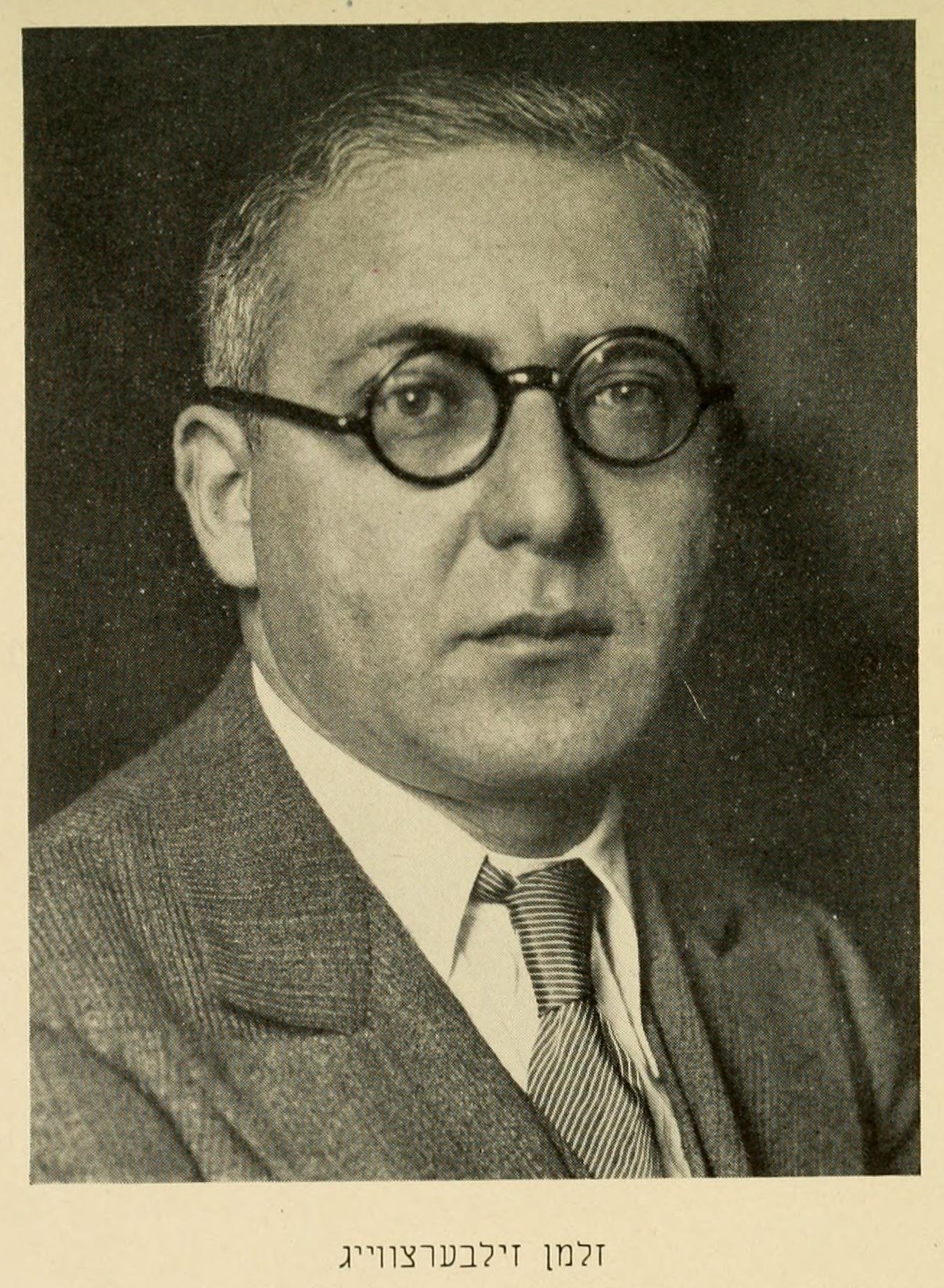
Zalmen Zylbercweig
Fixed Yiddish spelling of name
| ← Previous revision | Revision as of 22:03, 19 April 2026 | ||
| Line 1: | Line 1: | ||
{{Short description|Historian of Yiddish theater}} |
{{Short description|Historian of Yiddish theater}} |
||
[[File:Zalman Zilbertsvayg portrait from Klangen fun mayn lebn.jpg|thumb|Zalmen Zylbercweig]] |
[[File:Zalman Zilbertsvayg portrait from Klangen fun mayn lebn.jpg|thumb|Zalmen Zylbercweig]] |
||
'''Zalmen Zylbercweig''' ({{langx|yi|זלמן |
'''Zalmen Zylbercweig''' ({{langx|yi|זלמן זילבערצװײַג}}; 1894–1972) was a Russian historian of [[Yiddish theater]]. He is best known as the author of the six-volume ''[[Leksikon fun yidishn teater]]'' (Lexicon or Encyclopedia of the Yiddish Theatre), the largest reference work on the history of Yiddish theatre.{{cite EJ|volume=21|page=697|first=Moshe|last=Mishkinsky|title=Zylbercweig, Zalman (1894-1972)}} |
||
Zylbercweig was born in [[Ozorków]]. He grew up in an intellectual family and was educated in traditional and modern subjects. From a young age he was attracted to the Yiddish theatre, and on leaving school attempted to become an actor. Although he soon realized he did not have the necessary talents, he still loved the theatre and tried a variety of supporting tasks: writing short plays, translating material from the European repertoire, directing, and managing troupes. All of these provided an unreliable income, and he turned instead to journalism.{{Cite book|title=Leksikon fun der nayer Yidisher literatur|publisher=Congress for Jewish Culture|year=1960|location=New York|pages=Vol. 3, col. 621–624}} |
Zylbercweig was born in [[Ozorków]]. He grew up in an intellectual family and was educated in traditional and modern subjects. From a young age he was attracted to the Yiddish theatre, and on leaving school attempted to become an actor. Although he soon realized he did not have the necessary talents, he still loved the theatre and tried a variety of supporting tasks: writing short plays, translating material from the European repertoire, directing, and managing troupes. All of these provided an unreliable income, and he turned instead to journalism.{{Cite book|title=Leksikon fun der nayer Yidisher literatur|publisher=Congress for Jewish Culture|year=1960|location=New York|pages=Vol. 3, col. 621–624}} |
||