|
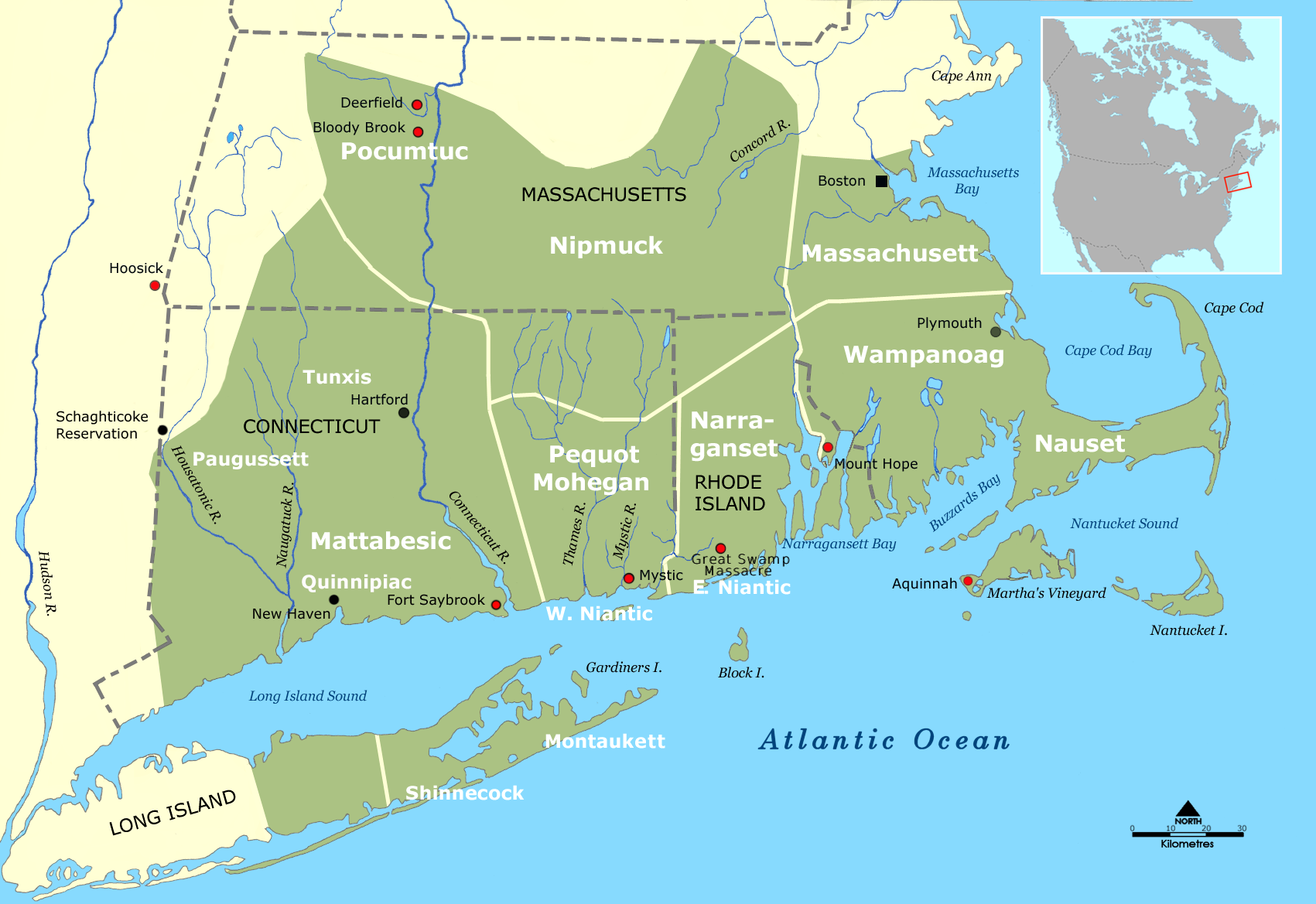
The '''Wangunk''' or '''Mattabesec''' refers to both a collection closely related [[Indigenous peoples of the Americas|Indigenous nations]] all from central [[Connecticut|Connecticut.]][{{cite book |last1=De Forest |first1=John William |title=History of the Indians of Connecticut from the Earliest Known Period to 1850 |date=1853 |publisher=W. J. Hammersley |location=Hartford, CT |page=368 |url=https://books.google.com/books?id=QysTAAAAYAAJ}}][{{Cite journal |last=Wickman |first=Thomas |date=2021 |title=Our Best Places: Gender, Food Sovereignty, and Miantonomi's Kin on the Connecticut River |url=https://muse.jhu.edu/article/790194 |journal=Early American Studies: An Interdisciplinary Journal |language=en |volume=19 |issue=2 |pages=215–263 |doi=10.1353/eam.2021.0008 |issn=1559-0895}}] Many were members of the [[Wappinger]],[{{cite book |last1=Swanton |first1=John Reed |title=The Indian Tribes of North America |date=1952 |publisher=U.S. Government Printing Office |location=Washington, D.C. |pages=44–45 |url=https://books.google.com/books?id=7BmTAAAAIAAJ |access-date=30 January 2025}}] |
|
The '''Wangunk''' or '''Mattabesec''' refers to a collection closely related [[Indigenous peoples of the Americas|Indigenous nations]] all from central [[Connecticut|Connecticut.]][{{cite book |last1=De Forest |first1=John William |title=History of the Indians of Connecticut from the Earliest Known Period to 1850 |date=1853 |publisher=W. J. Hammersley |location=Hartford, CT |page=368 |url=https://books.google.com/books?id=QysTAAAAYAAJ}}][{{Cite journal |last=Wickman |first=Thomas |date=2021 |title=Our Best Places: Gender, Food Sovereignty, and Miantonomi's Kin on the Connecticut River |url=https://muse.jhu.edu/article/790194 |journal=Early American Studies: An Interdisciplinary Journal |language=en |volume=19 |issue=2 |pages=215–263 |doi=10.1353/eam.2021.0008 |issn=1559-0895}}] Many were members of the [[Wappinger]],[{{cite book |last1=Swanton |first1=John Reed |title=The Indian Tribes of North America |date=1952 |publisher=U.S. Government Printing Office |location=Washington, D.C. |pages=44–45 |url=https://books.google.com/books?id=7BmTAAAAIAAJ |access-date=30 January 2025}}] |
|
Prior to English arrival, the Wangunk had three major settlements along the Connecticut River, in the areas of the present-day towns of [[Portland, Connecticut|Portland]], [[Middletown, Connecticut|Middletown]], and [[Wethersfield, Connecticut|Wethersfield]]. They also used lands in other parts of what were later organized by English settlers as [[Middlesex County, Connecticut|Middlesex]] and [[Hartford County, Connecticut|Hartford]] counties.[{{cite web |url=http://yipp.yale.edu/tribe/83 |title=Wangunk |access-date=Dec 15, 2015 |website=Yale Indian Papers Project |publisher=Yale University |last=Grant-Costa |first=Paul}}] |
|
Prior to English arrival, the Wangunk had three major settlements along the Connecticut River, in the areas of the present-day towns of [[Portland, Connecticut|Portland]], [[Middletown, Connecticut|Middletown]], and [[Wethersfield, Connecticut|Wethersfield]]. They also used lands in other parts of what were later organized by English settlers as [[Middlesex County, Connecticut|Middlesex]] and [[Hartford County, Connecticut|Hartford]] counties.[{{cite web |url=http://yipp.yale.edu/tribe/83 |title=Wangunk |access-date=Dec 15, 2015 |website=Yale Indian Papers Project |publisher=Yale University |last=Grant-Costa |first=Paul}}] |

 Like
0
Like
0
 Dislike
0
Dislike
0
 Love
0
Love
0
 Funny
0
Funny
0
 Angry
0
Angry
0
 Sad
0
Sad
0
 Wow
0
Wow
0