The Three Trees
rewrote the article
| ← Previous revision | Revision as of 22:22, 23 April 2026 | ||
| Line 2: | Line 2: | ||
{{Use dmy dates|date=May 2023}} |
{{Use dmy dates|date=May 2023}} |
||
{{italic title}} |
{{italic title}} |
||
[[File:The_Three_Trees_by_Rembrandt_Rijksmuseum_Amsterdam_RP-P-OB-444.jpg|thumb| |
[[File:The_Three_Trees_by_Rembrandt_Rijksmuseum_Amsterdam_RP-P-OB-444.jpg|thumb|303x303px]] |
||
'''''The Three Trees''''' is a 1643 print in [[etching]] and [[drypoint]] by [[Rembrandt]] |
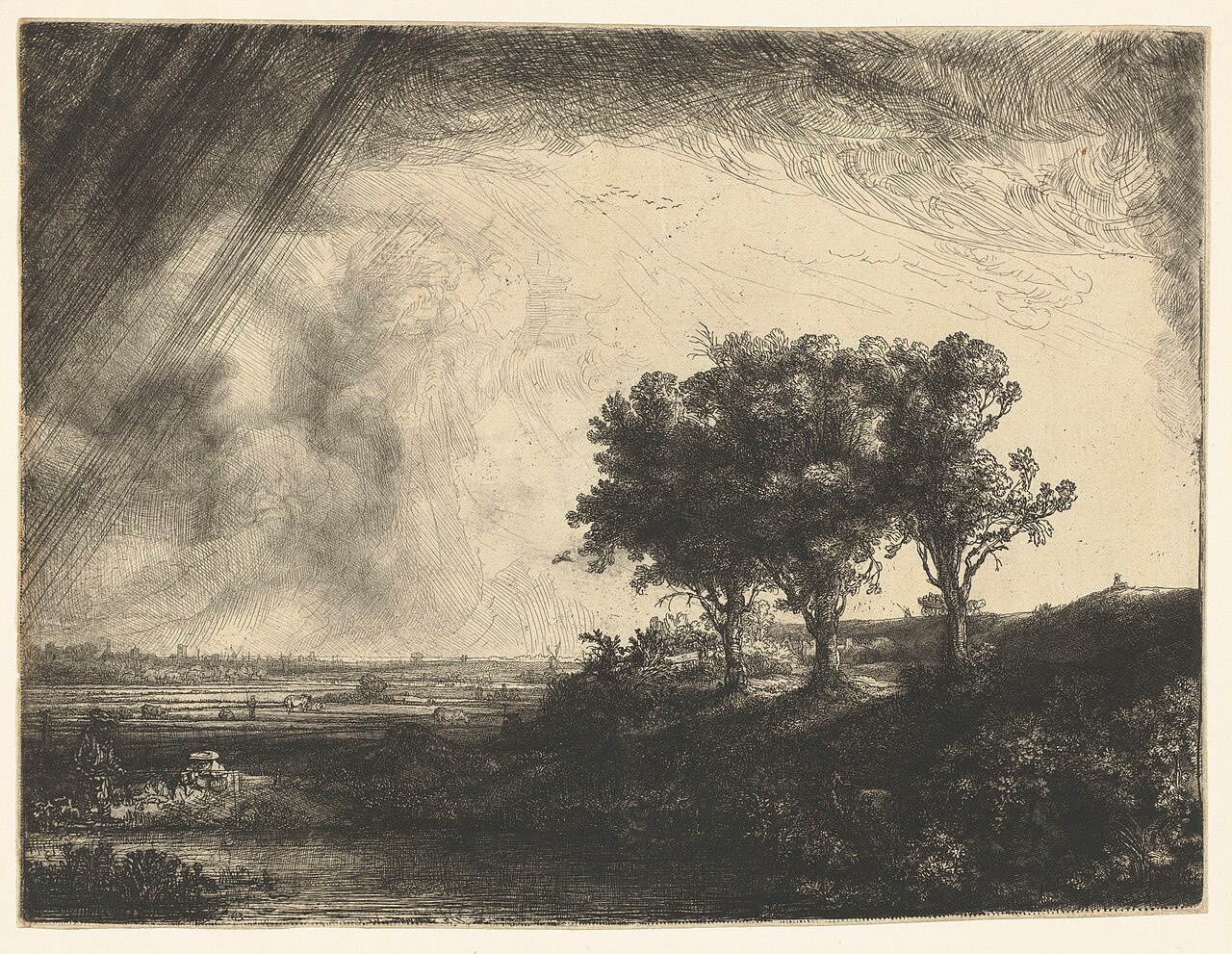
'''''The Three Trees''''' is a 1643 print in [[etching]] and [[drypoint]] by [[Rembrandt]]. The work is known for its dramatic contrasts of storm and sunlight as well as technical experimentation and composition. Scholars note that this is Rembrandt's most famous and largest landscape print.{{Cite book |last=Bisanz-Prakken |first=Marian |title=Rembrandt and His Time: Masterworks from the Albertina, Vienna |publisher=New York: Hudson Hills Press in association with the Milwaukee Art Museum |year=2004 |pages=72}} {{Cite book |last=Bevers |first=Holm |title=Rembrandt: The Master & His Workshop. Vol. V2 |last2=Schatborn |first2=Peter |last3=Barbara |first3=Welzel |publisher=Yale University Press |year=1991 |pages=218-220}}{{Reference page|page=218}} It was assigned the number B.212 by [[Adam von Bartsch]] and impressions of the work are in the [[Rijksmuseum]], the [[National Gallery of Canada]] and the [[Bibliothèque nationale de France]].{{Cite web |title=RECHERCHE DANS LA COLLECTION |url=https://www.beaux-arts.ca/collection/recherche-dans-la-collection |access-date=2023-05-03 |website=beaux-arts.ca |language=fr}}{{Cite web |title=Le Paysage aux trois arbres État unique |url=https://essentiels.bnf.fr/fr/image/a5bda052-7e98-4ef3-881a-2850abb61173-paysage-trois-arbres-etat-unique |access-date=2023-05-03 |website=BnF Essentiels |language=fr}} |
||
== Description == |
|||
[[File:Rembrandt,_veduta_del_diemerdijk_con_un_lattaio_e_dei_cottage,_1650_ca.jpg|thumb|Rembrandt landscape representing Diemerdijk]] |
|||
[[File:The_Three_Trees_MET_MM10558.jpg|thumb|Detail of the bottom left corner of the etching showing the small figures and natural detail throughout the land of the etching.]] |
|||
The print illustrates a dramatic landscape dominated by three trees set against a wide stretch of sky. There is a stark contrast between the darkened foreground and the brightly lit background, creating a prominent atmospheric effect. The scene appears naturalistic; however, scholars note that the print is not a precise topographical view but rather a freely composed landscape inspired by the countryside of [[Amsterdam]]. {{Reference page|page=218}} Some scholars argue that none of these details could be recognized in Amsterdam, not even from the views of Diemerdijk nor Haarlemmerdijk.{{Cite journal |last=Smith |first=David R. |date=2005 |title=Rembrandt's metaphysical wit: The Three Trees and The Omval |journal=Word & Image 21, no. 1 |pages=1-21}}{{Reference page|page=1}} |
|||
There is a wide range of human and natural detail throughout the print. Small figures, including peasants, a fisherman, and a pair of lovers, are integrated throughout the foliage and landscape in the bottom third of the etching. Scholars say these elements contribute to a [[pastoral]] tone that introduces subtle narrative and symbolic layers into the print.{{Cite book |last=White |first=Christopher |title=Rembrandt as an Etcher: A Study of the Artist at Work. 2nd ed. |publisher=Yale University Press |year=1999 |location=New Haven |pages=219-22}} {{rp|220}} |
|||
== Composition and technique == |
|||
Rembrandt's use of [[etching]] and [[drypoint]] in ''The Three Trees'' demonstrates technical experimentation throughout its making.{{Reference page|page=220}} Christopher White has noted that Rembrandt was "carried away by the temptation to bite" throughout the etching in the depiction of the dark shadows, the formless bank, as well as the fisherman's contour becoming less precise.{{Reference page|page=222}} The upper left corner includes areas of dense parallel [[hatching]], which contrast with the open areas of the sky, allowing for a dramatic interaction between light and shadows.{{Reference page|page=218}} |
|||
The dense parallel hatching has led to scholarly debates over whether the marks represent rain or rays of sunlight, demonstrating the ambiguity of the weather conditions within the print. The presence of rain would raise the question of why the people do not seem to react to precipitation.{{Reference page|page=218}} Scholars say there is a positive rendering of the sky, rather than completely dark and stormy, within this etching due to the bright area of sunlight throughout the background. Additionally, it is said to be one of the only light etchings of the sky during this period of Rembrandt's landscapes. {{Reference page|page=220}} Compared to Rembrandt's other etchings, some scholars argue there is a higher viewpoint creating a broader scene, while others say that the viewpoint is at eye level.{{Reference page|page=222}}{{Reference page|page=218}} |
|||
Lastly, there is speculation about the possibility of Rembrandt trying out a different version of this subject, and then redoing it. Signs of the other work are potentially observable in the rendering of the clouds, as well as the "Small strokes and spots from the earlier scene that remain around the trees." {{Reference page|page=220}} |
|||
== Interpretation and themes == |
|||
Smith says Rembrandt's etching mixes Dutch realism as well as pastoral romance to create a "metaphysical" dialectic between everyday life and poetic love. The inclusion of figures such as laborers and lovers creates this thematic contrast of reality and poetic ideals. The pair of lovers seen in the lower right is thought to be intensifying the pastoral and poetic characteristics of the scene. {{Reference page|pages=1,10}} Some scholars even believe this pastoral romance to be erotic. {{Reference page|page=220}} |
|||
The contrasting elements throughout the composition include the light and dark, and the relationship between the land and sky. Scholars note the contrasts between the left side's towering clouds and rain, while the right side's sky is bright and open.{{Cite journal |last=Kuretsky |first=Susan Donahue |date=1994 |title=Worldly Creation in Rembrandt's Landscape with Three Trees |journal=Artibus et Historiae 15, no. 30 |pages=157-191}}{{Reference page|page=16}} The three trees allow for a visual anchor as well as a symbolic element within the etching. Kuretsky's interpretation suggests that there is an allusion to [[Christianity]], more specifically the Trinity or three crosses, since in seventeenth-century Holland these "veiled meanings were... expected." {{Reference page|page=168}} |
|||
Kuretsky understands there to be divine creation mixed with human intervention. Elements within the etching, such as cultivated land and dikes, are able to coexist with more natural features, demonstrating how the Dutch atmosphere is shaped through both nature and human activity. {{Rp|page=173}} Both of these elements are shown throughout the etching. |
|||
== Historical influence == |
|||
''The Three Trees'' reflect Dutch naturalism as well as European artistic traditions. Scholars have identified parallels with [[Claude Lorrain|Claude Lorraine]]'s style of work through the idealized 'heroic' landscapes. The 'heroic' landscapes allow for a success in "capturing the atmosphere." {{Reference page|page=218}} Additionally, Bisanz-Prakken's questions if this landscape was supposed to be in contrast to Lorraine's southern, idealized landscapes. |
|||
==See also== |
==See also== |
||