|
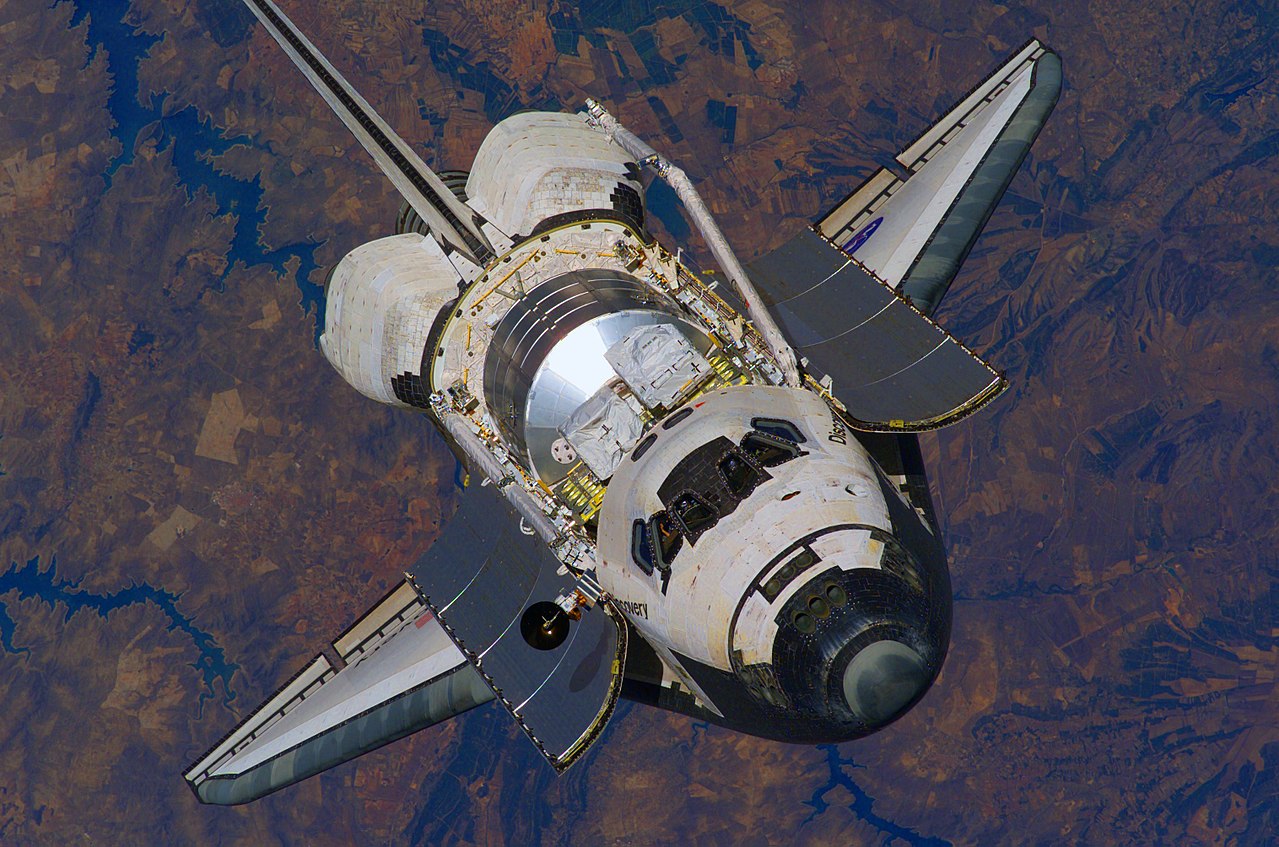
The orbiters were protected by [[Space Shuttle thermal protection system|Thermal Protection System]] (TPS) materials (developed by [[Rockwell International|Rockwell Space Systems]]) inside and out, from the orbiter's outer surface to the payload bay.[{{cite journal |url=https://ntrs.nasa.gov/search.jsp?R=20110003618 |title=Automotive Design & Manufacturing |series=40 Years of Innovations |journal=NASA Tech Briefs |volume=22 |issue=9 |page=26 |date=September 1998 |hdl=2060/20110003618}}][{{cite web | last=Oakes | first=Ryan | title=Space Shuttle Tiles | website=UW Departments Web Server | date=June 2, 2003 | url=https://depts.washington.edu/matseed/mse_resources/Webpage/Space%20Shuttle%20Tiles/Space%20Shuttle%20Tiles.htm | access-date=March 24, 2023}}] The TPS protected it from the cold soak of {{convert|−121|C}} in space to the {{convert|1649|C}} heat of re-entry. The tile materials comprising much of the orbiter's outermost layer were mostly air held within near-pure [[silica]] fibers, which made it efficient at [[Atmospheric entry#refractory insulation|refractory insulation]] that absorbed and redirected heat back out into the air, and covered in [[silicon boride]]s and [[borosilicate glass]], with blacker tiles covering the lower surface, and whiter tiles covering the tail, parts of the upper wing and crew cabin surfaces, and the outsides of the payload bay doors. The nose cap, nose landing gear doors, and leading edges were made of [[reinforced carbon–carbon]], which is [[rayon]] impregnated with [[graphite]]-filled resins and coated in [[silicon carbide]].[{{cite journal | last1=Lyle | first1=Karen H. | last2=Fasanella | first2=Edwin L. | title=Permanent set of the Space Shuttle Thermal Protection System Reinforced Carbon–Carbon material | journal=Composites Part A: Applied Science and Manufacturing | publisher=Elsevier BV | volume=40 | issue=6–7 | year=2009 | issn=1359-835X | doi=10.1016/j.compositesa.2009.02.016 | pages=702–708}}] The upper, white materials that were not in tiles were mostly made of either [[Nomex]] felt coated in [[silicon]]-rich [[elastomer]] or [[beta cloth]], woven silica fibers covered in [[Teflon]]. This was especially true in the interior of the payload bay.[{{Cite web|url=https://ntrs.nasa.gov/archive/nasa/casi.ntrs.nasa.gov/19990047691.pdf|title = Multilayer Insulation Material Guidelines|date = April 1999|last1 = Finckenor|first1 = M. M.|last2 = Dooling|first2 = D.|access-date=April 1, 2023}}][{{cite web|title=STS-6 Press Information|url=http://www.jsc.nasa.gov/history/shuttle_pk/mrk/FLIGHT_006_STS-006_MRK.pdf|publisher=Rockwell International – Space Transportation & Systems Group|access-date=March 16, 2023|page=7|date=March 1983|quote="Orbital maneuvering system/reaction control system low temperature reusable surface insulation tiles (LRSI) replaced with advanced flexible reusable surface insulation (AFRSI) consisting of a sewn composite quilted fabric blanket with same silica tile material sandwiched between outer and inner blanket."}}][{{cite web |url=http://www.nasa.gov/centers/kennedy/pdf/167473main_TPS-06rev.pdf |title=Orbiter Thermal Protection System, Thermal Materials |publisher=[[NASA]] |year=2006 |pages=3 |accessdate=March 16, 2023 |archive-date=February 12, 2023 |archive-url=https://web.archive.org/web/20230212114346/https://www.nasa.gov/centers/kennedy/pdf/167473main_TPS-06rev.pdf |url-status=dead }}] |
|
The orbiters were protected by [[Space Shuttle thermal protection system|Thermal Protection System]] (TPS) materials (developed by [[Rockwell International|Rockwell Space Systems]]) inside and out, from the orbiter's outer surface to the payload bay.[{{cite journal |url=https://ntrs.nasa.gov/search.jsp?R=20110003618 |title=Automotive Design & Manufacturing |series=40 Years of Innovations |journal=NASA Tech Briefs |volume=22 |issue=9 |page=26 |date=September 1998 |hdl=2060/20110003618}}][{{cite web | last=Oakes | first=Ryan | title=Space Shuttle Tiles | website=UW Departments Web Server | date=June 2, 2003 | url=https://depts.washington.edu/matseed/mse_resources/Webpage/Space%20Shuttle%20Tiles/Space%20Shuttle%20Tiles.htm | access-date=March 24, 2023}}] The TPS protected it from the cold soak of {{convert|−121|C}} in space to the {{convert|1649|C}} heat of re-entry. The tile materials comprising much of the orbiter's outermost layer were mostly air held within near-pure [[silica]] fibers, which made it efficient at [[Atmospheric entry#Refractory insulation|refractory insulation]] that absorbed and redirected heat back out into the air, and covered in [[silicon boride]]s and [[borosilicate glass]], with blacker tiles covering the lower surface, and whiter tiles covering the tail, parts of the upper wing and crew cabin surfaces, and the outsides of the payload bay doors. The nose cap, nose landing gear doors, and leading edges were made of [[reinforced carbon–carbon]], which is [[rayon]] impregnated with [[graphite]]-filled resins and coated in [[silicon carbide]].[{{cite journal | last1=Lyle | first1=Karen H. | last2=Fasanella | first2=Edwin L. | title=Permanent set of the Space Shuttle Thermal Protection System Reinforced Carbon–Carbon material | journal=Composites Part A: Applied Science and Manufacturing | publisher=Elsevier BV | volume=40 | issue=6–7 | year=2009 | issn=1359-835X | doi=10.1016/j.compositesa.2009.02.016 | pages=702–708}}] The upper, white materials that were not in tiles were mostly made of either [[Nomex]] felt coated in [[silicon]]-rich [[elastomer]] or [[beta cloth]], woven silica fibers covered in [[Teflon]]. This was especially true in the interior of the payload bay.[{{Cite web|url=https://ntrs.nasa.gov/archive/nasa/casi.ntrs.nasa.gov/19990047691.pdf|title = Multilayer Insulation Material Guidelines|date = April 1999|last1 = Finckenor|first1 = M. M.|last2 = Dooling|first2 = D.|access-date=April 1, 2023}}][{{cite web|title=STS-6 Press Information|url=http://www.jsc.nasa.gov/history/shuttle_pk/mrk/FLIGHT_006_STS-006_MRK.pdf|publisher=Rockwell International – Space Transportation & Systems Group|access-date=March 16, 2023|page=7|date=March 1983|quote="Orbital maneuvering system/reaction control system low temperature reusable surface insulation tiles (LRSI) replaced with advanced flexible reusable surface insulation (AFRSI) consisting of a sewn composite quilted fabric blanket with same silica tile material sandwiched between outer and inner blanket."}}][{{cite web |url=http://www.nasa.gov/centers/kennedy/pdf/167473main_TPS-06rev.pdf |title=Orbiter Thermal Protection System, Thermal Materials |publisher=[[NASA]] |year=2006 |pages=3 |accessdate=March 16, 2023 |archive-date=February 12, 2023 |archive-url=https://web.archive.org/web/20230212114346/https://www.nasa.gov/centers/kennedy/pdf/167473main_TPS-06rev.pdf |url-status=dead }}] |

 Like
0
Like
0
 Dislike
0
Dislike
0
 Love
0
Love
0
 Funny
0
Funny
0
 Angry
0
Angry
0
 Sad
0
Sad
0
 Wow
0
Wow
0







