
Sitones
uppercase per direct link (Roman Empire)
| ← Previous revision | Revision as of 01:02, 23 April 2026 | ||
| Line 1: | Line 1: | ||
{{Short description|Germanic people in Northern Europe mentioned by Tacitus}} |
{{Short description|Germanic people in Northern Europe mentioned by Tacitus}} |
||
[[Image:Roman Empire 125.png|thumb|right|250px|Map showing the Roman |
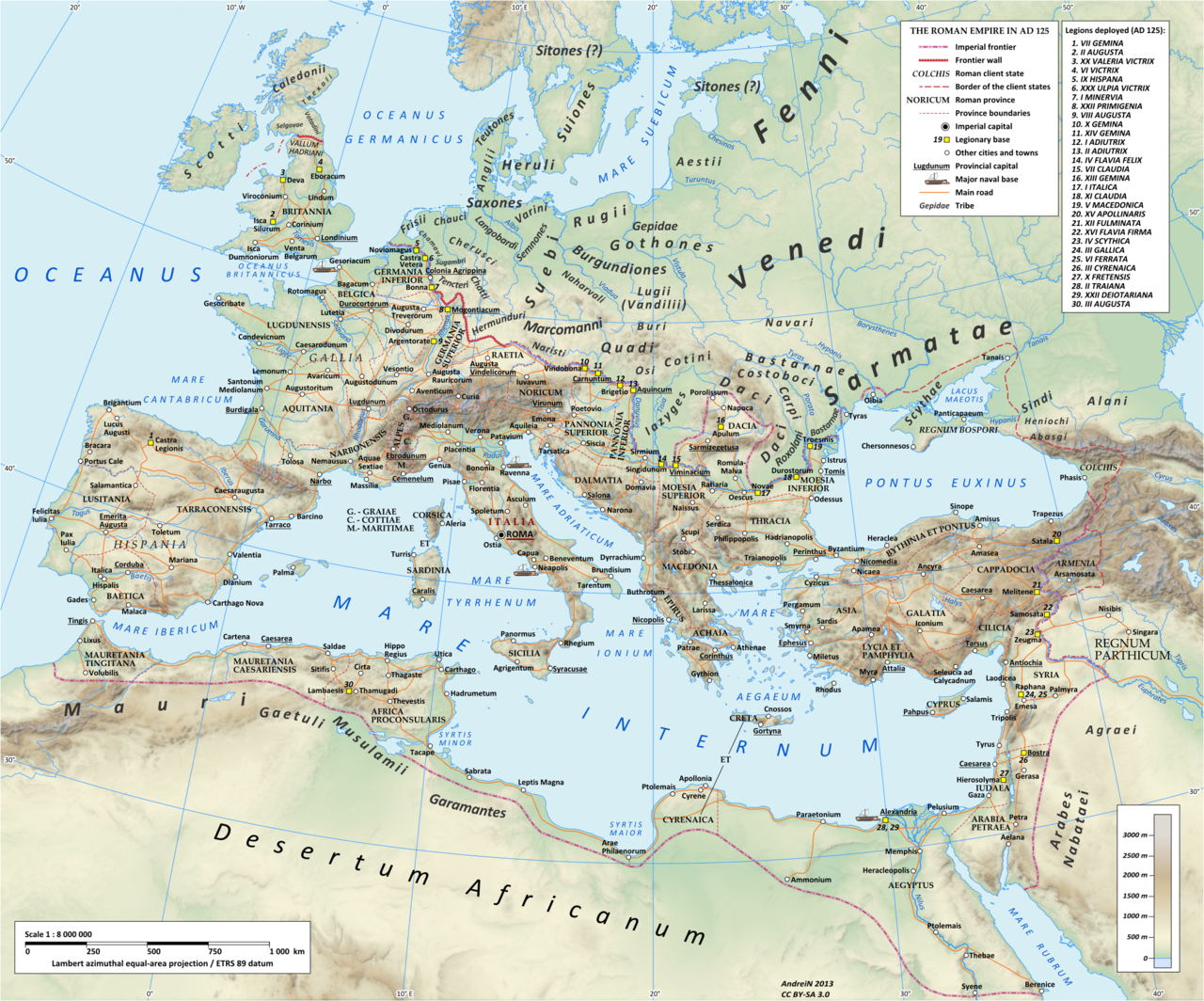
[[Image:Roman Empire 125.png|thumb|right|250px|Map showing the Roman Empire in AD 125 and contemporary barbarian Europe, showing two possible locations of the '''Sitones'''. One, based on [[Tacitus]], places them in central Sweden. Another view places them roughly in modern [[Estonia]] and/or [[Finland]].]] |
||
The '''Sitones''' were a [[Germanic people]] living somewhere in Northern Europe in the first century [[Common Era|CE]]. They are mentioned only by [[Cornelius Tacitus]] in 97 CE in [[Germania (book)|Germania]].{{Cite web |title=Worshiping Power- An Anarchist View of Early State Formation |url=https://lib.edist.ro/library/peter-gelderloos-worshipping-power.pdf}} Tacitus considered them similar to [[Suiones]] (ancestors of modern [[Sweden|Swedes]]) apart from one descriptor, namely that women were the ruling sex. Phonetical equivalent of ᚦ (þurisaz) may have been documented equivalent to either T or D, explaining sitones, suiones and suehans as local differences similar to viking age runestone carvings describing siþiuþu, suiþiuþu and suoþiauþu meaning [[Svitjod]] (Sweden). |
The '''Sitones''' were a [[Germanic people]] living somewhere in Northern Europe in the first century [[Common Era|CE]]. They are mentioned only by [[Cornelius Tacitus]] in 97 CE in [[Germania (book)|Germania]].{{Cite web |title=Worshiping Power- An Anarchist View of Early State Formation |url=https://lib.edist.ro/library/peter-gelderloos-worshipping-power.pdf}} Tacitus considered them similar to [[Suiones]] (ancestors of modern [[Sweden|Swedes]]) apart from one descriptor, namely that women were the ruling sex. Phonetical equivalent of ᚦ (þurisaz) may have been documented equivalent to either T or D, explaining sitones, suiones and suehans as local differences similar to viking age runestone carvings describing siþiuþu, suiþiuþu and suoþiauþu meaning [[Svitjod]] (Sweden). |
||














