|
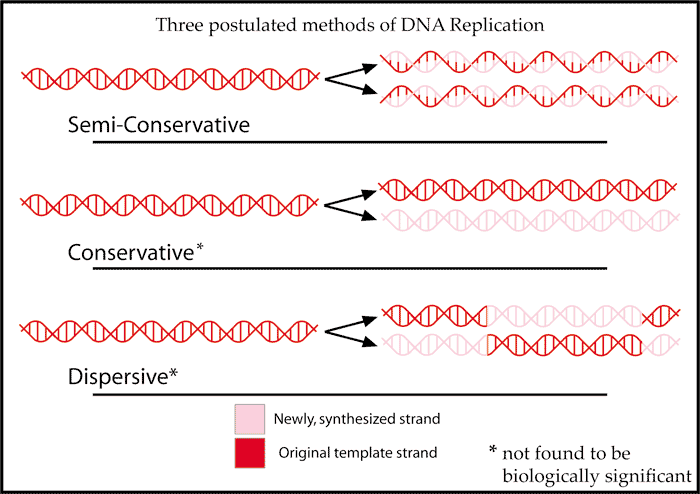
'''Semiconservative replication''' describes the mechanism of [[DNA replication]] in all living cells. DNA replication occurs on multiple [[Origin of replication|origins of replication]] along the DNA template strands. As the DNA double helix is unwound by [[helicase]], replication occurs separately on each template strand in antiparallel directions. This process is known as semi-conservative replication because two copies of the original DNA molecule are produced, each copy conserving (replicating) the information from one half of the original DNA molecule.[{{cite journal | vauthors = Ekundayo B, Bleichert F | title = Origins of DNA replication | journal = PLOS Genetics | volume = 15 | issue = 9 | article-number = e1008320 | date = September 2019 | pmid = 31513569 | pmc = 6742236 | doi = 10.1371/journal.pgen.1008320 | doi-access = free }}][{{cite journal | vauthors = Pray, Leslie A | title = Semi-conservative DNA replication: Meselson and Stahl | journal = Nature Education | volume = 1(1):98 }}] Each copy contains one original strand and one newly synthesized strand. (Both copies should be identical, but this is not entirely assured.) The structure of DNA (as deciphered by [[James D. Watson]] and [[Francis Crick]] in 1953) suggested that each strand of the double helix would serve as a template for synthesis of a new strand. It was not known how newly synthesized strands combined with template strands to form two double helical DNA molecules.[{{cite book|title=An Introduction to Genetic Analysis|vauthors=Griffiths AJ, Miller JH, Suzuki DT, Lewontin RC, Gelbart WM |publisher=W.H. Freeman |year=1999 |isbn=978-0-7167-3520-5 |location=San Francisco |chapter=Chapter 8: The Structure and Replication of DNA |chapter-url= https://www.ncbi.nlm.nih.gov/books/bv.fcgi?rid=iga.section.1505 }}][{{cite journal | vauthors = Meselson M, Stahl FW | title = The Replication of DNA in Escherichia Coli | journal = Proceedings of the National Academy of Sciences of the United States of America | volume = 44 | issue = 7 | pages = 671–82 | date = July 1958 | pmid = 16590258 | pmc = 528642 | doi = 10.1073/pnas.44.7.671 | bibcode = 1958PNAS...44..671M | doi-access = free }}] |
|
'''Semiconservative replication''' is the process by which copies of DNA are made in all living cells. DNA replication involves unwinding of the two strands of the double helix by [[helicase]], with each strand acting as a template for a new complementary strand, synthesized in opposite (antiparallel) directions. The process is called "semiconservative" because the replicated DNA molecule contains one parental strand and one newly synthesized strand[{{cite journal | vauthors = Ekundayo B, Bleichert F | title = Origins of DNA replication | journal = PLOS Genetics | volume = 15 | issue = 9 | article-number = e1008320 | date = September 2019 | pmid = 31513569 | pmc = 6742236 | doi = 10.1371/journal.pgen.1008320 | doi-access = free }}][{{cite journal | vauthors = Pray, Leslie A | title = Semi-conservative DNA replication: Meselson and Stahl | journal = Nature Education | volume = 1(1):98 }}] . Barring any replication errors, the copies are usually identical to their parental DNA molecules. The DNA structure was deciphered by [[James D. Watson]] and [[Francis Crick]] in 1953, which suggested that each strand of the double helix would serve as a template for synthesis of a new strand. However, it was not known how newly synthesized strands combined with template strands to form two double helical DNA molecules.[{{cite book|title=An Introduction to Genetic Analysis|vauthors=Griffiths AJ, Miller JH, Suzuki DT, Lewontin RC, Gelbart WM |publisher=W.H. Freeman |year=1999 |isbn=978-0-7167-3520-5 |location=San Francisco |chapter=Chapter 8: The Structure and Replication of DNA |chapter-url= https://www.ncbi.nlm.nih.gov/books/bv.fcgi?rid=iga.section.1505 }}][{{cite journal | vauthors = Meselson M, Stahl FW | title = The Replication of DNA in Escherichia Coli | journal = Proceedings of the National Academy of Sciences of the United States of America | volume = 44 | issue = 7 | pages = 671–82 | date = July 1958 | pmid = 16590258 | pmc = 528642 | doi = 10.1073/pnas.44.7.671 | bibcode = 1958PNAS...44..671M | doi-access = free }}] |

 Like
0
Like
0
 Dislike
0
Dislike
0
 Love
0
Love
0
 Funny
0
Funny
0
 Angry
0
Angry
0
 Sad
0
Sad
0
 Wow
0
Wow
0