Nandivarman II
| ← Previous revision | Revision as of 05:03, 22 April 2026 | ||
| Line 4: | Line 4: | ||
{{use Indian English|date=March 2016}} |
{{use Indian English|date=March 2016}} |
||
{{Infobox royalty |
{{Infobox royalty |
||
| name = Nandivarman II |
| name = Nandivarman II |
||
| |
| title = |
||
| caption = Nandivarman II with his queens and courtiers at [[Tiru Parameswara Vinnagaram]] (Vaikunta Perumal Temple) |
| image = |
||
| caption = Nandivarman II with his queens and courtiers at [[Tiru Parameswara Vinnagaram]] (Vaikunta Perumal Temple) |
|||
| succession = [[Pallava dynasty|Pallava Monarch]] |
| succession = [[Pallava dynasty|Pallava Monarch]] |
||
| reign = 731–796 |
| reign = 731–796 |
||
| predecessor = [[Paramesvaravarman II]] |
| predecessor = [[Paramesvaravarman II]] |
||
| successor = [[Dantivarman]] |
| successor = [[Dantivarman]] |
||
| birth_date = 718 |
| birth_date = 718 |
||
| birth_place = {{unbulleted list |
|||
| birth_place = Bhimhapura, [[Kambujadeśa]] (present-day [[Phimai]], [[Nakhon Ratchasima province]], Thailand) |
|||
| Simhapura, [[Champa]] (present-day [[Trà Kiệu]], Vietnam) |
|||
OR |
|||
| Bhimhapura, [[Kambujadeśa]] (present-day [[Phimai]], Thailand) |
|||
}} |
|||
| death_date = 796 (aged 77–78) |
|||
| death_place = [[Kanchipuram]], [[Pallava dynasty|Pallava Kingdom]] (present-day [[Tamil Nadu]], India) |
| death_date = 796 (aged 77–78) |
||
| death_place = [[Kanchipuram]], [[Pallava dynasty|Pallava Kingdom]] (present-day [[Tamil Nadu]], India) |
|||
| spouse = Reva |
| spouse = Reva |
||
| issue = [[Dantivarman]] |
| issue = [[Dantivarman]] |
||
| dynasty = [[Pallava dynasty|Pallava]] |
| dynasty = [[Pallava dynasty|Pallava]] |
||
| father = Hiranyavarman |
| father = Hiranyavarman |
||
| mother = |
| mother = |
||
}} |
}} |
||
{{Pallava}} |
{{Pallava}} |
||
'''Nandivarman II''' (718–796) was a [[Pallava]] monarch who reigned in southern India. Sen states Nandivarman reigned from 731 to 796 and built the [[Tiru Parameswara Vinnagaram|Vaikuntha-Perumal Temple]].{{Cite book |last=Sen |first=Sailendra |title=A Textbook of Medieval Indian History |publisher=Primus Books |year=2013 |isbn=978-9-38060-734-4 |pages=41–42}} From the Kasakkudi plates, it is learnt that Nandivarman II was a descendent of Bhimavarman, the younger brother of Pallava king [[Simhavishnu]]. Inscriptions beneath the panels at the Vaikuntha-Perumal Temple temple at Kanchipuram reveal that Nandivarman II hails from the country of [[Kambujadeśa]] (present-day Cambodia), where his father, Hiranyavarma Maharaja of the ''Katavesa-kula'', belonging to a collateral branch of the Pallavas, was ruling with Bhimapura as the capital. Of the four sons of Hiranyavarman: Srimalla, Ranamalla, Samkramalla and Pallavamalla, the twelve year old Pallavamalla accepted the offer to ascend the throne at Kanchipuram, where he was crowned King of the Pallavas under the name Nandivarman.{{cite book|title=The world of Tamil merchants |author=Kanakalatha Mukund|publisher=Penguin, 2015|page=17}} While some historians state that he was said to be a prince of the collateral branch of the family which had been ruling in Simhapura, Champa (in what is now Vietnam).{{Cite book |last=Mukund |first=Kanakalatha |title=The World of Tamil Merchants |publisher=Penguin |year=2015 |pages=17}} |
'''Nandivarman II''' (718–796) was a [[Pallava]] monarch who reigned in southern India. Sen states Nandivarman reigned from 731 to 796 and built the [[Tiru Parameswara Vinnagaram|Vaikuntha-Perumal Temple]].{{Cite book |last=Sen |first=Sailendra |title=A Textbook of Medieval Indian History |publisher=Primus Books |year=2013 |isbn=978-9-38060-734-4 |pages=41–42}} From the Kasakkudi plates, it is learnt that Nandivarman II was a descendent of Bhimavarman, the younger brother of Pallava king [[Simhavishnu]]. Inscriptions beneath the panels at the Vaikuntha-Perumal Temple temple at Kanchipuram reveal that Nandivarman II hails from the country of [[Kambujadeśa]] (present-day Cambodia), where his father, Hiranyavarma Maharaja of the ''Katavesa-kula'', belonging to a collateral branch of the Pallavas, was ruling with Bhimapura as the capital. Of the four sons of Hiranyavarman: Srimalla, Ranamalla, Samkramalla and Pallavamalla, the twelve year old Pallavamalla accepted the offer to ascend the throne at Kanchipuram, where he was crowned King of the Pallavas under the name Nandivarman.{{cite book|title=The world of Tamil merchants |author=Kanakalatha Mukund|publisher=Penguin, 2015|page=17}} While some historians state that he was said to be a prince of the collateral branch of the family which had been ruling in Simhapura, [[Champa]] (in what is now Vietnam).{{Cite book |last=Mukund |first=Kanakalatha |title=The World of Tamil Merchants |publisher=Penguin |year=2015 |pages=17}} |
||
== Biography == |
== Biography == |
||
[[File:8th century Nandivarman II Tiruvallam inscription, Tamil and Sanskrit, Tevaram singers.jpg|thumb |
[[File:8th century Nandivarman II Tiruvallam inscription, Tamil and Sanskrit, Tevaram singers.jpg|thumb|8th-century inscription of Nandivarman II from [[Vilwanatheswarar temple]], Tiruvallam.]] |
||
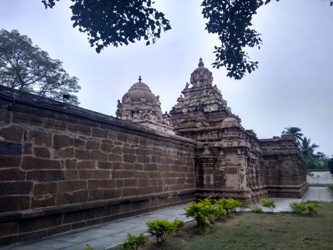
[[File:Tiru Parameswara Vinnagaram4.jpg|thumb |
[[File:Tiru Parameswara Vinnagaram4.jpg|thumb|[[Tiru Parameswara Vinnagaram]] (Vaikunta Perumal Temple)]] |
||
[[Paramesvaravarman II]] was succeeded by a 12-year-old Nandivarman II Pallavamalla who belonged to a collateral line of Pallavas called the [[Kadava]]s. The latter were the descendants of Bhimavarman, the brother of [[Simhavishnu]]. According to epigraphical findings, Hiranyavarman, the father of Nandivarman Pallavamalla belonged to the Kadavakula.{{cite book|title=History of Kongu, Volume 1|author=V. Ramamurthy|publisher=International Society for the Investigation of Ancient Civilization, 1986|page=172}} Nandivarman II himself is described as "one who was born to raise the prestige of the Kadava family".{{cite book|title=South Indian Inscriptions, Volume 12|author=Eugen Hultzsch|publisher=Manager of Publications, 1986|page=viii}} He commissioned the Tiru Parameswara Vinnagaram.{{cite book|title=Mahabalipuram|publisher=The Archaeological Survey of India, Government of India|year=2004|location=New Delhi|last=C.|first=Sivaramamurthi|page=6|ref=Malla}} |
[[Paramesvaravarman II]] was succeeded by a 12-year-old Nandivarman II Pallavamalla who belonged to a collateral line of Pallavas called the [[Kadava]]s. The latter were the descendants of Bhimavarman, the brother of [[Simhavishnu]]. According to epigraphical findings, Hiranyavarman, the father of Nandivarman Pallavamalla belonged to the Kadavakula.{{cite book|title=History of Kongu, Volume 1|author=V. Ramamurthy|publisher=International Society for the Investigation of Ancient Civilization, 1986|page=172}} Nandivarman II himself is described as "one who was born to raise the prestige of the Kadava family".{{cite book|title=South Indian Inscriptions, Volume 12|author=Eugen Hultzsch|publisher=Manager of Publications, 1986|page=viii}} He commissioned the Tiru Parameswara Vinnagaram.{{cite book|title=Mahabalipuram|publisher=The Archaeological Survey of India, Government of India|year=2004|location=New Delhi|last=C.|first=Sivaramamurthi|page=6|ref=Malla}} |
||