| ← Previous revision |
Revision as of 10:00, 26 April 2026 |
| Line 19: |
Line 19: |
|
}} |
|
}} |
|
|
|
|
|
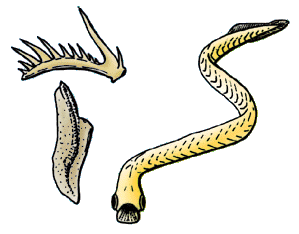
'''''Misikella''''' is an extinct genus of [[conodont]]s.[{{Cite journal|last1=Karádi|first1=Viktor|last2=Cau|first2=Andrea|last3=Mazza|first3=Michele|last4=Rigo|first4=Manuel|date=2019-04-02|title=The last phase of conodont evolution during the Late Triassic: Integrating biostratigraphic and phylogenetic approaches|url=http://www.sciencedirect.com/science/article/pii/S0031018218301767|journal=Palaeogeography, Palaeoclimatology, Palaeoecology|volume=549|page=109144|language=en|doi=10.1016/j.palaeo.2019.03.045|s2cid=134898058|issn=0031-0182|url-access=subscription}}] |
|
'''''Misikella''''' is an extinct genus of [[conodont]]s.[{{Cite journal|last1=Karádi|first1=Viktor|last2=Cau|first2=Andrea|last3=Mazza|first3=Michele|last4=Rigo|first4=Manuel|date=2019-04-02|title=The last phase of conodont evolution during the Late Triassic: Integrating biostratigraphic and phylogenetic approaches|url=http://www.sciencedirect.com/science/article/pii/S0031018218301767|journal=Palaeogeography, Palaeoclimatology, Palaeoecology|volume=549|page=109144|language=en|doi=10.1016/j.palaeo.2019.03.045|s2cid=134898058|issn=0031-0182|url-access=subscription}}] |
|
|
|
|
|
Two species were named as type species for the genus in separate publications by the same authors in the same year (1974). The first paper named ''Misikella longidentata'', while the second named ''Misikella posthernsteini''. Most species assigned to ''Misikella'' have a Norian-Rhaetian distribution and a bimembrate conodont apparatus, including ''M. posthernsteini''. On the other hand, ''M. longidentata'' has a [[Carnian]]-Norian distribution and a tetramembrate apparatus. Fåhræus & Ryley (1989) retained the name ''Misikella'' for only ''M. longidentata'', placing the rest of the species into the new genus '''''Axiothea'''''.[{{Cite journal|last1=Fåhræus|first1=Lars. E.|last2=Ryley|first2=C. Christopher|date=1989-06-01|title=Multielement species of Misikella Kozur and Mock, 1974 and Axiothea n.gen. (Conodonta) from the Mamonia Complex (Upper Triassic), Cyprus|url=https://www.nrcresearchpress.com/doi/abs/10.1139/e89-106|journal=Canadian Journal of Earth Sciences|volume=26|issue=6|pages=1255–1263|doi=10.1139/e89-106|bibcode=1989CaJES..26.1255F|issn=0008-4077|url-access=subscription}}] However, other conodont specialists utilize the name ''Misikella'' primarily in the context of ''M. posthernsteini'' and other bimembrate species, rather than ''M. longidentata''.[{{cite journal |last1=Du |first1=Yixing |last2=Onoue |first2=Tetsuji |last3=Tomimatsu |first3=Yuki |last4=Wu |first4=Qiangwang |last5=Rigo |first5=Manuel |title=Lower Jurassic conodonts from the Inuyama area of Japan: implications for conodont extinction |journal=Frontiers in Ecology and Evolution |date=2023 |volume=11 |doi=10.3389/fevo.2023.1135789 |issn=2296-701X |doi-access=free |hdl=11577/3479836 |hdl-access=free }}] suggesting that conodonts underwent [[extinction debt]] and then were outcompeted by other organisms. |
|
Two species were named as type species for the genus in separate publications by the same authors in the same year (1974). The first paper named ''Misikella longidentata'', while the second named ''Misikella posthernsteini''. Most species assigned to ''Misikella'' have a Norian-Rhaetian distribution and a bimembrate conodont apparatus, including ''M. posthernsteini''. On the other hand, ''M. longidentata'' has a [[Carnian]]-Norian distribution and a tetramembrate apparatus. Fåhræus & Ryley (1989) retained the name ''Misikella'' for only ''M. longidentata'', placing the rest of the species into the new genus '''''Axiothea'''''.[{{Cite journal|last1=Fåhræus|first1=Lars. E.|last2=Ryley|first2=C. Christopher|date=1989-06-01|title=Multielement species of Misikella Kozur and Mock, 1974 and Axiothea n.gen. (Conodonta) from the Mamonia Complex (Upper Triassic), Cyprus|url=https://www.nrcresearchpress.com/doi/abs/10.1139/e89-106|journal=Canadian Journal of Earth Sciences|volume=26|issue=6|pages=1255–1263|doi=10.1139/e89-106|bibcode=1989CaJES..26.1255F|issn=0008-4077|url-access=subscription}}] However, other conodont specialists utilize the name ''Misikella'' primarily in the context of ''M. posthernsteini'' and other bimembrate species, rather than ''M. longidentata''.[{{cite journal |last1=Du |first1=Yixing |last2=Onoue |first2=Tetsuji |last3=Tomimatsu |first3=Yuki |last4=Wu |first4=Qiangwang |last5=Rigo |first5=Manuel |title=Lower Jurassic conodonts from the Inuyama area of Japan: implications for conodont extinction |journal=Frontiers in Ecology and Evolution |date=2023 |volume=11 |doi=10.3389/fevo.2023.1135789 |issn=2296-701X |doi-access=free |hdl=11577/3479836 |hdl-access=free }}] suggesting that conodonts underwent [[extinction debt]] and then were outcompeted by other organisms. |
|
|
|
|
|
== Use in stratigraphy == |
|
==Use in stratigraphy== |
|
The top of the [[Norian]] (the base of the [[Rhaetian]], stages of the Upper Triassic) is close to the first appearance of several species of ''Misikella,'' as well as ''[[Epigondolella mosheri]]''. In 2010, the Norian-Rhaetian boundary was defined by the first appearance of ''Misikella posthernsteini''.[{{Cite journal|last=Krystyn|first=Leopold|date=March 2010|title=Decision report on the defining event for the base of the Rhaetian stage.|url=http://paleo.cortland.edu/albertiana/issues/Albertiana_38.pdf#page=11|journal=Albertiana|volume=38|pages=11–12}}] |
|
The top of the [[Norian]] (the base of the [[Rhaetian]], stages of the Upper Triassic) is close to the first appearance of several species of ''Misikella,'' as well as ''[[Epigondolella mosheri]]''. In 2010, the Norian-Rhaetian boundary was defined by the first appearance of ''Misikella posthernsteini''.[{{Cite journal|last=Krystyn|first=Leopold|date=March 2010|title=Decision report on the defining event for the base of the Rhaetian stage.|url=http://paleo.cortland.edu/albertiana/issues/Albertiana_38.pdf#page=11|journal=Albertiana|volume=38|pages=11–12}}] |
|
|
|
|
|
The most often-discussed Rhaetian [[List of Global Boundary Stratotype Sections and Points|GSSP Candidate sections]] are in [[Steinbergkogel]] in Austria,[{{Cite journal|last1=Krystyn|first1=L.|last2=Bouquerel|first2=H.|last3=Kuerschner|first3=W.|last4=Richoz|first4=S.|last5=Gallet|first5=Y.|date=2007|title=Proposal for a candidate GSSP for the base of the Rhaetian Stage|url=https://www.researchgate.net/publication/46691101|journal=New Mexico Museum of Natural History and Science|volume=41|pages=189–199}}] or [[Pignola-Abriola section|Pignola-Abriola]] in Italy.[{{Cite journal|last1=Rigo|first1=Manuel|last2=Bertinelli|first2=Angela|last3=Concheri|first3=Giuseppe|last4=Gattolin|first4=Giovanni|last5=Godfrey|first5=Linda|last6=Katz|first6=Miriam E.|last7=Maron|first7=Matteo|last8=Mietto|first8=Paolo|last9=Muttoni|first9=Giovanni|last10=Sprovieri|first10=Mario|last11=Stellin|first11=Fabio |first12= Mariachiara |last12=Zaffani|date=2016|title=The Pignola-Abriola section (southern Apennines, Italy): a new GSSP candidate for the base of the Rhaetian Stage|url=https://www.researchgate.net/publication/281461104|journal=Lethaia|language=en|volume=49|issue=3|pages=287–306|doi=10.1111/let.12145|hdl=11577/3157425 |issn=1502-3931|doi-access=|hdl-access=free}}] |
|
The most often-discussed Rhaetian [[List of Global Boundary Stratotype Sections and Points|GSSP Candidate sections]] are in [[Steinbergkogel]] in Austria,[{{Cite journal|last1=Krystyn|first1=L.|last2=Bouquerel|first2=H.|last3=Kuerschner|first3=W.|last4=Richoz|first4=S.|last5=Gallet|first5=Y.|date=2007|title=Proposal for a candidate GSSP for the base of the Rhaetian Stage|url=https://www.researchgate.net/publication/46691101|journal=New Mexico Museum of Natural History and Science|volume=41|pages=189–199}}] or [[Pignola-Abriola section|Pignola-Abriola]] in Italy.[{{Cite journal|last1=Rigo|first1=Manuel|last2=Bertinelli|first2=Angela|last3=Concheri|first3=Giuseppe|last4=Gattolin|first4=Giovanni|last5=Godfrey|first5=Linda|last6=Katz|first6=Miriam E.|last7=Maron|first7=Matteo|last8=Mietto|first8=Paolo|last9=Muttoni|first9=Giovanni|last10=Sprovieri|first10=Mario|last11=Stellin|first11=Fabio |first12= Mariachiara |last12=Zaffani|date=2016|title=The Pignola-Abriola section (southern Apennines, Italy): a new GSSP candidate for the base of the Rhaetian Stage|url=https://www.researchgate.net/publication/281461104|journal=Lethaia|language=en|volume=49|issue=3|pages=287–306|doi=10.1111/let.12145|hdl=11577/3157425 |issn=1502-3931|doi-access=|hdl-access=free}}] |
|
|
|
|
|
== References == |
|
==References== |
|
{{Reflist}} |
|
{{Reflist}} |
|
* Conodonts of the genus Misikella Kozur and Mock, 1974 from the Rhaetian of the Tatra Mts (West Carpathians). A Gazdzicki, Acta Palaeontologica Polonica, 1978 |
|
* Conodonts of the genus Misikella Kozur and Mock, 1974 from the Rhaetian of the Tatra Mts (West Carpathians). A Gazdzicki, Acta Palaeontologica Polonica, 1978 |
|
|
|
|
|
== External links == |
|
==External links== |
|
* {{eol|42349333}} |
|
* {{eol|42349333}} |
|
* {{fossilworks|id=33977|title=''Misikella''|date=13 July 2016}} |
|
* {{fossilworks|id=33977|title=''Misikella''|access-date=13 July 2016}} |
|
|
|
|
|
{{Taxonbar|from=Q28431180}} |
|
{{Taxonbar|from=Q28431180}} |
|
{{Conodonts|4}} |
|
{{Conodonts|4}} |
|
|
|
|
[[Category:Conodont genera]] |
|
[[Category:Conodont genera]] |
|
[[Category:Triassic conodonts]] |
|
[[Category:Triassic conodonts]] |
|
[[Category:Norian genus first appearances]] |
|
[[Category:Norian genus first appearances]] |
|
[[Category:Rhaetian genus extinctions]] |
|
[[Category:Rhaetian genus extinctions]] |
|
|
|
|
|
|
|
|
{{conodont-stub}} |
|
{{conodont-stub}} |

 Like
0
Like
0
 Dislike
0
Dislike
0
 Love
0
Love
0
 Funny
0
Funny
0
 Angry
0
Angry
0
 Sad
0
Sad
0
 Wow
0
Wow
0