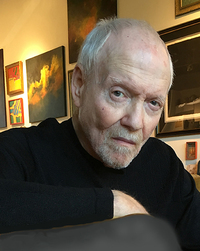
Larry Heck

Education and career: Added details to early DNN work.
| ← Previous revision | Revision as of 15:38, 21 April 2026 | ||
| Line 24: | Line 24: | ||
Larry Heck was born in [[Havre, Montana]]. After receiving the [[Bachelor of Science]] in [[electrical engineering]] at [[Texas Tech University]], he was admitted to graduate school at the [[Georgia Institute of Technology]] in 1986. Heck received the MSEE in 1989 and the PhD in 1991 under advisor Prof. [[James H. McClellan]].{{MathGenealogy|id=57460}} |
Larry Heck was born in [[Havre, Montana]]. After receiving the [[Bachelor of Science]] in [[electrical engineering]] at [[Texas Tech University]], he was admitted to graduate school at the [[Georgia Institute of Technology]] in 1986. Heck received the MSEE in 1989 and the PhD in 1991 under advisor Prof. [[James H. McClellan]].{{MathGenealogy|id=57460}} |
||
From 1992 to 1998, he was a senior research engineer at [[SRI International]] with the Acoustics and Radar Technology Lab (ARTL) and Speech Technology and Research (STAR) Lab, and in 1998 joined [[Nuance Communications]], serving as [[vice president]] of R&D. Funded by the US government's [[National Security Agency|NSA]] and [[DARPA]] from 1995-1998, Heck led the SRI team that was the first to successfully create large-scale [[deep neural network]] (DNN) [[deep learning]] technology in the field of speech processing. {{cite journal | last1 = Heck | first1 = L. | last2 = Konig | first2 = Y. | last3 = Sonmez | first3 = M. | last4 = Weintraub | first4 = M. | year = 2000 | title = Robustness to Telephone Handset Distortion in Speaker Recognition by Discriminative Feature Design | url = https://www.microsoft.com/en-us/research/wp-content/uploads/2000/01/1-s2.0-S0167639399000771-main.pdf | journal = Speech Communication | volume = 31 | issue = 2| pages = 181–192 | doi=10.1016/s0167-6393(99)00077-1}} The deep learning technology was used to win the 1998 National Institute of Standards and Technology Speaker Recognition evaluation {{cite journal | last1 = Doddington | first1 = G. | last2 = Przybocki | first2 = M. | last3 = Martin | first3 = A. | last4 = Reynolds | first4 = D. | year = 2000 | title = The NIST speaker recognition evaluation ± Overview, methodology, systems, results, perspective | journal = Speech Communication | volume = 31 | issue = 2| pages = 225–254 | doi=10.1016/S0167-6393(99)00080-1}} |
From 1992 to 1998, he was a senior research engineer at [[SRI International]] with the Acoustics and Radar Technology Lab (ARTL) and Speech Technology and Research (STAR) Lab, and in 1998 joined [[Nuance Communications]], serving as [[vice president]] of R&D. |
||
Funded by the US government's [[National Security Agency|NSA]] and [[DARPA]] from 1995-1998, Heck led the SRI team that was the first to successfully create large-scale [[deep neural network]] (DNN) [[deep learning]] technology in the field of speech processing. {{cite journal | last1 = Heck | first1 = L. | last2 = Konig | first2 = Y. | last3 = Sonmez | first3 = M. | last4 = Weintraub | first4 = M. | year = 2000 | title = Robustness to Telephone Handset Distortion in Speaker Recognition by Discriminative Feature Design | url = https://www.microsoft.com/en-us/research/wp-content/uploads/2000/01/1-s2.0-S0167639399000771-main.pdf | journal = Speech Communication | volume = 31 | issue = 2| pages = 181–192 | doi=10.1016/s0167-6393(99)00077-1}} The deep learning technology was used to win the 1998 National Institute of Standards and Technology Speaker Recognition evaluation. {{cite journal | last1 = Doddington | first1 = G. | last2 = Przybocki | first2 = M. | last3 = Martin | first3 = A. | last4 = Reynolds | first4 = D. | year = 2000 | title = The NIST speaker recognition evaluation ± Overview, methodology, systems, results, perspective | journal = Speech Communication | volume = 31 | issue = 2| pages = 225–254 | doi=10.1016/S0167-6393(99)00080-1}} The approach trained a 5-layer deep neural network, with the first two layers used as a (learned) feature extractor. To stabilize the training of the DNN, a weight normalization method {{cite web | URL=https://searchworks.stanford.edu | title="Scaled Stochastic Methods for Training Neural Networks"}} was used (later rediscovered in 2010 by Xavier, et.al). Heck deployed this DNN in 1999 with [[Nuance Communications]] at the Home Shopping Network, representing the first major industrial application of deep learning with over 100K Nuance Verifier voiceprints. {{cite web | url=https://www.latimes.com/archives/la-xpm-1999-jun-28-fi-50869-story.html#:~:text=In%20the%20first%20large%2Dscale%20consumer%20use%20of,software%20to%20authenticate%20a%20customer's%20identity%20over | title="Home Shopping to Use Voice ID"}} |
|||
From 2005 to 2008, he was vice president of search & advertising sciences at [[Yahoo!]], responsible for the company's search and advertising quality. In 2008, Heck worked with [[Yahoo! Research]] to combine the two organizations to form [[Yahoo! Labs]]. |
From 2005 to 2008, he was vice president of search & advertising sciences at [[Yahoo!]], responsible for the company's search and advertising quality. In 2008, Heck worked with [[Yahoo! Research]] to combine the two organizations to form [[Yahoo! Labs]]. |
||