| ← Previous revision |
Revision as of 03:02, 23 April 2026 |
| Line 65: |
Line 65: |
|
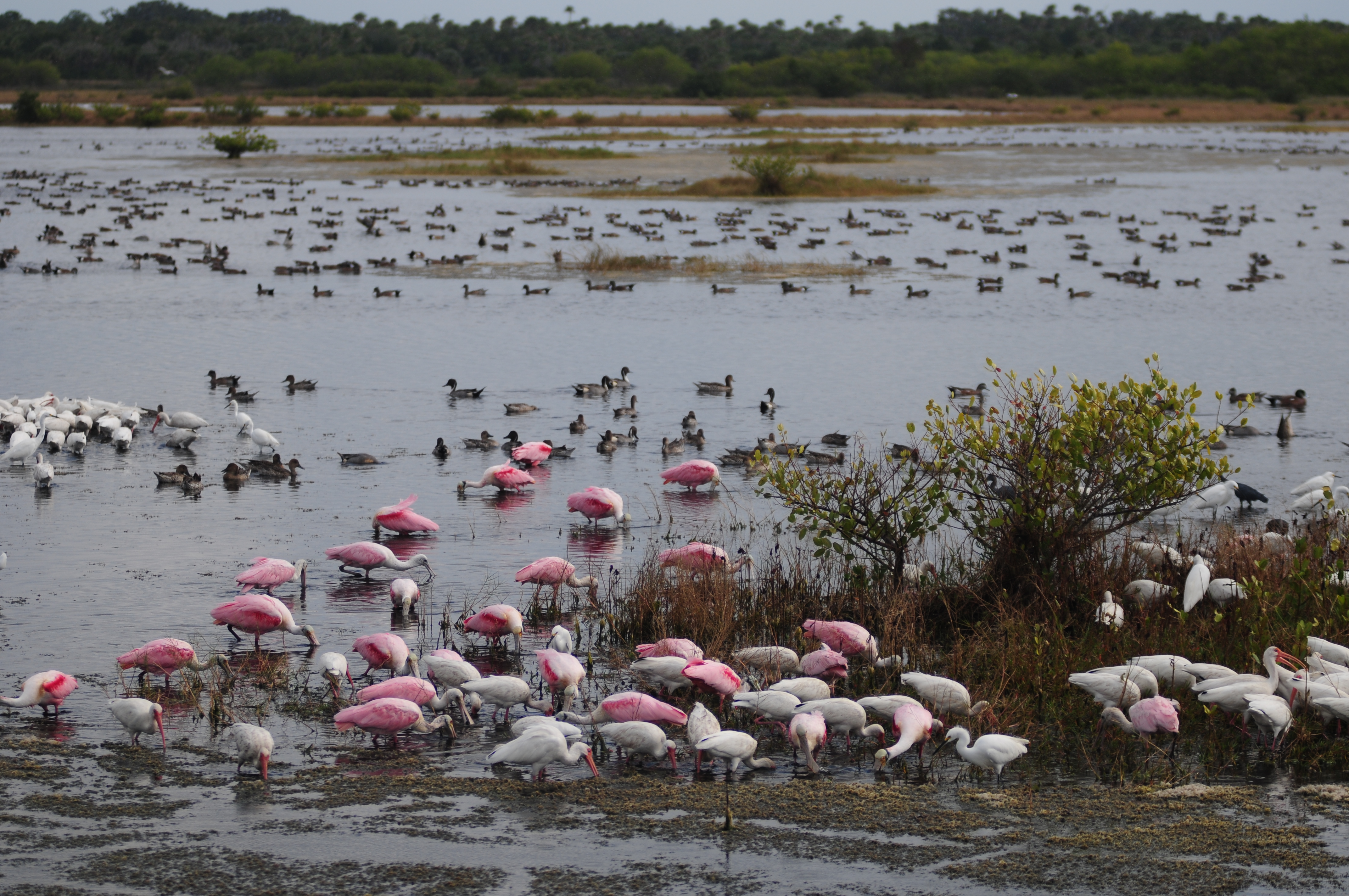
The lagoon contains 35 species listed as threatened or endangered — more than any other estuary in North America.[{{cite web |url=http://www.sjrwmd.com/itsyourlagoon/pdfs/IRL_Natural_Treasure_book.pdf |title=Indian River Lagoon; An Introduction to a National Treasure |access-date=2013-04-17 |url-status=dead |archive-url=https://web.archive.org/web/20130319193525/http://www.sjrwmd.com/itsyourlagoon/pdfs/IRL_Natural_Treasure_book.pdf |archive-date=2013-03-19 }}][{{cite web |url=http://www.sjrwmd.com/irlinsert/ |title=The health and future of this Estuary of National Significance |work=sjrwmd.com |access-date=February 1, 2017 |archive-url=https://archive.today/20100512123451/http://www.sjrwmd.com/irlinsert/ |archive-date=May 12, 2010 |url-status=dead}}] The lagoon has about 2,500 types of animals in it.{{clarify|moved from "course". Either this is wrong and s/b deleted or 2,200 is wrong. Note no citation to start with|date=October 2013}} It serves as a spawning and nursery ground for different species of oceanic and lagoon fish and shellfish. The lagoon also has one of the most diverse bird populations anywhere in America.{{fact|date=April 2025}} |
|
The lagoon contains 35 species listed as threatened or endangered — more than any other estuary in North America.[{{cite web |url=http://www.sjrwmd.com/itsyourlagoon/pdfs/IRL_Natural_Treasure_book.pdf |title=Indian River Lagoon; An Introduction to a National Treasure |access-date=2013-04-17 |url-status=dead |archive-url=https://web.archive.org/web/20130319193525/http://www.sjrwmd.com/itsyourlagoon/pdfs/IRL_Natural_Treasure_book.pdf |archive-date=2013-03-19 }}][{{cite web |url=http://www.sjrwmd.com/irlinsert/ |title=The health and future of this Estuary of National Significance |work=sjrwmd.com |access-date=February 1, 2017 |archive-url=https://archive.today/20100512123451/http://www.sjrwmd.com/irlinsert/ |archive-date=May 12, 2010 |url-status=dead}}] The lagoon has about 2,500 types of animals in it.{{clarify|moved from "course". Either this is wrong and s/b deleted or 2,200 is wrong. Note no citation to start with|date=October 2013}} It serves as a spawning and nursery ground for different species of oceanic and lagoon fish and shellfish. The lagoon also has one of the most diverse bird populations anywhere in America.{{fact|date=April 2025}} |
|
|
|
|
|
Nearly 1/3 of the nation's [[manatee]] population lives here or migrates through the Lagoon seasonally. There was a mass death of manatees in 2021 due to the loss of seagrass, caused by leaks from septic systems and overuse of fertilizers.[{{Cite web |last=Jones |first=Benji |date=2022-02-08 |title=The manatees are starving |url=https://www.vox.com/down-to-earth/22917307/florida-manatees-algae-seagrass-indian-river-lagoon |access-date=2022-02-11 |website=Vox |language=en}}] |
|
Nearly 1/3 of the nation's [[manatee]] population lives here or migrates through the Lagoon seasonally. There was a mass death of manatees in 2021 due to the loss of seagrass, caused by leaks from septic systems and overuse of fertilizers.[{{Cite web |last=Jones |first=Benji |date=2022-02-08 |title=The manatees are starving |url=https://www.vox.com/down-to-earth/22917307/florida-manatees-algae-seagrass-indian-river-lagoon |access-date=2022-02-11 |website=Vox |language=en}}][{{Cite web |last=Herrero |first=Hannah V. |last2=Insalaco-Wyner |first2=Stephanie |date=2026-04-21 |title=Hurricanes devastated Florida’s East Coast – then seagrass made an unexpected comeback |url=https://theconversation.com/hurricanes-devastated-floridas-east-coast-then-seagrass-made-an-unexpected-comeback-279177 |access-date=2026-04-23 |website=The Conversation |language=en-US}}] |
|
|
|
|
|
[[Nine-banded armadillo]]s comprise one of the 34 mammals in the area. It is a 1920s immigrant from the Southwestern United States. In 2016 a [[Right whale]] with her calf entered the lagoon by mistake and safely exited to the ocean. |
|
[[Nine-banded armadillo]]s comprise one of the 34 mammals in the area. It is a 1920s immigrant from the Southwestern United States. In 2016 a [[Right whale]] with her calf entered the lagoon by mistake and safely exited to the ocean. |
| Line 79: |
Line 79: |
|
[[Seagrass]] is a critical component to the overall health of the lagoon.[ By 1990, it had surpassed levels reached in 1943. The lagoon also contains [[night-blooming cereus]].] |
|
[[Seagrass]] is a critical component to the overall health of the lagoon.[ By 1990, it had surpassed levels reached in 1943. The lagoon also contains [[night-blooming cereus]].] |
|
|
|
|
|
95% of the seagrass, the main diet of manatees, disappeared by 2017 after an algae bloom fuelled by fertilizers. |
|
95% of the seagrass, the main diet of manatees, disappeared by 2017 after an algae bloom fuelled by fertilizers. |
|
|
|
|
|
==Protected areas== |
|
==Protected areas== |

 Like
0
Like
0
 Dislike
0
Dislike
0
 Love
0
Love
0
 Funny
0
Funny
0
 Angry
0
Angry
0
 Sad
0
Sad
0
 Wow
0
Wow
0







