Field line
Examples
| ← Previous revision | Revision as of 20:05, 23 April 2026 | ||
| Line 57: | Line 57: | ||
[[File:VFPt cylindermagnet field-representations.svg|thumb|420px|Different ways to depict the field of a magnet.]] |
[[File:VFPt cylindermagnet field-representations.svg|thumb|420px|Different ways to depict the field of a magnet.]] |
||
If the vector field describes a [[velocity]] [[velocity field|field]], then the field lines follow [[stream line]]s in the flow. Perhaps the most familiar example of a vector field described by field lines is the [[magnetic field]], which is often depicted using field lines emanating from a [[magnet]]. |
If the vector field describes a [[velocity]] [[velocity field|field]], then the field lines follow [[stream line]]s in the flow. Perhaps the most familiar example of a vector field described by field lines is the [[magnetic field]], which is often depicted using field lines emanating from a [[magnet]]. |
||
=== Electric field lines === |
|||
[[File:Electrostatic induction.svg|thumb|upright=1.7|The electric field ''(lines with arrows)'' of a charge (+) induces surface charges ''(red and blue areas)'' on metal objects due to [[electrostatic induction]].]] |
|||
{{main|field line}} |
|||
A convenient way to plot the electric field that works even for complex electric fields is to use [[field line]]s.{{cite book|title=Introduction to Electrodynamics|edition=3rd|first=D.J.|last=Griffiths|publisher=Cambridge University Press|date= 1999|pp = 65-66|location=§2.2.1|isbn=013805326X}} Here the magnitude and direction of an electric field in a region is represented by a number of non-intersecting curved lines that span the region. If plotted correctly, the direction of the electric field at any given point is represented by the direction of nearby lines while the magnitude is represented by the density of the field lines in that region. |
|||
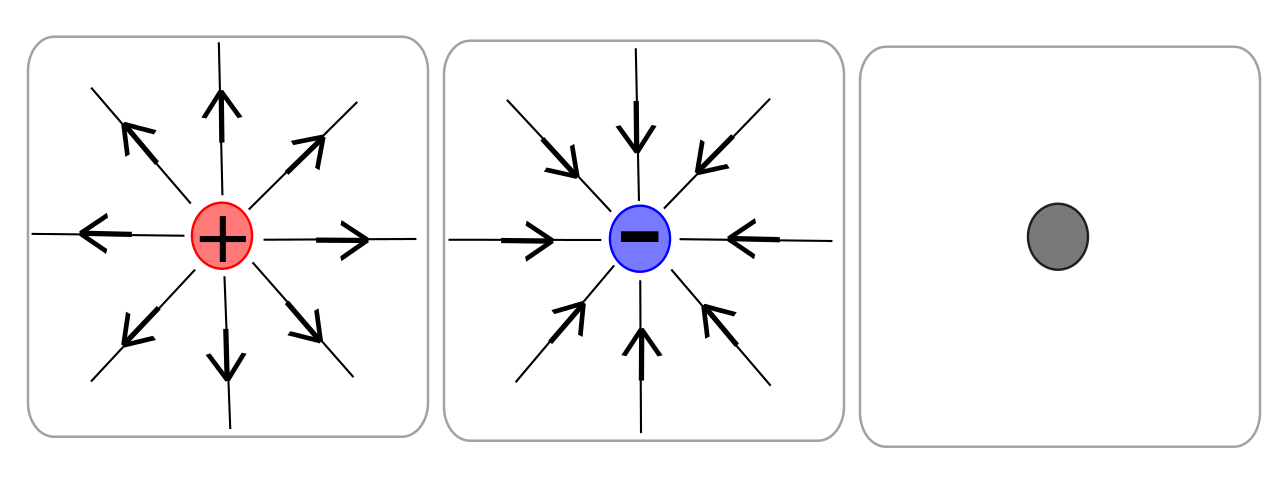
Electric field lines do not intersect. They begin at positive charge (or extend from infinity) and end at negative charge (or extend to infinity). Further the number of field lines from a given charge must be proportional to that charge. Electrostatic fields cannot form closed loops. (See the figure for an example of a complex electric field line diagram made for a positive point charge which induces electrical charge on the surfaces of 3 nearby conductors. |
|||
Field lines can only approximately represent the electric field in a given region. (It takes an infinite number of field lines to represent the electric field perfectly.) Nevertheless, these diagrams are useful at illustrating how the electric field changes over a given region. |
|||
== Divergence and curl == |
== Divergence and curl == |
||