
Dingwall
Reverted edits by ~2026-25268-04 (talk): vandalism (WS)
| ← Previous revision | Revision as of 16:46, 25 April 2026 | ||
| Line 29: | Line 29: | ||
}} |
}} |
||
'''Dingwall |
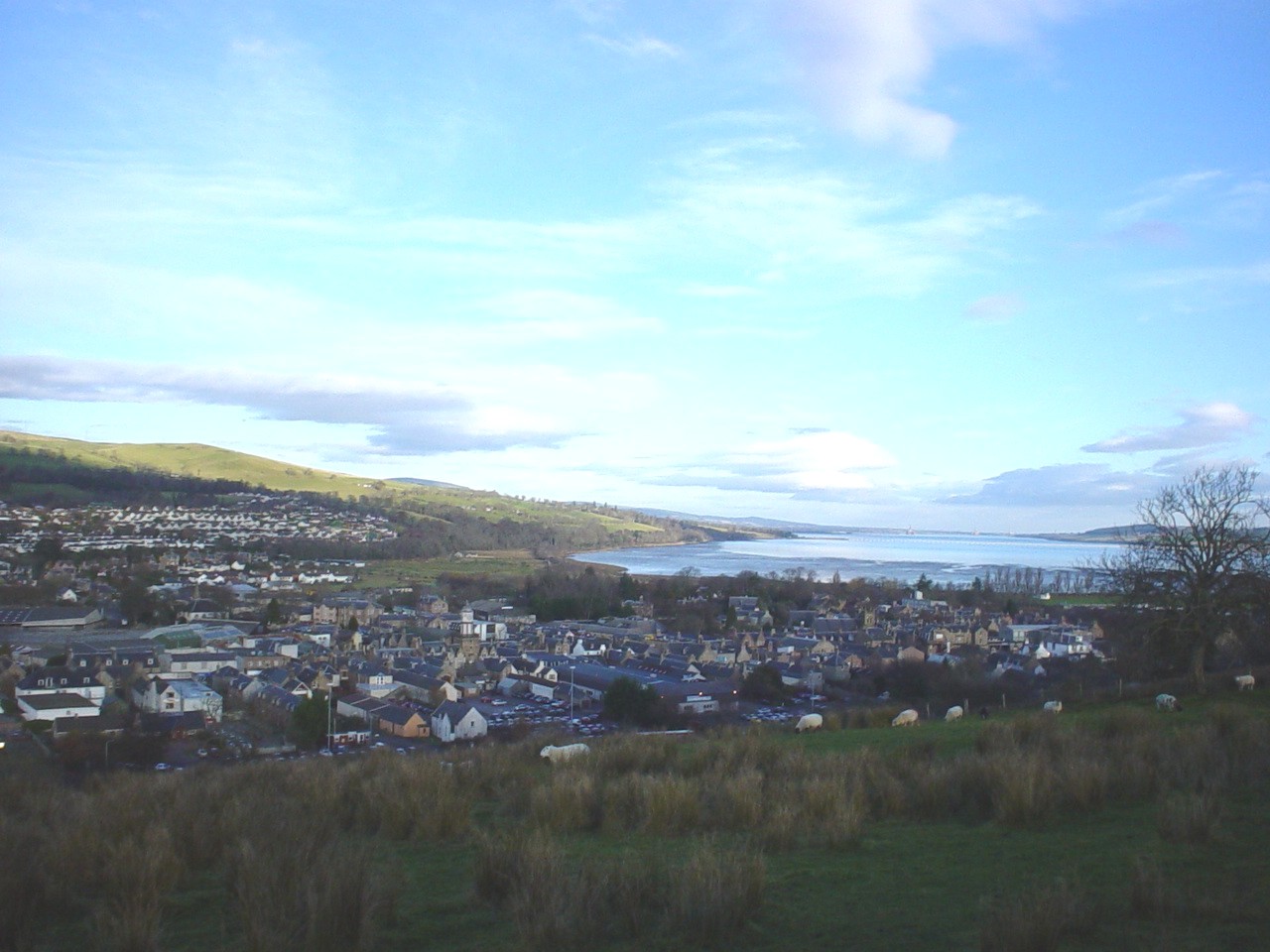
'''Dingwall''' ({{langx|sco|Dingwal}},{{cite web|url=http://www.scotslanguage.com/books/view/1/823/Names%20in%20Scots%20-%20Places%20in%20Scotland |title=Scots Language Centre: Scottish Place Names in Scots |publisher=Scotslanguage.com |access-date=2012-10-10}} {{langx|gd|Inbhir Pheofharain}}{{cite web |url=http://www.gaelicplacenames.org/databasedetails.php?id=94 |title=Ainmean-Àite na h-Alba ~ Gaelic Place-Names of Scotland |publisher=Gaelicplacenames.org |access-date=2012-10-10 |archive-date=25 April 2012 |archive-url=https://web.archive.org/web/20120425002205/http://www.gaelicplacenames.org/databasedetails.php?id=94 |url-status=dead }} {{IPA|gd|ˈiɲɪɾʲ ˈfjɔhəɾɛɲ|}}) is a town on the [[Cromarty Firth]] in [[Easter Ross]] in the Highlands of Scotland. It has enjoyed the status of [[royal burgh]] since the 13th century, and its local government is the [[Highland Council]]. The town has a population of 5,491, and though today it lies inland, its topography used to be that of an east-coast [[harbour]]. At one time, it was a significant medieval port, a hub of foreign trading and customs collection.MacDonald, D. D. "Investigating Dingwall as Þingvöllr" (PDF), p. 103. The Highland Council. Retrieved 6 July 2025. Dingwall’s medieval history affirms its status as an important country town and administrative centre,Kruse, Susan. "Case Study: The origins of Dingwall". Scottish Archeological Research Framework. Retrieved 6 July 2025. an extension perhaps of its history as a Viking settlement as evidenced by the Norse origin (Þingvöllr) of its name. |
||
The royal burgh is also the site of historic castles and clan skirmishes. [[Dingwall Castle]] was once the biggest [[castle]] north of [[Stirling]]. On the town's present-day outskirts lies [[Tulloch Castle]], parts of which may date back to the 12th century. In 1411 the [[Battle of Dingwall]] is said to have taken place between the [[Clan Mackay]] and the [[Clan Donald]]. |
|||
==History== |
==History== |
||














