
Conidium
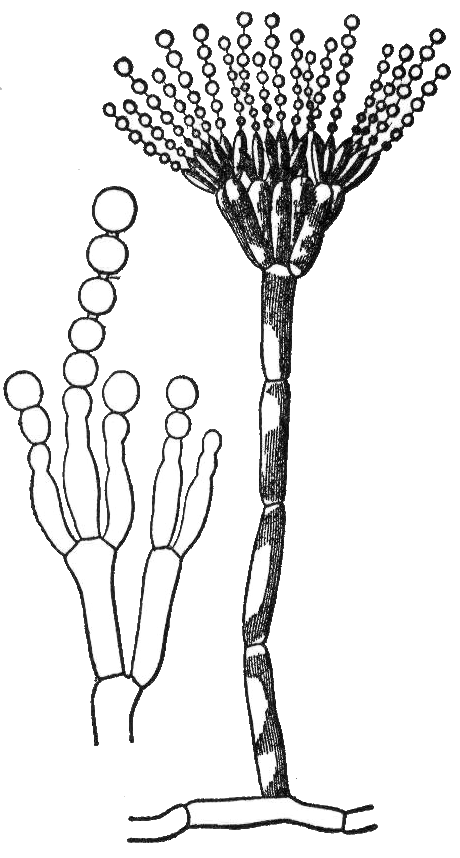
Structures for release of conidia
| ← Previous revision | Revision as of 16:15, 21 April 2026 | ||
| Line 37: | Line 37: | ||
Pycnidial conidiomata or ''pycnidia'' form in the fungal tissue itself, and are shaped like a bulging vase. The conidia are released through a small opening at the apex, the '''ostiole'''.{{cn}} |
Pycnidial conidiomata or ''pycnidia'' form in the fungal tissue itself, and are shaped like a bulging vase. The conidia are released through a small opening at the apex, the '''ostiole'''.{{cn}} |
||
Acervular conidiomata, or ''acervuli'', are cushion-like structures that form within the tissues of a host organism: |
Acervular conidiomata, or ''acervuli'', are cushion-like structures that form within the tissues of a host organism:{{cn}} |
||
* ''subcuticular'', lying under the outer layer of the plant (the [[Plant cuticle|cuticle]]), |
* ''subcuticular'', lying under the outer layer of the plant (the [[Plant cuticle|cuticle]]), |
||
* ''intraepidermal'', inside the outer cell layer (the [[Epidermis (botany)|epidermis]]), |
* ''intraepidermal'', inside the outer cell layer (the [[Epidermis (botany)|epidermis]]), |
||














