
Computer worm
Reverted edit by ~2026-24856-03 (talk) to last version by Bruce1ee
| ← Previous revision | Revision as of 12:09, 23 April 2026 | ||
| Line 5: | Line 5: | ||
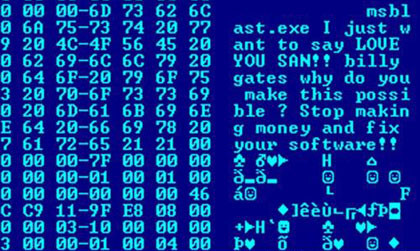
[[File:Virus Blaster.jpg|thumb|right|325px|[[Hex dump]] of the [[Blaster (computer worm)|Blaster worm]], showing a message left for [[Microsoft]] [[CEO]] [[Bill Gates]] by the worm's creator]] |
[[File:Virus Blaster.jpg|thumb|right|325px|[[Hex dump]] of the [[Blaster (computer worm)|Blaster worm]], showing a message left for [[Microsoft]] [[CEO]] [[Bill Gates]] by the worm's creator]] |
||
[[File:Conficker.svg|thumb|Spread of [[Conficker worm]]]] |
[[File:Conficker.svg|thumb|Spread of [[Conficker worm]]]] |
||
A '''computer worm''' is a standalone [[malware]] [[computer program]] that replicates itself in order to spread to other computers.{{cite web|last=Barwise|first=Mike|title=What is an internet worm?|url=http://www.bbc.co.uk/webwise/guides/internet-worms|publisher=BBC|access-date=9 September 2010|archive-url=https://web.archive.org/web/20150324073759/http://www.bbc.co.uk/webwise/guides/internet-worms|archive-date=2015-03-24}} It often uses a [[computer network]] to spread itself, relying on security failures on the target computer to access it. It will use this machine |
A '''computer worm''' is a standalone [[malware]] [[computer program]] that replicates itself in order to spread to other computers.{{cite web|last=Barwise|first=Mike|title=What is an internet worm?|url=http://www.bbc.co.uk/webwise/guides/internet-worms|publisher=BBC|access-date=9 September 2010|archive-url=https://web.archive.org/web/20150324073759/http://www.bbc.co.uk/webwise/guides/internet-worms|archive-date=2015-03-24}} It often uses a [[computer network]] to spread itself, relying on security failures on the target computer to access it. It will use this machine as a host to scan and infect other computers. When these new worm-invaded computers are controlled, the worm will continue to scan and infect other computers using these computers as hosts, and this behavior will continue.{{Cite journal|last1=Zhang|first1=Changwang|last2=Zhou|first2=Shi|last3=Chain|first3=Benjamin M.|date=2015-05-15|title=Hybrid Epidemics—A Case Study on Computer Worm Conficker|journal=PLOS ONE|volume=10|issue=5|article-number=e0127478|doi=10.1371/journal.pone.0127478|pmid=25978309|pmc=4433115|arxiv=1406.6046|bibcode=2015PLoSO..1027478Z|issn=1932-6203|doi-access=free}} Computer worms use [[recursion (computer science)|recursive methods]] to copy themselves without host programs and distribute themselves based on exploiting the advantages of [[exponential growth]], thus controlling and infecting more and more computers in a short time.{{Cite journal|last=Marion|first=Jean-Yves|date=2012-07-28|title=From Turing machines to computer viruses|journal=Philosophical Transactions of the Royal Society A: Mathematical, Physical and Engineering Sciences|volume=370|issue=1971|pages=3319–3339|doi=10.1098/rsta.2011.0332|pmid=22711861|bibcode=2012RSPTA.370.3319M|issn=1364-503X|doi-access=free}} Worms almost always cause at least some harm to the network, even if only by consuming [[bandwidth (computing)|bandwidth]], whereas [[computer virus|viruses]] almost always corrupt or modify files on a targeted computer. |
||
Many worms are designed only to spread, and do not attempt to change the systems they pass through. However, as the [[Morris worm]] and [[Mydoom]] showed, even these "payload-free" worms can cause major disruption by increasing network traffic and other unintended effects. |
Many worms are designed only to spread, and do not attempt to change the systems they pass through. However, as the [[Morris worm]] and [[Mydoom]] showed, even these "payload-free" worms can cause major disruption by increasing network traffic and other unintended effects. |
||














