
Checkmate
Basic mates
| ← Previous revision | Revision as of 09:52, 21 April 2026 | ||
| Line 72: | Line 72: | ||
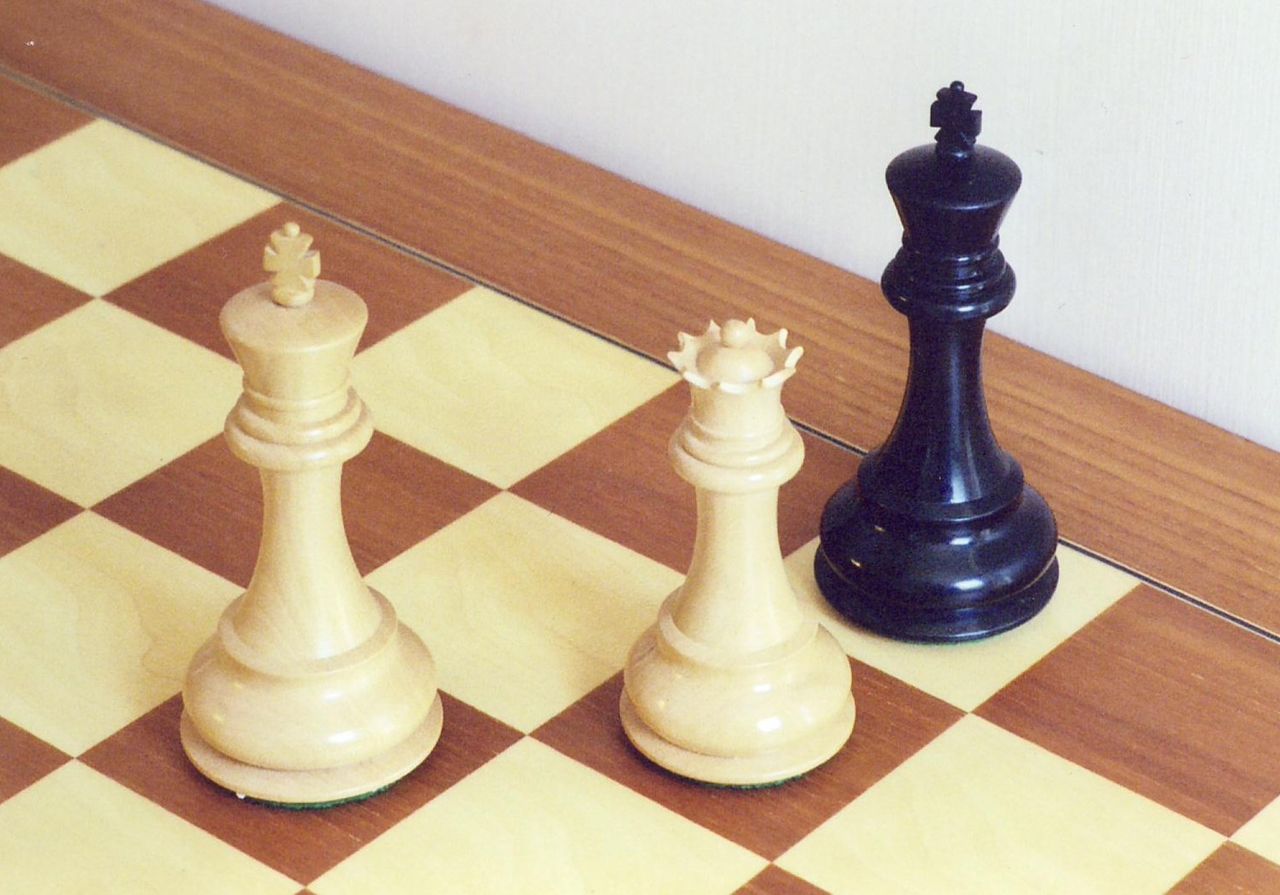
There are four fundamental mates when one side has a [[bare king]] and the other side has only the minimum {{chessgloss|material}} needed to force mate, i.e. (1) one [[queen (chess)|queen]], (2) one [[rook (chess)|rook]], (3) two [[bishop (chess)|bishops]] on opposite-colored squares, or (4) a bishop and a [[knight (chess)|knight]]. The king must help in accomplishing all of these mates.{{harvnb|Silman|2007|p=33}} If the winning side has more material, mates are easier. |
There are four fundamental mates when one side has a [[bare king]] and the other side has only the minimum {{chessgloss|material}} needed to force mate, i.e. (1) one [[queen (chess)|queen]], (2) one [[rook (chess)|rook]], (3) two [[bishop (chess)|bishops]] on opposite-colored squares, or (4) a bishop and a [[knight (chess)|knight]]. The king must help in accomplishing all of these mates.{{harvnb|Silman|2007|p=33}} If the winning side has more material, mates are easier. |
||
The mate with the queen is the most common, and easiest to achieve. It often occurs when a [[pawn (chess)|pawn]] [[promotion (chess)|queens]]. A mate with the rook is also common, but a mate with two bishops or with a bishop and knight occurs infrequently. The two-bishop mate is |
The mate with the queen is the most common, and easiest to achieve. It often occurs when a [[pawn (chess)|pawn]] [[promotion (chess)|queens]]. A mate with the rook is also common, but a mate with two bishops or with a bishop and knight occurs infrequently. The two-bishop mate is hard to accomplish as a beginner, but the [[bishop and knight checkmate]] is difficult and requires precision. |
||
===King and queen=== |
===King and queen=== |
||














