
Caroline Island
Reverted good faith edits by JacobProfessional (talk)
| ← Previous revision | Revision as of 08:39, 23 April 2026 | ||
| Line 1: | Line 1: | ||
{{short description|Coral atoll in the Pacific Ocean}} |
|||
{{short description|Caroline Atoll (Millennium Atoll) is a remote, uninhabited crescent of 39 coral islets surrounding a shallow lagoon in the central Pacific Ocean. Part of the Line Islands of Kiribati, it is celebrated as one of the most pristine tropical reef ecosystems remaining on Earth. |
|||
Geography and Environment |
|||
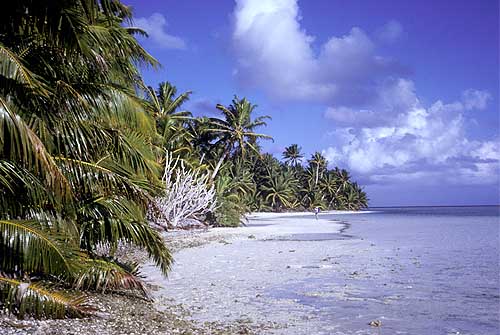
Structure: The atoll is roughly 13 kilometers long and 2.5 kilometers wide. It consists of three large islets—Nake, Long, and South—and dozens of smaller ones. Most islets are barely 6 meters above sea level. |
|||
The Lagoon: The central lagoon is shallow, reaching depths of only 5–7 meters, and is closed off from the open ocean by a continuous reef rim, which limits water exchange and makes boat access dangerous. |
|||
Wildlife: It is a critical sanctuary for the Coconut Crab, the world's largest terrestrial arthropod. It also serves as a massive breeding ground for seabirds, particularly the Sooty Tern, with populations often exceeding 500,000. |
|||
Flora: The interior is dominated by dense forests of Pisonia grandis trees, which can grow up to 30 meters tall, surrounded by Cordia subcordata shrubs and Morinda citrifolia. |
|||
History and Cultural Significance |
|||
Polynesian Roots: Ancient stone marae (temple platforms) and graves found on the islets prove that early Polynesians lived on or visited the atoll centuries before European contact. |
|||
Western Discovery: Captain William Robert Broughton of the HMS Providence sighted the islands in 1795. Throughout the 19th and early 20th centuries, it was sporadically used for guano mining and coconut plantations (copra). |
|||
The Millennium Change: In 1995, the Kiribati government shifted the International Date Line. This move placed Caroline Atoll in the world's earliest time zone (UTC+14), making it the first point of land to see the sunrise of the year 2000. It was officially renamed Millennium Island for the celebration. |
|||
Modern Status and Threats |
|||
Conservation: In 2014, the Kiribati government established a 12-nautical-mile fishing exclusion zone around the atoll to protect its high-density shark populations and healthy coral reefs. |
|||
Sea Level Rise: Because the atoll is so low-lying, it is at extreme risk of disappearing due to rising sea levels. Experts estimate it could be submerged or rendered uninhabitable by the end of the 21st century. |
|||
Visitation: There are no permanent residents, no airstrip, and no harbor. Access is only possible via long-range private yachts or specialized scientific expeditions, usually departing from French Polynesia. |
|||
Would you like to know more about the specific Polynesian ruins found there or the logistics involved in visiting such a remote site? |
|||
}} |
|||
{{for|the islands in the western Pacific|Caroline Islands}} |
{{for|the islands in the western Pacific|Caroline Islands}} |
||
{{Use British English|date=September 2022}} |
{{Use British English|date=September 2022}} |
||














